
After conservative treatment in Iraq failed to provide relief to Ahmed Abdulmueen Kadhim over several years, he travelled to India seeking treatment. NEW DELHI: A 36-year-old Iraqi man weighing 162 kg has regained his ability to walk after undergoing a technically challenging total hip replacement at a private hospital, in what doctors describe as one of the most complex joint replacement surgeries performed on a morbidly obese patient at the facility.Ahmed Abdulmueen Kadhim had been living with severe pain and progressive loss of mobility due to secondary degenerative arthritis of his right hip. After conservative treatment in Iraq failed to provide relief over several years, he travelled to India seeking treatment.The patient’s extreme body weight posed major surgical and anaesthetic challenges. Excessive weight not only makes surgical exposure and implant positioning more difficult but also places significantly higher mechanical stress on the artificial joint, requiring meticulous planning and specialised implants.The surgery, performed at Max Super Speciality Hospital, Patparganj, was led by Dr (Prof. ) Anil Arora, Chairman and Head of Orthopaedics and Joint Replacement. The team carefully planned the implant selection and fixation strategy to ensure long-term stability despite the patient’s high body weight.”Performing a total hip replacement in a patient weighing 162 kg presents significant technical challenges. Careful pre-operative planning, precise implant positioning and stable fixation were critical to achieving a successful outcome,” Dr Arora said.Doctors used a collared femoral stem implant to provide additional support for the replacement joint. The surgery was completed without complications, and postoperative X-rays confirmed satisfactory positioning and stability of the implants.Following the operation, the patient underwent supervised physiotherapy and rehabilitation aimed at strengthening the muscles around the operated hip and gradually restoring mobility. He reported early pain relief, showed improvement in walking ability and was discharged seven days after surgery before returning to Iraq.Get the latest India news and live updates. Download the TOI App.About the AuthorAnuja JaiswalAnuja Jaiswal is a Senior Assistant Editor at The Times of India, with an impressive 18-year career in narrative journalism. She specializes in health and heritage reporting, expertly simplifying complex health information to make it engaging and understandable for readers. Her deep dives into heritage topics are well-researched, resulting in captivating narratives that resonate with her audience. Over the years, she has worked in Chandigarh, Chhattisgarh and West UP, gaining diverse on-ground experience that shapes her storytelling.Read MoreEnd of ArticleFollow Us On Social MediaVideos’I Will Bow At Every Door’: Narottam Mishra Gets Emotional, Chokes Up At BJP’s Datia Bypoll Rally“Putin Pays Close Attention To PM Modi”: Poland Highlights India’s Global Power Amid Global CrisesBengal Government Backs Airport Mosque Relocation, Cites Security And Runway Expansion NeedsSuvendu Govt Replaces Mamata’s ‘Khela Hobey Divas’ With ‘Ayushman Divas’Man Claiming To Be Ex-US Navy Officer Held At India-Nepal Border Without Travel Documents’I Am Not Gandhiji’: Kerala Double Murder Convict Shows No Remorse In CourtUS Inmate Matthew Aaron VanDyke Seeks Special Diet, Cooking Permission Inside Tihar JailMission $500 Billion: India, US Push To Deepen Trade Ties As Deal Nears CompletionMission $500 Billion: India, US Push To Deepen Trade Ties As Deal Nears CompletionCDS To Present Theatre Command Roadmap As India Moves Closer To Military Reforms123Photostories5 ways meditation can quietly transform you from the insideAbhishek Sharma vs Vaibhav Sooryavanshi vs Yuvraj Singh: Who delivered Wimbledon 2026’s most iconic suit moment?60-second money lesson: Why smart women don’t always buy the cheapest thingFrom opening up about problems in their married life and his battle with anxiety to Yuvika’s emotional breakdown: Prince Narula and Yuvika Chaudhary get candid5 signs you’re not in love; it’s obsessionWhy you can still cringe over something you said 10 years ago… but forget why you walked into the kitchen just seconds laterJanhvi Kapoor’s 24K gold corset to black embroidered lehenga is wedding guest fashion at its boldest10 beautiful baby names that symbolise new life and fresh beginningsAkshay Kumar’s go-to high-protein snack at 58 is packed with fiber and contains no chilliJuly New Moon 2026: Affirmations for your birth date123Hot PicksNEET recorded responseRSCIT admit cardGold rate todayITR filingOil Price TodaySonam Wangchuk hunger strikeS. JaishankarTaylor Swift and Travis KelceE20 petrol newsTop TrendingSamantha BuschMadurai AccidentITR filingFIFA World Cup 2026Karnataka Pakistani ArrestedGhaziabad Mall Rape MurderDelhi MurderTG TET 2026 resultGurgaon EncounterIran war

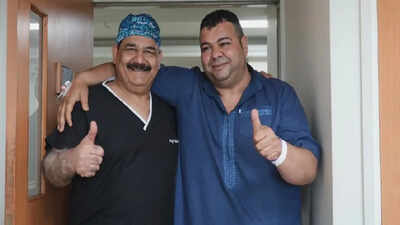
NEW DELHI: A 36-year-old Iraqi man weighing 162 kg has regained his ability to walk after undergoing a technically challenging total hip replacement at a private hospital, in what doctors describe as one of the most complex joint replacement surgeries performed on a morbidly obese patient at the facility.Ahmed Abdulmueen Kadhim had been living with severe pain and progressive loss of mobility due to secondary degenerative arthritis of his right hip. After conservative treatment in Iraq failed to provide relief over several years, he travelled to India seeking treatment.The patient’s extreme body weight posed major surgical and anaesthetic challenges. Excessive weight not only makes surgical exposure and implant positioning more difficult but also places significantly higher mechanical stress on the artificial joint, requiring meticulous planning and specialised implants.The surgery, performed at Max Super Speciality Hospital, Patparganj, was led by Dr (Prof. ) Anil Arora, Chairman and Head of Orthopaedics and Joint Replacement. The team carefully planned the implant selection and fixation strategy to ensure long-term stability despite the patient’s high body weight.“Performing a total hip replacement in a patient weighing 162 kg presents significant technical challenges. Careful pre-operative planning, precise implant positioning and stable fixation were critical to achieving a successful outcome,” Dr Arora said.Doctors used a collared femoral stem implant to provide additional support for the replacement joint. The surgery was completed without complications, and postoperative X-rays confirmed satisfactory positioning and stability of the implants.Following the operation, the patient underwent supervised physiotherapy and rehabilitation aimed at strengthening the muscles around the operated hip and gradually restoring mobility. He reported early pain relief, showed improvement in walking ability and was discharged seven days after surgery before returning to Iraq.


