
Tanzania’s Lake Natron is one of the world’s deadliest lakes, yet a paradise for flamingos | World News

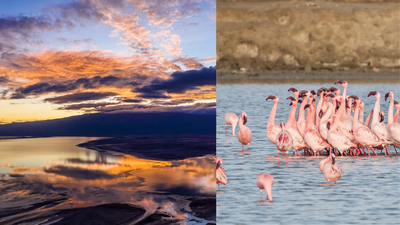
At first glance, Lake Natron in northern Tanzania appears almost otherworldly. Its shimmering red waters, highly alkaline chemistry and scorching temperatures create one of the harshest aquatic environments on Earth. Yet this seemingly inhospitable lake supports one of nature’s most remarkable survival stories. Every year, millions of lesser flamingos gather along its shores to breed, thriving in conditions that would prove fatal to most other animals. Their extraordinary resilience, combined with the lake’s unique chemistry, has made LakeNatron one of the world’s most important breeding grounds for the species and a fascinating example of how life can adapt to extreme environments.
What makes Lake Natron unique
According to Nasa, Lake Natron is a shallow salt lake located in the eastern branch of the Great Rift Valley in northern Tanzania, close to the Kenyan border. It is fed primarily by mineral-rich hot springs and the Southern Ewaso Ng’iro River, while high evaporation rates leave behind large concentrations of sodium carbonate and other alkaline minerals.The lake’s waters can reach a pH 9 to 10.5 (almost as alkaline as straight ammonia), making them highly caustic. During the dry season, water temperatures may exceed 40°C, while salt-loving microorganisms, including cyanobacteria, give the lake its distinctive shades of red, pink and orange.
Why can lesser flamingos survive in Lake Natron?
Despite its extreme conditions, Lake Natron provides the perfect habitat for lesser flamingos. Their tough skin and specialised scales on their legs help protect them from the lake’s alkaline waters, while their uniquely adapted beaks allow them to filter-feed on the cyanobacteria that flourish in the salty environment.According to ‘Remote sensing the hydrological variability of Tanzania’s Lake Natron, a vital Lesser Flamingo breeding site under threat’ the harsh chemistry of the lake also discourages most predators, creating a relatively safe breeding site. As a result, an estimated 75% of the world’s lesser flamingo population breeds at Lake Natron, making it one of the species’ most important nesting locations.
How Lake Natron supports one of the world’s largest flamingo breeding grounds
Research published in Ecohydrology & Hydrobiology found that Lake Natron is the only regular breeding site for the entire East African population of lesser flamingos and the principal breeding site globally. The study showed that successful breeding depends on very specific hydrological conditions rather than simply the lake’s extreme chemistry.Using nearly three decades of Landsat satellite imagery, researchers demonstrated that flamingos breed most successfully when lake levels are receding but remain high enough to isolate nesting colonies from predators. Falling water levels expose fresh trona (sodium carbonate) mudflats, allowing the birds to construct cone-shaped nests, while a surrounding moat of shallow water keeps predators such as hyaenas at bay. If water levels rise, nests may flood; if they fall too far, predators can access the colonies. The researchers concluded that maintaining this delicate hydrological balance is essential for the long-term survival of lesser flamingos and warned that changes caused by dams, water abstraction or soda ash extraction could disrupt one of the world’s most important flamingo breeding habitats.
Why Lake Natron is vital for global biodiversity
Lake Natron is far more than a geological curiosity. It is recognised internationally as a wetland of exceptional ecological importance because it supports the vast majority of the world’s breeding lesser flamingos, making it one of the most significant breeding habitats for any bird species. Its unique combination of highly alkaline waters, seasonal flooding and isolated mudflats creates conditions that are difficult for most animals to survive but ideal for flamingos to nest and raise their young with relatively little disturbance from predators.Scientists continue to study the lake to better understand how wildlife adapts to some of Earth’s most extreme environments and how these specialised ecosystems respond to environmental change. Research has shown that the timing and extent of seasonal water levels play a crucial role in breeding success, meaning that even small alterations to the lake’s natural hydrology could affect nesting colonies. This has raised concerns over activities such as upstream water abstraction, dam construction and industrial development, which could disrupt the delicate ecological balance that flamingos rely upon.The relationship between Lake Natron and the lesser flamingo remains one of the most remarkable examples of adaptation in the natural world. It demonstrates how a landscape that appears inhospitable to most forms of life can become an irreplaceable sanctuary for a highly specialised species. Protecting Lake Natron therefore safeguards not only a unique ecosystem but also the future of one of the planet’s largest and most spectacular flamingo populations.


