
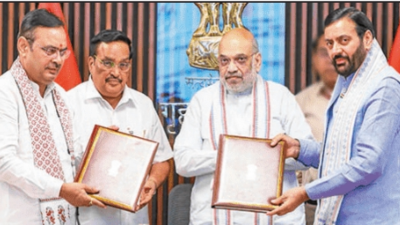
Home minister Amit Shah with Rajasthan CM Sharma, Haryana CM Saini and Union jal shakti minister CR Patil in New Delhi, Monday NEW DELHI: Haryana and Rajasthan Monday signed an agreement that allows the latter to get water from the Yamuna Canal through three underground pipelines from July to Oct every year under the 1994 memorandum of understanding (MoU) on the sharing of utilisable surface waters of the Upper Yamuna Basin.The agreement, signed in the national capital in the presence of Union home and cooperation minister Amit Shah and jal shakti minister C R Patil, will facilitate the supply of drinking water to the districts of Sikar, Churu and Jhunjhunu in Rajasthan, as well as Bhiwani and Fatehabad areas in Haryana. The 32year-old agreement could not be implemented until now because of the absence of a canal system to supply water to Rajasthan. The move will now allow the implementation of the Yamuna Water Project.Stating that the agreement had resolved the three-decadeold water-related problem faced by people of Haryana and Rajasthan, Shah said the agreement is an excellent example of the mantra ‘Solution Through Dialogue’ given by Prime Minister Narendra Modi.“This agreement demonstrates that if states move forward with the spirit of cooperative federalism, even a problem persisting for three decades can be resolved easily… It’s a win-win situation for both the states,” said Shah. Rajasthan chief minister Bhajan Lal Sharma and Haryana CM Nayab Singh Saini were also present on the occasion.Shah said water that earlier went to waste will now quench people’s thirst and will be stored in large ponds to recharge the groundwater level. Approximately 580 million cubic metres of water will be supplied from Yamuna Canal to Rajasthan through three underground pipelines having a diameter of more than 3.6 metres.The project seeks to ensure the conveyance of Rajasthan’s allocated share of Yamuna waters through an underground pipeline system from Western Yamuna Canal, enabling the state to effectively utilise the water allocated to it under the 1994 MoU by the Yamuna Basin states — UP, Haryana, Rajasthan, Himachal and Delhi regarding allocation of the surface flow of the river. After its creation in 2000, Uttarakhand was also included in the MoU.Get the latest India news and live updates. Download the TOI App.End of ArticleFollow Us On Social MediaVideosAre We Learning Nothing From Deadly Fire Accidents Across India? Experts Sound AlarmSarla Bhat Murder Case: SIA Files 737-Page Chargesheet, Yasin Malik Named Main AccusedWhat West Bengal’s New Public Safety and Anti-Goonda Bill Means and Why It Is ControversialSonam Wangchuk Begins Indefinite Fast, Urges Nation To Join Education Reform MovementBengal BJP Govt Rolls Back OBC Quota Hike, Scraps 113 Groups Added Under TMCPM Modi To Skip Khamenei Funeral; Bihar Governor, MoS External Affairs To Represent India: Report’In 3 Or 6 Months’: Stalin Predicts Early Polls, Says Vijay-led TVK Govt May Not Last Full TermExplained: Why The Akal Takht Has Summoned 87 Sikh Legislators Over Punjab’s Anti-Sacrilege LawIndia’s First Integrated Battle Groups Explained: A New Era of Border Readiness32 Years After the Pact, Rajasthan Finally Set to Get Yamuna Water from Haryana123PhotostoriesTop 10 countries with the best cuisines in the world5 towns in America where it feels like time stopped 100 years agoThese 5 Zodiac Signs Can Read You in SecondsBTS’ V proves red is the new power colour for Celine at Paris Fashion Week 2026Mothers often put their heart health last: Doctors explain why that’s a mistakeThe hidden impact of “ghost fat”: Understanding body image after major weight lossPsychology says people who don’t have many close friends may be more selective in love, and that’s not always a bad thing10 timeless baby girl names inspired by courageous women warriors in history4 secrets the happiest couples you meet are hiding from youVande Bharat routes under ₹1,500: From Goa to Kerala, these budget trips are worth every rupee123Hot PicksIreland CoachKerala HSCAP third allotment listGermany VS ParaguayFIFA world cup 2026Ketan Agarwal murder caseMumbai monsoonFIFA World Cup Round of ScheduleUS Strike on IranVaibhav SooryavanshiTop TrendingRam Mandir Donation TheftSimone BilesNoida fireFIFA World Cup 2026CBSE Three language GuidelinesBengaluru TechieAnukalp MishraSergei IvanovMK StalinMumbai Local Train News

NEW DELHI: Haryana and Rajasthan Monday signed an agreement that allows the latter to get water from the Yamuna Canal through three underground pipelines from July to Oct every year under the 1994 memorandum of understanding (MoU) on the sharing of utilisable surface waters of the Upper Yamuna Basin.The agreement, signed in the national capital in the presence of Union home and cooperation minister Amit Shah and jal shakti minister C R Patil, will facilitate the supply of drinking water to the districts of Sikar, Churu and Jhunjhunu in Rajasthan, as well as Bhiwani and Fatehabad areas in Haryana. The 32year-old agreement could not be implemented until now because of the absence of a canal system to supply water to Rajasthan. The move will now allow the implementation of the Yamuna Water Project.Stating that the agreement had resolved the three-decadeold water-related problem faced by people of Haryana and Rajasthan, Shah said the agreement is an excellent example of the mantra ‘Solution Through Dialogue’ given by Prime Minister Narendra Modi.“This agreement demonstrates that if states move forward with the spirit of cooperative federalism, even a problem persisting for three decades can be resolved easily… It’s a win-win situation for both the states,” said Shah. Rajasthan chief minister Bhajan Lal Sharma and Haryana CM Nayab Singh Saini were also present on the occasion.Shah said water that earlier went to waste will now quench people’s thirst and will be stored in large ponds to recharge the groundwater level. Approximately 580 million cubic metres of water will be supplied from Yamuna Canal to Rajasthan through three underground pipelines having a diameter of more than 3.6 metres.The project seeks to ensure the conveyance of Rajasthan’s allocated share of Yamuna waters through an underground pipeline system from Western Yamuna Canal, enabling the state to effectively utilise the water allocated to it under the 1994 MoU by the Yamuna Basin states — UP, Haryana, Rajasthan, Himachal and Delhi regarding allocation of the surface flow of the river. After its creation in 2000, Uttarakhand was also included in the MoU.


