
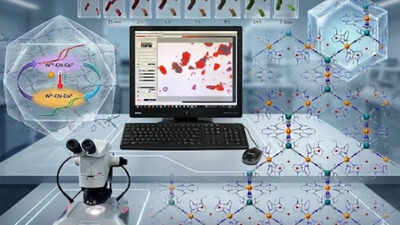
Caption: Illustration showing the new porous material switching between magnetic states when exposed to light, heat or pressure, with a visible colour change. | Credit: IISc BENGALURU: IISc scientists have developed a new class of “smart” materials that can change their magnetic properties when exposed to light, heat or pressure, a breakthrough that could help build more sensitive industrial sensors, energy-efficient data storage devices and future quantum technologies.The findings, reported in two separate studies, describe porous crystalline materials that can repeatedly switch between magnetic and non-magnetic states without losing their performance. The researchers say the ability to reverse this change makes the materials suitable for repeated use in practical devices.The research, led by associate professor Abhishek Mondal of the Solid State and Structural Chemistry Unit (SSCU), tackles a long-standing challenge in materials science. Existing porous materials used in gas and liquid sensing often fail to switch their magnetic state uniformly because changes remain confined to a small part of the material.The team overcame this by designing a highly porous material with an elastic internal structure. When one atom changes its magnetic state, it triggers neighbouring atoms to do the same, creating a domino effect that spreads across the material.“In addition to mechanical pressure, light and heat can also stimulate the spin state switch reversibly, allowing the material to be used repeatedly,” researchers said.Mondal said they are already exploring practical applications. “We’re working on scaling up the complex to design smart gas-capture sensors that can selectively adsorb industrially critical gases like methane, carbon and carbon dioxide with supreme sensitivity,” he said.The second study addresses another major hurdle: temperature. Many existing materials with similar properties work only at extremely low temperatures, making them expensive and impractical outside laboratories.“Our goal was to synthesise a chemical system that exhibits these transitions near ambient temperatures. Contemporary materials often operate only at ultra-low temperatures below 50 K (-223°C). They are highly volatile and relax back to their ground state with even a slight rise in temperature,” Krishna Kaushik, a PhD student and first author of both studies, said.The new material functions close to room temperature and also changes colour as it switches between magnetic states, making the transformation visible to the naked eye.“…Although these discoveries are still at the fundamental research stage, they address important global challenges. Modern data centres and electronic devices consume enormous amounts of energy. Developing alternative materials that operate more efficiently could reduce energy demands and contribute to more sustainable technologies,” Mondal said.He added that materials capable of acting as sensors, switches and memory elements at the same time could simplify electronic devices and reduce manufacturing costs.Get the latest India news and live updates. Download the TOI App.About the AuthorChethan KumarChethan Kumar is a Senior Assistant Editor with the Times of India. Aside from specialising in Space & Science, he has reported extensively on varied topics, with special focus on defence, policy and data stories. He has covered multiple elections, too. As a young democracy grows out of adolescence, Chethan feels, there are reels of tales emerging which need to be captured. To do this, he alternates between the mundane goings-on of the Common Man and the wonder-filled worlds of scientists and scamsters, politicians and soldiers. In a career spanning nearly 18 years, he has reported from multiple datelines — Houston, Florida, Kochi, Hyderabad, Chennai, Sriharikota (AP), NH-1 (J&K Highway), New Delhi, Ahmedabad, Raichur, Bhatkal, Mysuru, Chamarajanagar, to name a few — but is based out of Bengaluru, India’s science capital that also hosts the ISRO HQ.Read MoreEnd of ArticleFollow Us On Social MediaVideosMumbai Muharram Poison Plot: Why Police Are Investigating the Iran-Iraq Angle?Nah Tribal Body Claims PLA Occupied Ancestral Land, China Built Roads and Camps in Arunachal PradeshSC Defers Urgent Hearing on Plea Seeking CBI Probe Into Alleged Ram Mandir Donation EmbezzlementPakistani National Apprehended Near LoC, Poonch, Second Cross-Border Intrusion Reported In 2 DaysBengal Moves Toward Uniform Civil Code as BJP Government Prepares to Introduce UCC BillBengal Likely To Adopt Odisha’s Midday Meal Formula Amid ISKCON Egg ControversyFrom India, Sheikh Hasina Announces Plan to Return to Bangladesh This YearArunachal Flash Floods: Death Toll Rises To 3, Rescue Ops On, 7 Districts Cut Off By LandslidesUddhav Thackeray Seeks Disqualification Of 6 Rebel MPs, Claims ‘Operation Devendra’ Targets FadnavisKetan Agarwal Murder Probe Enters Crucial Phase As Police Recreate Crime Scene At Lohagad Fort123PhotostoriesChant these mantras on Full Moon June 2026 to attract prosperity in lifeMeet Clare Ratcliffe, the woman Ben Stokes confided in before announcing his retirementFrom learning to say no to limiting digital distractions: Time management tips that actually workAnushka Sharma brings blue crush energy to the benches in a breezy linen dress alongside Virat KohliPadma Shri awardee Rohit Sharma loves this high-protein Maharashtrian snack; detailed recipe inside6 places in Europe that are hotter right now than several North Indian cities and what travellers need to knowCan a snake bite through jeans or boots? Here’s what experts say and tips to stay safe outdoorsBeyond the traffic jams: The real overtourism crisis in hill stationsThe honey buzzard: 6 Fascinating facts about the bird that feasts on bee and wasp nests5 Canadian lakes and the interesting stories behind their names123Hot PicksTNEA rank listKerala HSCAP third allotment listWeather tomorrowFIFA world cup 2026Ketan Agarwal murder caseMumbai monsoonFIFA World Cup Round of ScheduleUS Strike on IranVaibhav SooryavanshiTop TrendingRam Mandir Donation TheftWeather TomorrowNoida fireFIFA World Cup 2026CBSE Three language GuidelinesKarla Caves Lion PillarAnukalp MishraSergei IvanovMK StalinMumbai Local Train News

BENGALURU: IISc scientists have developed a new class of “smart” materials that can change their magnetic properties when exposed to light, heat or pressure, a breakthrough that could help build more sensitive industrial sensors, energy-efficient data storage devices and future quantum technologies.The findings, reported in two separate studies, describe porous crystalline materials that can repeatedly switch between magnetic and non-magnetic states without losing their performance. The researchers say the ability to reverse this change makes the materials suitable for repeated use in practical devices.The research, led by associate professor Abhishek Mondal of the Solid State and Structural Chemistry Unit (SSCU), tackles a long-standing challenge in materials science. Existing porous materials used in gas and liquid sensing often fail to switch their magnetic state uniformly because changes remain confined to a small part of the material.The team overcame this by designing a highly porous material with an elastic internal structure. When one atom changes its magnetic state, it triggers neighbouring atoms to do the same, creating a domino effect that spreads across the material.“In addition to mechanical pressure, light and heat can also stimulate the spin state switch reversibly, allowing the material to be used repeatedly,” researchers said.Mondal said they are already exploring practical applications. “We’re working on scaling up the complex to design smart gas-capture sensors that can selectively adsorb industrially critical gases like methane, carbon and carbon dioxide with supreme sensitivity,” he said.The second study addresses another major hurdle: temperature. Many existing materials with similar properties work only at extremely low temperatures, making them expensive and impractical outside laboratories.“Our goal was to synthesise a chemical system that exhibits these transitions near ambient temperatures. Contemporary materials often operate only at ultra-low temperatures below 50 K (-223°C). They are highly volatile and relax back to their ground state with even a slight rise in temperature,” Krishna Kaushik, a PhD student and first author of both studies, said.The new material functions close to room temperature and also changes colour as it switches between magnetic states, making the transformation visible to the naked eye.“…Although these discoveries are still at the fundamental research stage, they address important global challenges. Modern data centres and electronic devices consume enormous amounts of energy. Developing alternative materials that operate more efficiently could reduce energy demands and contribute to more sustainable technologies,” Mondal said.He added that materials capable of acting as sensors, switches and memory elements at the same time could simplify electronic devices and reduce manufacturing costs.


