
Zohran Mamdani’s revolution is remaking New York politics, and Democrats may be heading for their own MAGA moment


At polling stations across New York City, an electoral storm just made landfall.Less than seven months after democratic socialist Zohran Mamdani completed a stunning mayoral run to become the youngest leader of New York City in a century, his political movement has proven that it is anything but a fluke.In the June 2026 Democratic congressional primaries, a trio of Mamdani-backed left-wing candidates — Brad Lander, Darializa Avila Chevalier and Claire Valdez — pulled off monumental upsets against the party’s entrenched establishment.The clean sweep has sent shockwaves from the streets of Brooklyn and Manhattan straight to the halls of Congress, leaving establishment leaders caught on their heels and sparking a fierce national debate: Is the Democratic Party finally experiencing its own version of a MAGA takeover.
The new kingmaker?
Zohran Mamdani’s ascent to City Hall in the 2025 election — defeating former Governor Andrew Cuomo in the primary—was treated by some moderates as an isolated incident driven by local anxieties over housing and a soaring cost of living. But the results of Tuesday’s primaries have transformed the 34-year-old mayor into a budding national kingmaker.By aggressively campaigning for three ‘insurgent’ congressional candidates, Mamdani successfully exported his populist, anti-establishment brand of politics from City Hall to federal races. The newly minted nominees are virtual locks for the general election in November, meaning a larger, highly vocal democratic socialist contingent is headed to Washington.“Tonight, we haven’t just won an election. We have declared that this movement is durable—that it is growing, and that it will not stop,” state Assemblywoman Claire Valdez declared at her victory party.
Who won
The sheer scale of the victories caught seasoned political operatives by surprise.
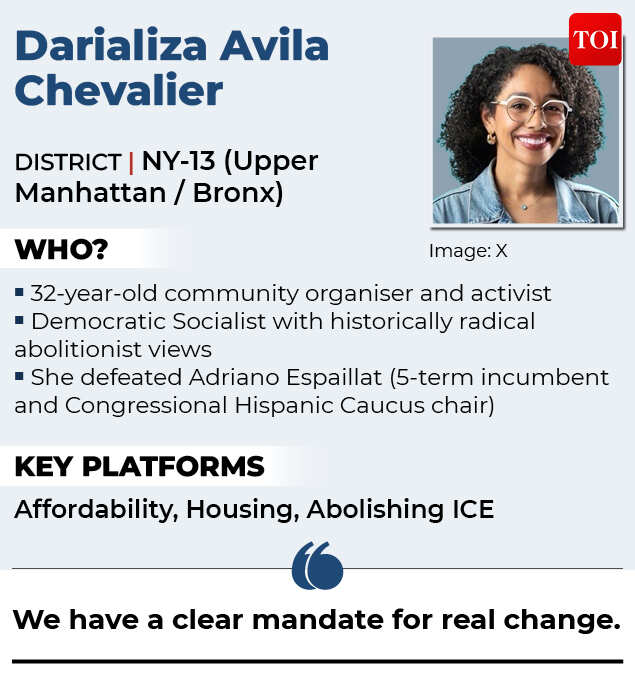
Chevalier narrowly ousted five-term incumbent Rep. Adriano Espaillat.
The Mamdani-aligned candidates systematically targeted and dismantled mainstream heavyweights:
- Darializa Avila Chevalier: In the most shocking upset of the night, the 32-year-old community organiser and doctoral student narrowly ousted five-term incumbent Rep. Adriano Espaillat. Espaillat was not just any incumbent; he was the leader of the powerful Congressional Hispanic Caucus and the first Dominican American elected to Congress.
- Brad Lander: The former New York City Comptroller—who ran against Mamdani in the crowded 2025 mayoral primary before backing him—decisively defeated incumbent Rep. Dan Goldman. Goldman, famous as the lead counsel in Donald
Trump ‘s first impeachment trial, enjoyed massive financial support from deep-pocketed pro-Israel lobbying groups like AIPAC.
- Claire Valdez: Running to succeed the retiring Rep. Nydia Velázquez, Valdez crushed Brooklyn Borough President Antonio Reynoso by more than 20 points, despite Reynoso holding the endorsements of much of the city’s traditional Democratic apparatus.
The core tenets unifying these three candidates mirror Mamdani’s own platform: populist economic policy centered on government-funded health insurance, higher taxes on billionaires, and aggressive affordable housing initiatives.
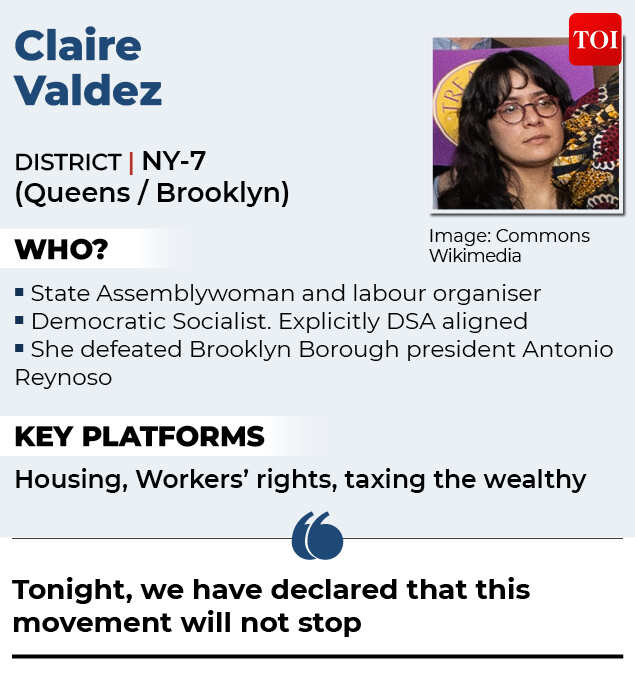
Claire Valdez crushed Brooklyn Borough President Antonio Reynoso by more than 20 points.
However, their foreign policy positions—specifically a fierce critique of US military support for Israel—and aggressive anti-establishment rhetoric are what have Washington Democrats sweating.
The ‘Mamdani Wing’
The rise of this uncompromising left wing has drawn immediate, anxious comparisons to the right-wing Tea Party movement of 2010 and the subsequent MAGA surge that fundamentally reshaped the Republican Party.Now, House Minority Leader Hakeem Jeffries and Senate Majority Leader Chuck Schumer face a similar brewing insurgency in their own party.While Brad Lander sought to soften the comparison — arguing on Wednesday that progressives possess a “joyful energy” focused on “building something, not just breaking something” — moderate Democrats are sounding the alarm.
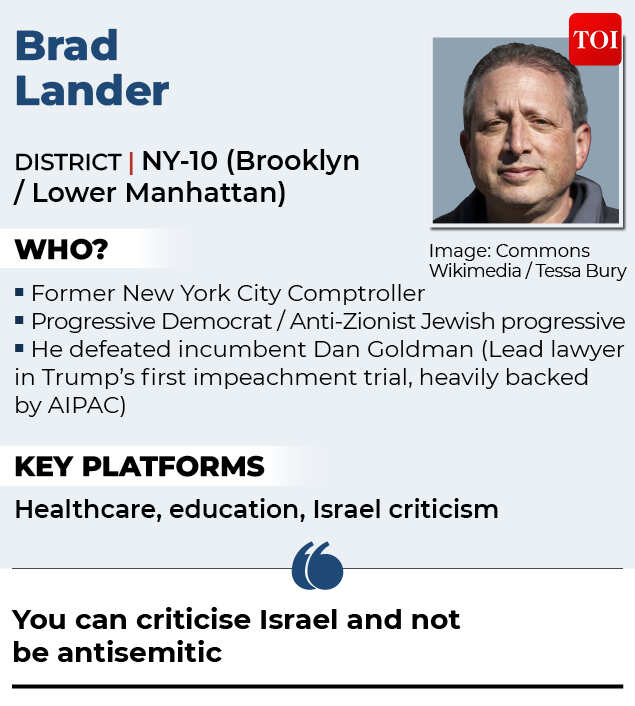
Lander defeated incumbent Rep. Dan Goldman who enjoyed financial support from pro-Israel lobbying groups like AIPAC.
Representative Josh Gottheimer of New Jersey bluntly summarised the existential anxiety gripping the centrist wing: “Obviously, the socialists had a big win last night. The question is, are we going to let them take over the party? Or are we going to stand up and fight back? Many of us believe, as I do, that if you’re a socialist, you’re not a Democrat.”Rep. Greg Meeks and others fretted that intra-party battles squander resources better spent against Republicans.Some Democrats privately feared donors might defect if the party shifts too visibly left.Compounding the anxiety is the past rhetoric of some victorious candidates.Republicans are already digging up deleted social media posts from Chevalier, spanning 2018 to 2022, in which she called for open borders, the total abolition of police and prisons, labeled Joe Biden a “war criminal,” and directed profanity at Kamala Harris.Though Chevalier has since disavowed those statements as youthful immaturity, the National Republican Congressional Committee (NRCC) is already using them as a cudgel to paint the entire Democratic Party as swinging dangerously to the far left.
Not a revolution yet
Despite the earthquake in New York City’s ‘Commie corridor’, mainstream Democrats were quick to point out that the socialist wave has geographical limits.Outside the five boroughs on Tuesday, moderate and establishment forces held their ground:
- Manhattan: Micah Lasher, a former staffer to retiring Rep. Jerry Nadler, won a high-profile primary to keep the seat firmly within the mainstream column.
- Upstate New York: Moderate Army veteran Cait Conley won her primary, setting up a crucial swing-district battle against Republican incumbent Mike Lawler.
- Utah: Mainstream former Congressman Ben McAdams defeated a slate of progressive rivals in a newly drawn, blue-leaning district.
- Maryland: Voters chose a moderate candidate who explicitly backed continued U.S. support for Israel, highlighting a stark ideological divide with the anti-Zionist rhetoric championed by Lander and Chevalier.
If Mamdani-style candidates remain concentrated in urban districts, they may push the party’s agenda left on issues like single-payer healthcare, housing and taxes while remaining a small voting bloc that influences committee priorities and messaging.If their model spreads to competitive suburban and Sun Belt districts, Democrats could face a trade-off between maintaining electoral broadness and satisfying a more progressive base.
A MAGA-like movement?
There are clear parallels between Mamdani-style politics and Trump’s MAGA movement that reshaped the Republican Party.Both harness grassroots energy; both center personality-driven politics and a willingness to break with party orthodoxy; and both exploit voters’ frustration with elites.Mamdani’s movement, like Trump’s, derives power from a disciplined activist base that mobilises door-knocking and social-media buzz to overcome the institutional advantages of incumbents.In places such as parts of Brooklyn and Queens—already labeled by some as New York’s ‘Commie corridor’ — that energy translates into durable electoral returns.
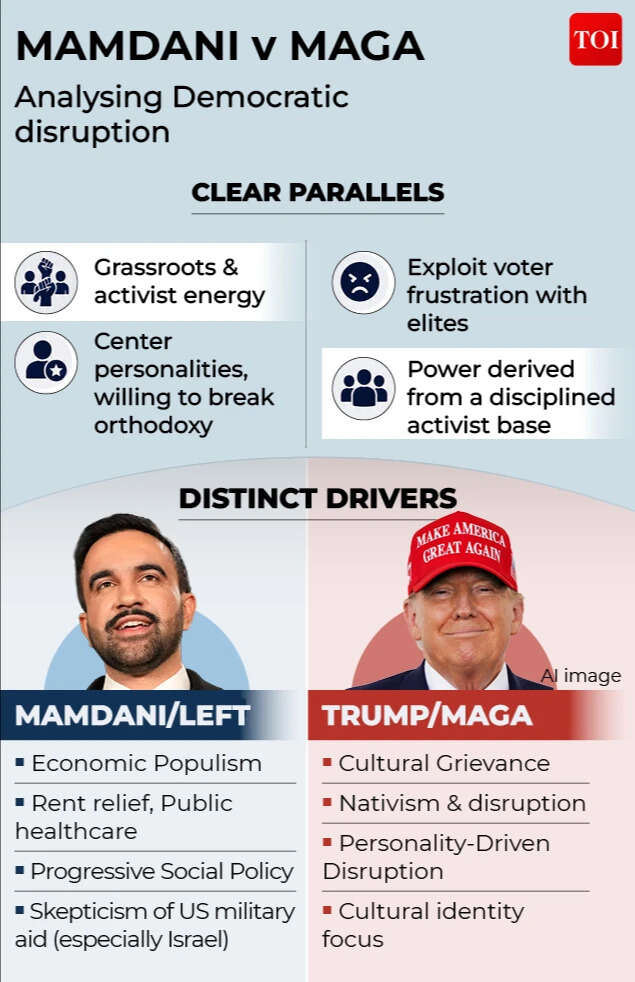
There are clear parallels between Mamdani-style politics and Trump’s MAGA movement that reshaped the Republican Party.
Yet the parallels have limits.The prime drivers in Mamdani’s coalition are economic populism, progressive social policy, and skepticism of US military aid — especially for Israel — not cultural grievance or nativism.Many on the left insist their agenda is about delivering tangible results — rent relief, public healthcare and investment in services — rather than the chaotic, personality-driven disruption associated with Trump.Trump remade the Republican Party by turning a populist fringe into a dominant national force with broad rural and suburban appeal.Mamdani’s coalition currently excels in dense urban precincts and among younger voters activated by economic insecurity and anti-establishment messaging.To become a nationwide force, it must expand beyond the progressive enclaves where its ideas already resonate.For now, Tuesday’s wins are a warning shot and an invitation.They show a left that is better organised and more electorally potent than many in the party realised. They also expose fault lines that Democrats must manage carefully: the balance between ideological renewal and electoral pragmatism.If Democrats navigate those tensions well, Mamdani’s revolution could enrich the party’s debate and policy portfolio. If they mishandle it, Republicans will likely use these victories as fodder to nationalise November races — and persuade swing voters that Democrats have drifted too far from the center.
The road to November and 2028
Democratic strategists worry that battleground moderates will spend the next five months answering for the radical positions of New York’s new progressive standard-bearers.Republicans were quick to exploit the primary outcomes: President Trump declared the wins evidence of America “never” becoming a communist country and the NRCC framed the results as proof that the Democratic establishment has “surrendered” to radicals.
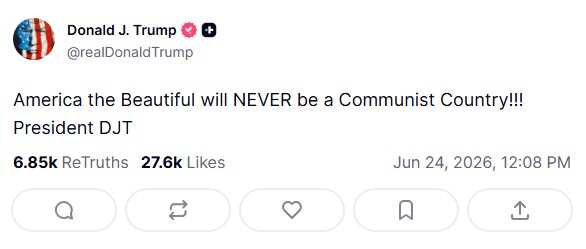
Donald Trump Truth Social post
In battleground districts this November, Republicans will try to tether moderate Democrats to the more extreme-sounding positions of Mamdani’s allies, even where those positions are softened or disavowed by the candidates.Yet, Mamdani and his allies view this friction as a necessary reckoning.Looking ahead to the 2028 presidential cycle, the New York mayor has made it clear that he intends to use his expanding coalition to shift the national party’s trajectory.
In your opinion, are the recent primary victories a sign of a broader progressive movement?
3k+ users shared opinion today
5k+ users already voted today
3k+ users shared opinion today
Share Opinion
The Democratic establishment may still hold the levers of power in Washington, but the Mamdani revolution has officially proven that the old political playbook is no longer a guarantee of survival.


