
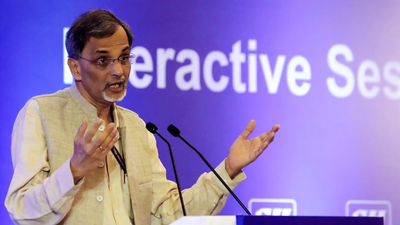
Chief Economic Advisor V Anantha Nageswaran addresses a gathering in IIT Madras (Image/ANI) NEW DELHI: Chief Economic Advisor V Anantha Nageswaran has cautioned that the world is entering a turbulent two-decade cycle echoing the geopolitical upheaval of the early 20th century, even as he insisted that the public heavily underestimates India’s underlying strength and dismissed fears of AI-driven job losses as overstated.Speaking on the Professor Mahesh Podcast, an IITM Global initiative at IIT-Madras, the CEA said the global order faces severe flux between 2026 and 2046. “The next 20 years will mimic to some extent the period between 1925 and 1945,” he warned, urging corporations to shift from “just-in-time” efficiency to “just-in-case” resilience as nations increasingly weaponise supply chains and financial systems. He stressed that, in this environment, businesses worldwide would increasingly prioritise security and self-reliance over the pursuit of the lowest possible cost.Nageswaran argued that India is far better placed than commonly believed. He noted that the country is among only two or three nations capable of simultaneously growing its own food, launching its own satellites, and manufacturing vital pharmaceuticals such as paracetamol and antibiotics — a baseline strength he said is routinely overlooked.Elaborating on AI, he contended that the technology would increase the cognitive load on humans rather than replace them, adding that students must master prompt composition because the quality of outputs depends on the quality of inputs. He flagged trade skills — electrical work, mechanical maintenance and plumbing — as opportunities relatively insulated from AI disruption.Describing the country as a “living economics laboratory” unmatched anywhere on Earth, Nageswaran evoked an observation attributed to economist Joan Robinson. “Whatever you say about India, the opposite can be equally true,” he said, pointing to the paradox of a nation undertaking massive socio-economic transformation within a vibrant democracy before attaining full prosperity.The CEA also pushed back against frequently cited international data on India’s informal sector, arguing that reforms such as the Goods and Services Tax had accelerated formalisation of MSMEs. Citing internal assessments, he said the economy was now roughly 65% formalised.Turning to education, Nageswaran urged institutions to embrace interdisciplinary learning. Studying engineering or computer science in isolation was no longer sufficient, he said; a grounding in economics, history and political economy was essential to navigate an increasingly non-linear world.The wide-ranging conversation with Professor Mahesh Panchagnula, hosted at IIT Madras, offered policymakers, corporate leaders and students a roadmap for future-proofing careers amid global uncertainty and rapid technological change.Get the latest India news and live updates. Download the TOI App.About the AuthorManash Pratim GohainManash Pratim Gohain is a seasoned journalist with over two decades at The Times of India, where he has built a rich body of work spanning education policy, politics, and governance. Renowned for his incisive coverage of the National Education Policy (NEP) 2020, accreditation reforms, and skilling initiatives, he has also reported on student politics, urban policy, and social movements. His political reportage—both reflective and news-driven—adds depth to his writing, bridging policy with public impact. Through his 2,500 articles and related outlets, he has emerged as a trusted voice in national discourse, particularly in linking education reform to broader societal change.Read MoreEnd of ArticleFollow Us On Social MediaVideosAnthropic CEO Dario Amodei’s ‘Disorganised’ India AI Summit Remark Triggers Congress-BJP FaceoffTelegram Loses Court Battle As Delhi HC Refuses To Lift Temporary Block | WatchCross-Voting Shock? NDA-Backed Nathwani Wins As India Bloc’s Math Collapses | Watch’Exporting Terror Has Costs’: India Rejects Pakistan’s Claims At UN Human Rights CouncilChinese Foreign Minister Wang Yi To Visit India For BRICS Meet Amid Ongoing India-China ResetCongress’s Former Rebels Are Struggling. Should They Return to the Fold?India-U.S. Interim Trade Deal Nears Finish Line, Key U.S. Official To Visit Next Week | Watch’Priya Mitra Narendra’: Macron’s Hindi Message To Modi Caps High-Profile France VisitExplained: India’s Telegram Ban Ahead of NEET Re-Exam; Necessary Step or Pointless Move?Football Legend’s Kolkata Tour Mismanagement Still Under Scanner; Accountability Questions Grow123PhotostoriesJapanese proverb of the day on relationships: “If the fish has a mind, so does…”5 everyday habits to heal and balance your throat chakraSamantha Ruth Prabhu’s fiery red saree sets the stage for an iconic reunion with TN Chief Minister Thalapathy VijayConjunctivitis cases surge during monsoon: Eye doctor shares 10 simple ways to protect your eyes and prevent infectionFather’s Day 2026: 9 things Indian dads rarely say, but show every single dayFriday Special: How to make Bihari-Style Spicy Masala ChickenThese habits may be blocking positive energy in life; based on your birth dateFrom Batik to Block Prints: 10 incredible destinations every textile lover should visit at least once60-second money lesson: The ₹500 challenge that could help you build over ₹1 lakhDoctor explains what happens to your body when you practice yoga for 20 minutes every day123Hot PicksJesse MarschCA TopperLionel MessiAP SSC resultsKannur University FYUGP TrialShiv SenaJD VanceStrait of HormuzHormoz nuclear power plantTop TrendingBihar gang-rapeUS-Iran Peace DealStock Market LiveFIFA World Cup 2026What is Legacy BadgeBEST bus strikeAIIMS Admit CardMHT CET PCM 2nd attempt resultsGold rate todayIndia-UK FTA

NEW DELHI: Chief Economic Advisor V Anantha Nageswaran has cautioned that the world is entering a turbulent two-decade cycle echoing the geopolitical upheaval of the early 20th century, even as he insisted that the public heavily underestimates India’s underlying strength and dismissed fears of AI-driven job losses as overstated.Speaking on the Professor Mahesh Podcast, an IITM Global initiative at IIT-Madras, the CEA said the global order faces severe flux between 2026 and 2046. “The next 20 years will mimic to some extent the period between 1925 and 1945,” he warned, urging corporations to shift from “just-in-time” efficiency to “just-in-case” resilience as nations increasingly weaponise supply chains and financial systems. He stressed that, in this environment, businesses worldwide would increasingly prioritise security and self-reliance over the pursuit of the lowest possible cost.Nageswaran argued that India is far better placed than commonly believed. He noted that the country is among only two or three nations capable of simultaneously growing its own food, launching its own satellites, and manufacturing vital pharmaceuticals such as paracetamol and antibiotics — a baseline strength he said is routinely overlooked.Elaborating on AI, he contended that the technology would increase the cognitive load on humans rather than replace them, adding that students must master prompt composition because the quality of outputs depends on the quality of inputs. He flagged trade skills — electrical work, mechanical maintenance and plumbing — as opportunities relatively insulated from AI disruption.Describing the country as a “living economics laboratory” unmatched anywhere on Earth, Nageswaran evoked an observation attributed to economist Joan Robinson. “Whatever you say about India, the opposite can be equally true,” he said, pointing to the paradox of a nation undertaking massive socio-economic transformation within a vibrant democracy before attaining full prosperity.The CEA also pushed back against frequently cited international data on India’s informal sector, arguing that reforms such as the Goods and Services Tax had accelerated formalisation of MSMEs. Citing internal assessments, he said the economy was now roughly 65% formalised.Turning to education, Nageswaran urged institutions to embrace interdisciplinary learning. Studying engineering or computer science in isolation was no longer sufficient, he said; a grounding in economics, history and political economy was essential to navigate an increasingly non-linear world.The wide-ranging conversation with Professor Mahesh Panchagnula, hosted at IIT Madras, offered policymakers, corporate leaders and students a roadmap for future-proofing careers amid global uncertainty and rapid technological change.


