
AI generated image BENGALURU: If Karnataka’s CMs are plotted not by party but by regions they came from, a pattern emerges: Its political centre of gravity hasn’t remained fixed. When DK Shivakumar took oath last week, he became the latest stop in a political journey that began in the northern districts, shifted to Old Mysuru, scattered across regions during the Janata era, and eventually settled into a contest between the Vokkaliga south and the Lingayat north.In the years immediately after the formation of Mysore State in 1956, power lay firmly in the northern districts. Congress organisation was strongest in these regions, drawing support from the influential Lingayat community. Many of the leaders who shaped the newly reorganised state emerged from this political landscape.S Nijalingappa, one of Karnataka’s significant early leaders, dominated the state’s politics during this period. Though born in Chitradurga, his political strength rested largely on the Lingayat belt of northern Karnataka. Alongside him, chief ministers such as BD Jatti, SR Kanthi and later Veerendra Patil stressed the region’s importance in the state’s formative years.The first major shift came with Devaraj Urs.When Urs assumed office in 1972, he did more than lead a new govt. He fundamentally altered where political power was exercised in Karnataka. By building a coalition centred on backward classes, Dalits and minorities, Urs transformed the Old Mysuru region into the state’s dominant political arena.His politics expanded the social base of power beyond traditionally dominant groups and firmly established southern Karnataka as the state’s political heartland. More than five decades later, Old Mysuru continues to exert considerable influence over Karnataka’s political fortunes.However, this dominance was briefly interrupted during the Janata era. From the early 1980s until the turn of the century — which began and ended with Congress govts but dominated by the Janata Parivar, Karnataka witnessed perhaps its most geographically diverse period of political leadership. No single region monopolised power: it rotated across the state, from coastal, Malnad, south, central and northern districts.Key faces during this time were: Gundu Rao, Ramakrishna Hegde, SR Bommai, S Bangarappa, Veerappa Moily, HD Deve Gowda, JH Patel, SM Krishna and Dharam Singh. This phase, however, proved temporary. Over the past three decades, Karnataka’s politics has increasingly revolved around two competing centres of power.On one side stood the Old Mysuru region, strengthened by the rise of HD Deve Gowda and later HD Kumaraswamy. Siddaramaiah too draws much of his strength from this influential southern belt.On the other side emerged a powerful counterweight through BJP’s expansion under BS Yediyurappa. Although Yediyurappa himself hailed from Shivamogga, his political appeal was deeply rooted in the Lingayat strongholds of northern and central Karnataka. Leaders such as DV Sadananda Gowda, Jagadish Shettar and Basavaraj Bommai sustained this non-Old Mysuru axis.For much of recent history, Karnataka’s political contests have effectively been fought between these two centres, each anchored in distinct regional and social coalitions.The elevation of DK Shivakumar now raises a new question: Is Karnataka witnessing another shift in its political geography? Unlike many recent chief ministers, Shivakumar’s political base lies in Kanakapura, on Bengaluru’s southern edge. His rise comes at a time when Bengaluru’s influence over the state has grown dramatically.The city and its surrounding regions account for a significant share of Karnataka’s economic output, attract migrants from across the state, and continue to expand in both population and electoral significance. Urban concerns increasingly shape statewide political conversations, from infrastructure and water supply to mobility and governance.If political power follows demographic and economic importance, Bengaluru may be poised to emerge as Karnataka’s next major centre of gravity. There is also a historical symmetry to this moment. The first elected chief minister of the erstwhile Mysore State, Kengal Hanumanthaiah, hailed from Ramanagara district, part of the broader Bengaluru region. He is remembered for envisioning and constructing Vidhana Soudha, the imposing seat of Karnataka’s political power.Seven decades later, with DK Shivakumar occupying that office, Karnataka’s political journey may have completed a full circle. Whether this marks the beginning of another long-term realignment, however, remains a question only future elections can answer.About the AuthorChethan KumarChethan Kumar is a Senior Assistant Editor with the Times of India. Aside from specialising in Space & Science, he has reported extensively on varied topics, with special focus on defence, policy and data stories. He has covered multiple elections, too. As a young democracy grows out of adolescence, Chethan feels, there are reels of tales emerging which need to be captured. To do this, he alternates between the mundane goings-on of the Common Man and the wonder-filled worlds of scientists and scamsters, politicians and soldiers. In a career spanning nearly 18 years, he has reported from multiple datelines — Houston, Florida, Kochi, Hyderabad, Chennai, Sriharikota (AP), NH-1 (J&K Highway), New Delhi, Ahmedabad, Raichur, Bhatkal, Mysuru, Chamarajanagar, to name a few — but is based out of Bengaluru, India’s science capital that also hosts the ISRO HQ.Read MoreEnd of ArticleFollow Us On Social MediaVideos‘Electric Stove Exploded, Then…: What Chef Told Police In Malviya Nagar Hotel Fire‘Below Replacement Level’: Elon Musk Flags India’s Falling Fertility RateLPG Price Hike: Domestic Cooking Gas Rates Raised By Rs 29 In India, Second Hike In 3 MonthsAhead Of INDIA Bloc Meet, CPI(M) Asks Congress To Explain BJP ‘Deal’ Charge During Kerala Polls‘Untrue’: Sourav Ganguly Denies Asking Yusuf Pathan To Resign On Behalf Of Mamata Banerjee‘TMC Fooled Muslims, Suvendu Is Secular’: Ajmal Siddiqui Resigns From Post, Slams Abhishek BanerjeeAbhishek Banerjee’s Role Reworked As Mamata Banerjee Reshuffles TMC LeadershipTamil Nadu BJP Faces Resignation Wave as Annamalai’s New Movement Draws VolunteersSix Detained As CJP’s Jantar Mantar Protest Over NEET Leak Concludes Without Major ClashesAshwini Vaishnaw Unveils Bengal Bullet Train Plan, Targets Faster Northeast Connectivity123Photostories7 surprising things nobody tells you when you start gardening8 ways to enjoy apple for summer breakfastHow to identify a Crocodile vs. an Alligator: Snout shape, teeth visibility, habitat clues5 unique temples in India where bringing the ‘prasad’ home is not allowed and recommendedWeekly tarot guidance from June 7 to 13, 2026 for your birth numberGopika Gopi to Aneesh: Here’s a look at the commoner contestants of Bigg Boss Malayalam5 silent signs your body may be missing key nutrients, according to a neurologistWhy you should ‘marry for money’, according to a top divorce lawyerPrincess Diana’s most iconic fashion moments: 5 designers behind her legendary style12 must-follow emergency rules for modern apartments and gated real estate communities123Hot PicksSuryakumar YadavYusuf PathanKerala Student HospitalisedIran AttackKhan SirAnnamalaiKaru Nagarajan ResignRoger GoodellAIADMKTop TrendingCJP ProtestKarnataka Constable RecruitmentTS Inter Supplementary ResultsIndia vs Afghanistan ScoreAnnamalai BJP exitE85 FuelDelhi hotel fireKhan sir coaching fireDelhi Plice HCM Result 2026Pawan Kalyan

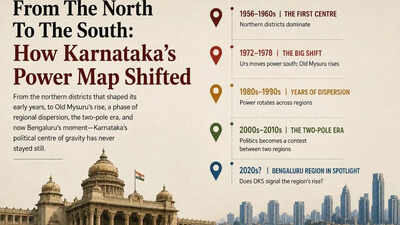
BENGALURU: If Karnataka’s CMs are plotted not by party but by regions they came from, a pattern emerges: Its political centre of gravity hasn’t remained fixed. When DK Shivakumar took oath last week, he became the latest stop in a political journey that began in the northern districts, shifted to Old Mysuru, scattered across regions during the Janata era, and eventually settled into a contest between the Vokkaliga south and the Lingayat north.In the years immediately after the formation of Mysore State in 1956, power lay firmly in the northern districts. Congress organisation was strongest in these regions, drawing support from the influential Lingayat community. Many of the leaders who shaped the newly reorganised state emerged from this political landscape.S Nijalingappa, one of Karnataka’s significant early leaders, dominated the state’s politics during this period. Though born in Chitradurga, his political strength rested largely on the Lingayat belt of northern Karnataka. Alongside him, chief ministers such as BD Jatti, SR Kanthi and later Veerendra Patil stressed the region’s importance in the state’s formative years.The first major shift came with Devaraj Urs.When Urs assumed office in 1972, he did more than lead a new govt. He fundamentally altered where political power was exercised in Karnataka. By building a coalition centred on backward classes, Dalits and minorities, Urs transformed the Old Mysuru region into the state’s dominant political arena.His politics expanded the social base of power beyond traditionally dominant groups and firmly established southern Karnataka as the state’s political heartland. More than five decades later, Old Mysuru continues to exert considerable influence over Karnataka’s political fortunes.However, this dominance was briefly interrupted during the Janata era. From the early 1980s until the turn of the century — which began and ended with Congress govts but dominated by the Janata Parivar, Karnataka witnessed perhaps its most geographically diverse period of political leadership. No single region monopolised power: it rotated across the state, from coastal, Malnad, south, central and northern districts.Key faces during this time were: Gundu Rao, Ramakrishna Hegde, SR Bommai, S Bangarappa, Veerappa Moily, HD Deve Gowda, JH Patel, SM Krishna and Dharam Singh. This phase, however, proved temporary. Over the past three decades, Karnataka’s politics has increasingly revolved around two competing centres of power.On one side stood the Old Mysuru region, strengthened by the rise of HD Deve Gowda and later HD Kumaraswamy. Siddaramaiah too draws much of his strength from this influential southern belt.On the other side emerged a powerful counterweight through BJP’s expansion under BS Yediyurappa. Although Yediyurappa himself hailed from Shivamogga, his political appeal was deeply rooted in the Lingayat strongholds of northern and central Karnataka. Leaders such as DV Sadananda Gowda, Jagadish Shettar and Basavaraj Bommai sustained this non-Old Mysuru axis.For much of recent history, Karnataka’s political contests have effectively been fought between these two centres, each anchored in distinct regional and social coalitions.The elevation of DK Shivakumar now raises a new question: Is Karnataka witnessing another shift in its political geography? Unlike many recent chief ministers, Shivakumar’s political base lies in Kanakapura, on Bengaluru’s southern edge. His rise comes at a time when Bengaluru’s influence over the state has grown dramatically.The city and its surrounding regions account for a significant share of Karnataka’s economic output, attract migrants from across the state, and continue to expand in both population and electoral significance. Urban concerns increasingly shape statewide political conversations, from infrastructure and water supply to mobility and governance.If political power follows demographic and economic importance, Bengaluru may be poised to emerge as Karnataka’s next major centre of gravity. There is also a historical symmetry to this moment. The first elected chief minister of the erstwhile Mysore State, Kengal Hanumanthaiah, hailed from Ramanagara district, part of the broader Bengaluru region. He is remembered for envisioning and constructing Vidhana Soudha, the imposing seat of Karnataka’s political power.Seven decades later, with DK Shivakumar occupying that office, Karnataka’s political journey may have completed a full circle. Whether this marks the beginning of another long-term realignment, however, remains a question only future elections can answer.


