
As China and Pakistan move forward with their fifth generation plans, India’s two short term options

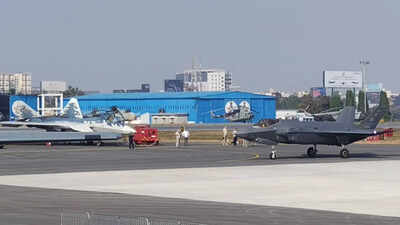
Russian president Vladimir Putin reaffirmed Russia’s commitment to deepening ties with India as Moscow continues to offer the Su-57 fifth generation fighter jet with technology transfer and local production. While addressing journalists in St Petersburg the Russian President said, “We are ready to work with India to supply the Sukhoi Su-57, to develop it.”Putin remarks come at a time when the Indian air force is facing depleting squadron numbers and delays in his domestic programs. With changing dynamics in airpower with his hostile neighbours, the debate over acquiring an interim fifth-generation fighter has once again come into focus.What is interesting is, that India was a partner in the fifth-generation fighter aircraft (FGFA) programme on which the Su-57 platform is based. However, India withdrew from the programme in 2018 over concerns on stealth, technology transfer and work share.Urgency to acquire fifth generation fighter.As India’s security environment is rapidly changing, the need for a fifth-generation fighter is rapidly reducing. On one hand, China has significantly expanded its fleet of J-20 stealth fighter and on the other hand, Pakistan is seeking to acquire J-35 stealth fighter from China in the next few years.India program to develop fifth generation fighter platform remains under development. Advanced medium combat aircraft (AMCA) has received the government approval and funding support, but the aircraft is unlikely to enter operational service before a decade.The IAF currently operates 29 fighter squadrons against a sanctioned strength of 42, while several older aircraft are approaching retirement.In modern warfare, fifth-generation fighters are becoming increasing important due to their stealth and advance sensors. The modern air defences are increasingly becoming even more comprehensive and capable, increasing the vulnerability of non-stealth fighters to operate in a contested airspace. Fifth generation fighters provide a decisive advantage through stealth, sensor fusion and superior situational awareness.Options for the IndiaAs the indigenous AMCA is at least a decade away, IAF is exploring steps to acquire a fifth generation aircraft to bridge the capability gap. At present, only two platforms can be thought of as options these are, the Russian Su-57 Felon and the American F-35 Lightning II.Moscow has actively pitched the Su-57 to New Delhi, offering technology transfer, local production and integration with India’s defence industry.Meanwhile, Washington has shown its willingness to provide F-35 to India. Last year in February, US President Donald Trump publicly raised the prospect of supplying the aircraft to India. Trump stated, “We’ll be increasing military sales to India by many billions of dollars. We’re also paving the way to ultimately provide India with the F-35 stealth fighters.”However, despite Trump’s remarks, no formal offer or negotiations have followed. Indian officials have clarified that discussions on a potential F-35 acquisition had not begun and that the proposal remained at a preliminary stage.
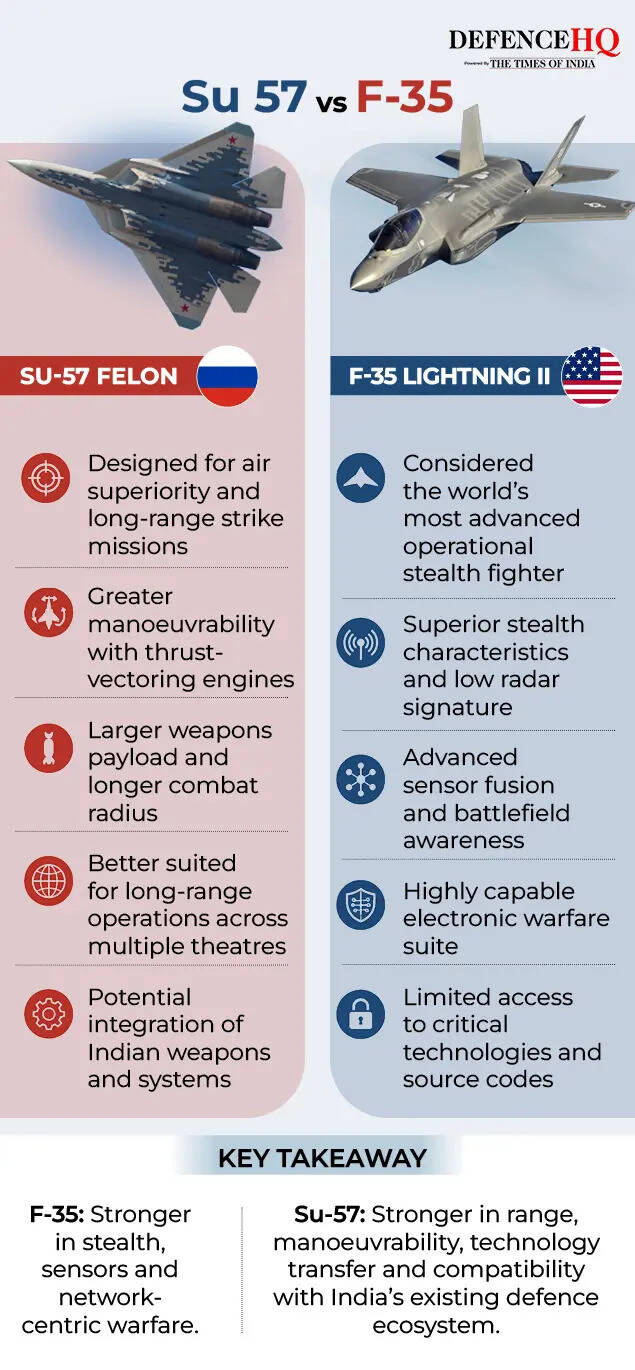
Su 57 vs F-35
Su-57 vs F-35The F-35 is widely regarded as the world’s most advanced operational fifth-generation fighter. The aircraft’s AN/APG-81 AESA radar, Distributed Aperture System (DAS), Electro-Optical Targeting System (EOTS) and secure data links allow it to detect, track and engage threats at long ranges.F-35’s ability to combine stealth technology with advanced suite of sensors, electronic warfare systems and sensor-fusion capabilities provide the pilot with an unmatched situational awareness and real time battlefield picture.The Su-57 follows a different approach. While it incorporates stealth features, Russia designed the aircraft to balance stealth with high speed, manoeuvrability and long-range combat performance. Su-57 can also carries a larger weapons payload.One of the biggest hurdles is India’s operation of the Russian S-400 air defence system. The United States has consistently expressed concerns about operating the F-35 alongside the S-400, arguing it risk exposing sensitive information about the aircraft’s stealth and electronic warfare capabilities. These very concerns led Washington to remove Turkey, a foundational member of the project from the F-35 program after Ankara acquired the S-400.Technology transfer is another major concern. The F-35 programme remains tightly controlled by the United States, with limited access to key software, mission systems and critical technologies. India by contrast has increasingly prioritised defence acquisitions that contribute to domestic manufacturing and indigenous capability development.On the other hand, Russia has offered technology transfer, local production and greater flexibility in integrating Indian weapons and systems. The Indian Air Force already operates a large fleet of Russian-origin aircraft, including the Su-30MKI, giving it decades of experience with Russian weapons, logistics and maintenance systems. The aircraft’s long combat radius, high speed, super cruise capability and large weapons payload will be able to support missions across vast distances, which can help India project power.As India weighs its air combat requirements, the urgency to acquire a fifth-generation fighter is becoming increasingly difficult to ignore. Ultimately, New Delhi’s decision will extend beyond mere spec-sheet data.


