
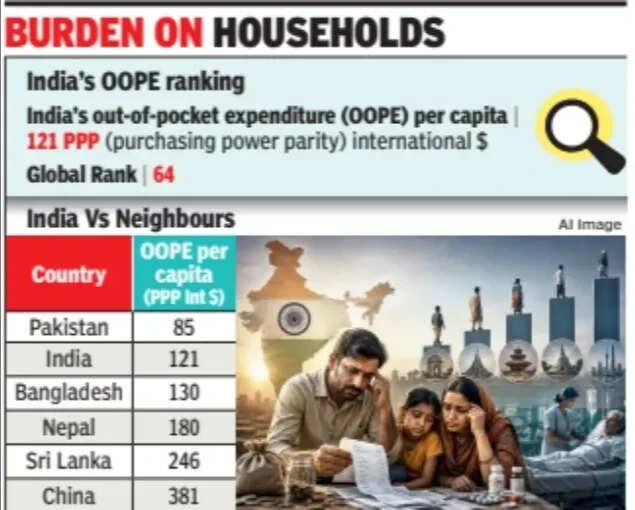
Representative imageShare, However, Sees A Drop To 43.4% In FY23Representative imageShare, However, Sees A Drop To 43.4% In FY23Representative image12 NEW DELHI: Even after a sharp decline over the past decade, Indians continue to spend more from their own pockets on healthcare than people in several neighbouring and developing countries, according to the National Health Accounts (NHA) Estimates 2022-23 released by the health ministry.The report’s international comparison of out-of-pocket expenditure (OOPE) showed India’s per capita spending from personal pockets stood at 121 international dollars (PPP) in 2022, placing the country at rank 64 globally. The figures highlight that despite the expansion of public healthcare schemes and insurance coverage, households in India continue to bear a substantial share of treatment costs themselves. Among neighbouring countries, the OOPE burden stood at 85 international dollars in Pakistan, 180 in Nepal, 130 in Bangladesh and 246 in Sri Lanka.The report, however, pointed to a major long-term improvement within India. Out-of-pocket expenditure as a share of total health expenditure declined sharply from 64.2% in 2013-14 to 43.4% in 2022-23. Govt officials attributed the decline to rising public health spending, expansion of Ayushman Bharat PM-JAY, free drug schemes, Jan Aushadhi outlets and wider access to primary healthcare services through Ayushman Arogya Mandirs.The report showed govt health expenditure nearly tripled over the decade, rising from Rs 1.3 lakh crore in 2013-14 to Rs 3.8 lakh crore in 2022-23. Health economists say India’s healthcare financing system continues to remain heavily dependent on household spending despite recent improvements.According to the report, medicines and pharmaceutical purchases remain the single-biggest driver of personal healthcare spending in India. The international comparison also showed massive contrasts globally. Switzerland reported the world’s highest per capita out-of-pocket health spending at 2,302 international dollars, followed by Malta at 1,729 and Singapore at 1,647.Among major developed economies, the US reported OOPE of 1,380 international dollars, while the UK stood at 857 and Canada at 1,038.At the lower end of the global ranking, Kiribati reported the world’s lowest OOPE at just 2 international dollars, followed by Tuvalu and Solomon Islands at 4 international dollars each.Public health experts say lower out-of-pocket spending is considered a key indicator of stronger public healthcare systems because it reduces the risk of families falling into poverty due to medical expenses.About the AuthorAnuja JaiswalAnuja Jaiswal is a Senior Assistant Editor at The Times of India, with an impressive 18-year career in narrative journalism. She specializes in health and heritage reporting, expertly simplifying complex health information to make it engaging and understandable for readers. Her deep dives into heritage topics are well-researched, resulting in captivating narratives that resonate with her audience. Over the years, she has worked in Chandigarh, Chhattisgarh and West UP, gaining diverse on-ground experience that shapes her storytelling.Read MoreEnd of ArticleFollow Us On Social MediaVideos’Trauma Care Part Of Right To Life’: SC Orders 112 As One Unified Emergency Response NumberAfter 20 Years In Saudi Prison, Kerala Man Abdul Rahim Returns HomePatna Builder Gifts CM Portrait, Internet Reacts With “Majnu Bhai Would Be Proud” JokesTension At West Bengal Border As Migrants Wait For Return Amid Holding Centre OperationsTwisha Sharma Death Case: CBI Arrests Mother-In-Law & Retired Judge Giribala SinghFrom Brazil To India: Inside Gujarat’s Biggest Cocaine SeizureSiddaramaiah Resigns As Karnataka CM, DK Shivakumar Likely To Take OverSpecial Eid-ul-Adha Namaz Held At Taj Mahal Amid Tight Security Across Uttar Pradesh CitiesTamil Nadu CM Vijay Postpones Delhi Meeting With Rahul Gandhi After PM Modi MeetPriyanka Gandhi Intervention Boosts DK Shivakumar’s Push For Karnataka Chief Minister Post: Report123PhotostoriesDiscovering India’s only snake-free region10 famous snake parks and zoos in the USA every wildlife traveller should visit and how to reach here”Egg is the worst thing you can…” Sadhguru shares 3 traditional South Indian vegetarian dishes rich in protein and vitamin B125 most iconic Katrina Kaif movie looks that are making a comeback online10 toxic habits you think are normal, but they’re holding you backIndoor plants that you can grow without soilIndia’s hidden wine regions beyond NashikWhy atta dough turns dry in the fridge and 3 easy ways to retain its moistureThought of the day, inspired by Bhagavad Gita: “Inner peace begins where ego ends”5 art villages of india where art has been passed down from generations and is a way of life123Hot PicksParris Campbell RetirementClaude Lemieux DeathMitch MarnerKarnataka CMJai Pal SinghCristiano RonaldoSachine TendulkarTop TrendingPatna Boat AccidentGujarat Drug BustNEET UG Paper LeakNorth India HeatwaveGrocery price hikeBengaluru Ebola CaseUK NEETRahul GandhiIndian mango exportsFuel price hike

The report, however, pointed to a major long-term improvement within India. Out-of-pocket expenditure as a share of total health expenditure declined sharply from 64.2% in 2013-14 to 43.4% in 2022-23. Govt officials attributed the decline to rising public health spending, expansion of Ayushman Bharat PM-JAY, free drug schemes, Jan Aushadhi outlets and wider access to primary healthcare services through Ayushman Arogya Mandirs.The report showed govt health expenditure nearly tripled over the decade, rising from Rs 1.3 lakh crore in 2013-14 to Rs 3.8 lakh crore in 2022-23. Health economists say India’s healthcare financing system continues to remain heavily dependent on household spending despite recent improvements.According to the report, medicines and pharmaceutical purchases remain the single-biggest driver of personal healthcare spending in India. The international comparison also showed massive contrasts globally. Switzerland reported the world’s highest per capita out-of-pocket health spending at 2,302 international dollars, followed by Malta at 1,729 and Singapore at 1,647.Among major developed economies, the US reported OOPE of 1,380 international dollars, while the UK stood at 857 and Canada at 1,038.At the lower end of the global ranking, Kiribati reported the world’s lowest OOPE at just 2 international dollars, followed by Tuvalu and Solomon Islands at 4 international dollars each.Public health experts say lower out-of-pocket spending is considered a key indicator of stronger public healthcare systems because it reduces the risk of families falling into poverty due to medical expenses.


