
File photo NEW DELHI: Following the launch of the Quad Critical Minerals Initiative last year, the foreign ministers’ meeting on Tuesday is likely to announce key measures for collaboration to strengthen economic security through diversification of supply chains in a separate joint statement.The likely key takeaway from the meeting will be an important step towards countering China’s dominance of critical minerals and thwarting any possible weaponisation of its resources.Diplomats from Australia, India, Japan and the US, which is spearheading the critical minerals initiative, were busy giving finishing touches to the joint statement on Monday, ahead of the meeting that will also focus on energy security, including the situation in the Strait of Hormuz, along with maritime and transnational security, humanitarian assistance and emergency response in the Indo-Pacific.The Quad foreign ministers’ meeting will take place at a time prospects for a summit in India of the diplomatic partnership among like-minded democracies still appear bleak. India has tried unsuccessfully to host the summit for the past three years, amid growing concerns about President Donald Trump’s efforts to reshape US ties with China. However, external affairs minister S Jaishankar said after his bilateral meeting with counterpart Marco Rubio on Sunday that Quad ministers would have a “good, strong” story to tell after the foreign ministers’ meeting on Tuesday.Significantly, while the ministerial meeting is taking place after a gap of just 11 months, cooperation at the ground level continued with workshops and technical exchanges on issues like counterterrorism. Indian govt last year also took note of then ambassador-designate Sergio Gor’s remarks during his confirmation hearing that Trump remained committed to a meeting of Quad leaders and to strengthen the strategic grouping, a potential bulwark against threats to a free and open Indo-Pacific.The joint statement issued after the last meeting in July 2025 was significant for India as it strongly condemned cross-border terrorism and explicitly committed to counterterrorism cooperation, in the aftermath of the Pahalgam terrorist attack. It had condemned the attack in the strongest terms, calling for the perpetrators, organisers and financiers to be brought to justice without any delay and urging all UN states to cooperate actively with all relevant authorities in this regard. Official sources said the Quad ministers will reinforce their commitment to jointly working against terrorism in the meeting.The meeting is also likely to stress the importance of upholding freedom of navigation and overflight, and unimpeded commerce consistent with the United Nations Convention on the Law of the Sea, in South and East China Seas.The ministers are also expected to discuss progress in their stated agenda for cooperation in four areas to leverage its resources and address challenges in the region: maritime and transnational security, economic prosperity and security, critical and emerging technology and humanitarian assistance and emergency response.End of ArticleFollow Us On Social MediaVideos’Crafted By Iranian Architects’: Iran Takes Swipe At Rubio Over Taj Mahal VisitTMC MP Abhishek Banerjee Under Scrutiny As Kolkata Police Arrive After Property Notice ControversyIndian Army, J&K Police, SDRF Pull Off High-Altitude Rescue After Gulmarg Gondola SnagSupreme Court Refuses To Entertain NGO’s Plea To Clarify Rabid Dogs Euthanasia OrderCockroach Janta Party Founder Abhijeet Dipke Moves Delhi High Court Challenging X Account BlockingKharge Targets Modi-Trump Friendship After Viral Call, Says Both Share “Traits Of Destruction”AIADMK Faces Major Setback As Three MLAs Resign From Shanmugam–Velumani Faction In Tamil NaduFormer MLA Alka Lamba Found Guilty In Women Reservation Protest Case; Court To Pronounce Sentence’To Serve As Deterrent To Others’: Tamil Nadu CM Vijay Orders Swift Action In Sexual Crime CasesCongress Leader P L Punia Urges Immediate Seat Sharing Talks With SP Ahead Of UP Polls123Photostories5 perfect ways travellers can spend summer holidays in UttarakhandAishwarya Rai Bachchan ended Cannes 2026 in sculpted coutures and main-character energyTop 10 most visited states of America and travellers should know5 animals that are faster than a cheetahThis viral Zebra puzzle has left thousands confused, can you find the hidden Tiger in just 10 seconds?Travel trivia: 10 countries famous for what they don’t have‘There is no reason not to follow your heart’: 7 life lessons to teach kids from Steve Jobs’ iconic speechShoaib Ibrahim reveals father suffered brain hemorrhage and is admitted to ICU; says ‘He had internal bleeding’10 small habits that could quietly change your life by the end of 2026Sattu vs Besan: Which is more nutritious in summer and 3 easy ways to consume them123Hot PicksDelhi heatwaveKerala LSS USS Result Official WebsiteDHSE Kerala plus two resultUPSC prelims 2026Mumbai local train newsIran US TalksFM SitharamanTop TrendingAlka LambaDelhi GymkhanaAmbala Triple MurderCoimbatore Rape MurderCockroach Janta PartyScott RemerNepal Plastic RoadsMegan Thee StallionBandra DemolitionWest Bengal Annapurna Yojana

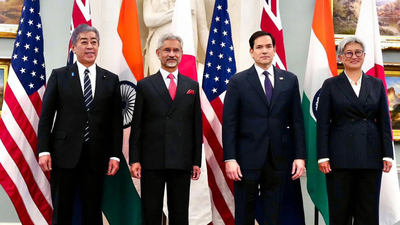
NEW DELHI: Following the launch of the Quad Critical Minerals Initiative last year, the foreign ministers’ meeting on Tuesday is likely to announce key measures for collaboration to strengthen economic security through diversification of supply chains in a separate joint statement.The likely key takeaway from the meeting will be an important step towards countering China’s dominance of critical minerals and thwarting any possible weaponisation of its resources.Diplomats from Australia, India, Japan and the US, which is spearheading the critical minerals initiative, were busy giving finishing touches to the joint statement on Monday, ahead of the meeting that will also focus on energy security, including the situation in the Strait of Hormuz, along with maritime and transnational security, humanitarian assistance and emergency response in the Indo-Pacific.The Quad foreign ministers’ meeting will take place at a time prospects for a summit in India of the diplomatic partnership among like-minded democracies still appear bleak. India has tried unsuccessfully to host the summit for the past three years, amid growing concerns about President Donald Trump’s efforts to reshape US ties with China. However, external affairs minister S Jaishankar said after his bilateral meeting with counterpart Marco Rubio on Sunday that Quad ministers would have a “good, strong” story to tell after the foreign ministers’ meeting on Tuesday.Significantly, while the ministerial meeting is taking place after a gap of just 11 months, cooperation at the ground level continued with workshops and technical exchanges on issues like counterterrorism. Indian govt last year also took note of then ambassador-designate Sergio Gor’s remarks during his confirmation hearing that Trump remained committed to a meeting of Quad leaders and to strengthen the strategic grouping, a potential bulwark against threats to a free and open Indo-Pacific.The joint statement issued after the last meeting in July 2025 was significant for India as it strongly condemned cross-border terrorism and explicitly committed to counterterrorism cooperation, in the aftermath of the Pahalgam terrorist attack. It had condemned the attack in the strongest terms, calling for the perpetrators, organisers and financiers to be brought to justice without any delay and urging all UN states to cooperate actively with all relevant authorities in this regard. Official sources said the Quad ministers will reinforce their commitment to jointly working against terrorism in the meeting.The meeting is also likely to stress the importance of upholding freedom of navigation and overflight, and unimpeded commerce consistent with the United Nations Convention on the Law of the Sea, in South and East China Seas.The ministers are also expected to discuss progress in their stated agenda for cooperation in four areas to leverage its resources and address challenges in the region: maritime and transnational security, economic prosperity and security, critical and emerging technology and humanitarian assistance and emergency response.


