
‘Drones launching drones’: How the battle to clear sea mines in Strait of Hormuz may play out

As shipping in the Strait of Hormuz continues to be disrupted due to the Middle East crisis, defence companies and marine contractors are planning to deploy uncrewed mine-clearing systems in and around the narrow waterway.According to a report by the Financial Times, the United Kingdom will send autonomous minehunting vessels built by Canada’s Kraken Robotics as part of a multinational effort to reopen the strait “when conditions allow”.
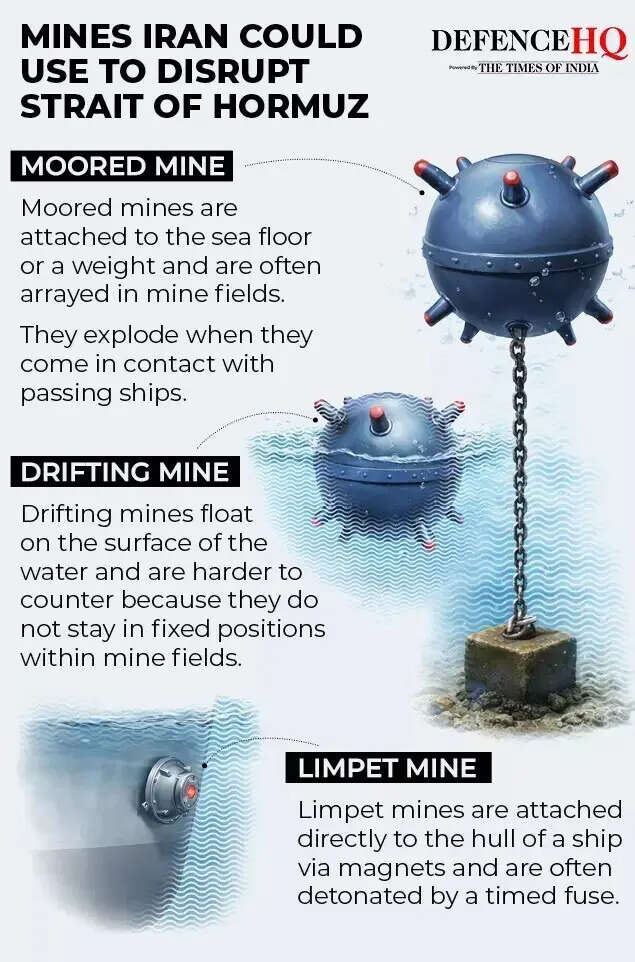
Why it mattersModern mines – unlike Second World War-era mines – are usually placed on the seabed and triggered when sensors detect ships passing overhead. According to experts, the key question is not whether every mine has been removed, but whether shipowners and insurers believe the risks have been reduced enough for commercial traffic to resume safely.“Minefields don’t even need mines to be effective as long as everyone thinks they might be there,” former rear admiral in the UK’s Royal Navy John Pentreath told the Financial Times.“Because how do you prove they’re not there?” he added.Why uncrewed systems are being deployedAccording to the report, navies are increasingly relying on uncrewed systems consisting of surface vessels equipped with sonar arrays or submersible drones.“You have drones launching drones. And the operator can do it from London,” said Oleg Rogynskyy, chief executive of Ukrainian-UK start-up Uforce.The company’s Magura sea drones have been used to sink Russian ships in the Black Sea. But they can also be equipped to tow sonar systems or carry mine-disposal drones such as the SeaFox, made by Germany’s Atlas Elektronik.
The aim is not to eliminate every mine, industry executives say, but to sweep a path that is safe enough for commercial traffic to resume.“Twenty years ago, you would send a UK minehunter with 50 people on it at huge expense,” said Simon Tucker, chief executive of UK maritime surveillance specialist SRT Marine, which is in talks with several Gulf countries about using its technology to support mine detection.He added that the idea under discussion was to sweep routes ahead of ship convoys to establish confidence that “there aren’t that many” mines in their path.SRT is already supplying its maritime surveillance systems, including uncrewed surface vessels supplied by Ocean Infinity, to monitor and patrol Kuwait’s waters, according to Tucker, and is in discussions with other Gulf governments.Which countries have invested in mine-clearing systemsAccording to the Financial Times report, the United States, UK, France and Germany have invested in autonomous mine-clearing systems that combine uncrewed surface vessels, sonar arrays and hunter submersibles.Earlier in May, US Central Command commander Admiral Brad Cooper said US efforts to clear the strait included unmanned technology, adding that the mines Iran had deployed were “not so extensive that we couldn’t use our exquisite technology to clear a pathway”.The US Navy has Textron Systems’ Common Uncrewed Surface Vehicle at its disposal, along with Raytheon’s AQS-20 sonar minehunting system and its Barracuda submersible.Meanwhile, the British and French navies started taking delivery of Thales’s new unmanned Maritime Mine Counter Measures system, consisting of a drone boat, towed sonar array and hunter submersible.“We’ve run the system across dummy minefields to see if we are seeing everything that the Navy knows is there,” French defence group Thales’s underwater systems sales director Ian McFarlane said at London’s Undersea Defence Technology conference last month. “And yes, we can do that with high confidence.”The Royal Navy has adapted its Lyme Bay support ship to be used as a “mothership” for autonomous systems if required for operations in the strait, and has contracts to buy sea drones from Atlas Elektronik and Kraken Robotics.“We have world-leading capabilities in terms of autonomous minehunting,” said Rich Knighton, chief of the UK defence staff. “A hybrid navy concept provides us with opportunities to avoid putting people into harm’s way while helping secure the strait.”Germany’s Euroatlas also said it had signed contracts to supply its Greyshark submersible drone to two European defence ministries, although it declined to name them.A difficult businessDespite being more efficient, mine-sweeping remains a difficult business.One hydrographic expert told the Financial Times that the system can generate imagery with a resolution of 3cm to 4cm, making it possible to identify objects such as shopping trolleys or tractor tyres. “But the challenge is that there are a huge number of cylindrical objects lying on the seabed,” he noted.The Strait of Hormuz presents additional complications beyond being an active conflict zone. Its relatively shallow waters and constant heavy marine traffic frequently alter seabed conditions, allowing mines to become buried under sand or mud.
Although the latest mine-clearing systems are unmanned, the risks to personnel have not disappeared entirely. Surface vessels used in these operations have ranges of about 800km to 1,200km, meaning support ships still need to operate within reach of Iranian anti-ship missiles if large stretches of water are to be cleared.Britain has prior experience in mine-clearing operations in the strait. Adrian Pierce, a former captain of a Royal Navy minesweeper, said it took “weeks” to secure the waterway during the Iran-Iraq “tanker war” in the 1980s. Even with modern systems, clearing a safe route to a single Gulf port would still take several days.“The new technology certainly speeds up the process, but the fundamental issue remains the same — confidence,” Pierce said. “We fool ourselves if we ignore the statistical nature of mine clearance.”Thales executive McFarlane echoed that view, saying no operation could ever guarantee that every mine had been detected. “You can never say you’ve found 100 per cent of everything,” he said. “Someone could drop another object into the water overnight, or shifting tides and currents could uncover something that was hidden the day before.”


