
BJP flag When Mamata Banerjee came to power in 2011, Kolkata was washed in blue and white. Railings, flyovers, government offices, lamp posts, bridges, medians – everything began to resemble a giant municipal tribute to the Argentine football team. In fairness, many Kolkatans would probably vote for Argentina if FIFA ever allowed absentee ballots from Gariahat. (And those who don’t would vote for Brazil.)But Bengal was never merely repainting itself. It performs politics theatrically. Every regime leaves behind a colour palette: the Left left fading red walls and union offices smelling faintly of damp paper and ideological exhaustion; Mamata Banerjee’s Trinamool Congress arrived with blue-and-white optimism, welfare politics, hyperlocal charisma, and a promise that Bengal would finally breathe after 34 years of communist heaviness.Election Results 2026Vijay’s TVK party emerges as formidable force in Tamil Nadu; all you need to know about its journeyWest Bengal election results: Mamata lags behind Suvendu Adhikari after 2nd round in BhabanipurTVK pushes DMK, AIADMK to margins; BJP may oust Mamata in Bengal, retain AssamWest BengalTamil NaduKeralaAssamPuducherry PreviousBJP LEADINGWest BengalParty ViewAlliance ViewSeats279/294Total: 294Note: Repolling for the Falta assembly constituency in West Bengal has been scheduled for May 21.L + WMajority: 148BJP0AITC0CONG0CPI(M)0OTH0TVK LEADINGTamil NaduParty ViewAlliance ViewSeats227/234Total: 234L + WMajority: 118TVK0AIADMK0DMK0CONG0BJP0OTH0CONG LEADINGKeralaParty ViewAlliance ViewSeats140/140Total: 140L + WMajority: 71CONG0CPI(M)0IUML0CPI0BJP0OTH0BJP LEADINGAssamParty ViewAlliance ViewSeats126/126Total: 126L + WMajority: 64BJP0CONG0AGP0AIUDF0OTH0AINRC LEADINGPuducherryParty ViewAlliance ViewSeats29/30Total: 30L + WMajority: 16AINRC0BJP0CONG0DMK0OTH0 Next12345Source: PValue Watch ‘Will Win After Sunset’: Mamata Banerjee’s First Reaction After BJP Crosses Majority Mark In BengalFifteen years later, the question is no longer whether Bengal changed governments, it is whether Bengal itself is changing. Today’s results suggest something larger than routine anti-incumbency.The BJP, which had won 77 seats and 38.15% vote share in 2021, is now showing a dramatic surge in counting trends. By noon, several live trackers had the BJP crossing or approaching the halfway mark, with leads in the 140–150 range and vote share estimates hovering around 46–48%, while the TMC trailed significantly behind.That swing matters. In Bengal’s first-past-the-post arithmetic, an 8–10% vote swing is not merely statistical movement; it is tectonic drift. Entire districts begin changing colour. South Bengal, south-west Bengal and large belts once considered difficult terrain for the BJP are now heavily saffron on the electoral map. The old Left geography has not disappeared; it has, in many places, migrated. Perhaps that is the first truth one must acknowledge about Bengal: Bengal rarely abandons its anger. It merely transfers it.The cadre culture that once belonged to the CPM did not vanish in 2011. It changed ownership. Even analysts sympathetic to the TMC have admitted that Bengal’s political violence is not episodic but structural; an inheritance from decades of deeply embedded party control over local administration, welfare networks and electoral life. That is why the role of central forces and the Election Commission became such a central subtext in this election. Kolkata Police banning victory processions on counting day is itself an extraordinary reflection of the state’s political temperature.Think about how unusual that is in a democracy: an election where the state is already preparing for the emotional consequences of the verdict before the verdict is fully known. And yet, Bengal has seen this before. Fear has always hovered just outside the polling booth; the flags changed.This may also explain the shift among women voters. The BJP appears to have made significant gains among women, especially outside Kolkata’s elite discourse bubble. The aftermath of the RG Kar rape-murder case lingered politically far longer than the TMC anticipated. The BJP repeatedly foregrounded women’s safety, even fielding the victim’s mother from Panihati.Now, whether one agrees with the BJP’s politics or not is almost secondary. Elections are often less about ideological conversion and more about emotional accumulation. Fatigue, fear, humiliation – it all accumulates. The middle classes, particularly in Bengal, can tolerate inefficiency for astonishingly long periods. What perhaps they cannot tolerate indefinitely is the feeling that institutions themselves are becoming partisan extensions of local power.And this is where one is reminded of a Satyajit Ray film (granted that his 105th birth anniversary has some of his references swirling on top of Bengali minds). Ray seemed to understand authoritarianism better through children’s fantasy than many modern political consultants understand through data dashboards.In Hirak Rajar Deshe, the rhyme was devastatingly simple:অনাচার করো যদি, রাজা তবে ছাড়ো গদিযারা তার ধামাধারী, তাদেরও বিপদ ভারী।Loosely translated:If misrule persists, the king must leave the throne.And those who uphold him will not escape either.That, more than any slogan, may explain today’s verdict in West Bengal.The TMC’s problem is not merely anti-incumbency. Governments survive anti-incumbency all the time. The deeper issue is organisational psychology. The TMC became less a party and more a governing ecosystem. An ecosystem survives while resources, protection and access flow downward. But unlike the CPM of old, much of the TMC’s local machinery is not ideologically hardened. It is politically adaptive, which means if power slips, loyalty may suddenly discover flexibility.That is why the CPM question becomes fascinating again. Can the Left return?Electorally, perhaps not immediately. Socially and psychologically, however, there may be space opening up again. West Bengal’s educated middle class still retains a peculiar nostalgia for ideological seriousness, even while rejecting the economic stagnation that accompanied it. The CPM’s challenge is that nostalgia does not automatically become organisation and adda does not become cadre. Quoting Marx over fish fry in Southern Avenue is not booth management – there is grassroots work that needs to be done.West Bengal’s politics, and its tolerant masses, have historically rewarded parties that can convert moral language into administrative confidence. The BJP has successfully converted grievance into momentum. Whether it can convert momentum into governance is a completely different examination and that examination will begin immediately. Because Bengal is not Uttar Pradesh, Gujarat or Delhi.Bengal absorbs outsiders culturally before resisting them politically. The BJP’s rise here has required the party itself to become more Bengali than it once imagined necessary. The aggressive outsider-insider framing that once benefited the TMC appears weaker today precisely because the BJP no longer feels entirely external in large parts of Bengal.PollWhat should be the priority for the next government in Bengal?Improving women’s safetyEconomic developmentRestoration of political stabilityYet the Bengali character itself remains curiously intact beneath the shifting colours. The voter turnout crossed 92%, among the highest in Bengal’s electoral history, which tells you something important. Bengal may be cynical about politicians, but it remains emotionally invested in politics itself. Politics here is not merely governance. It is culture, theatre, revenge, poetry, class anxiety, para (locality) gossip, television spectacle and civilisational argument compressed into a ballot paper. And that is why the map alone can mislead.A saffron Bengal does not automatically mean a permanently saffron Bengali mind. Just as blue-and-white flyovers did not erase Bengal’s argumentative instincts, the Bengali voter is perfectly capable of electing a nationalist government in the morning and spending the evening debating whether Tagore would have approved.The colours change. The argument remains. And perhaps that is Bengal’s deepest continuity of all.Follow the latest election results 2026, live updates, winner lists, constituency-wise results, party-wise trends and full coverage for Tamil Nadu election results, West Bengal election results, Kerala election results, Assam election results and Puducherry election results results on Times of India.End of ArticleFollow Us On Social MediaVideosIndia Rejects Nepal’s Objection To Kailash Mansarovar Yatra Route Via Lipulekh PassNepal Objects To India-China Plan To Conduct Kailash Mansarovar Yatra Via LipulekhIndia-Linked LPG Tanker MT Sarv Shakti Heads To Visakhapatnam After Crossing HormuzPassenger Opens Emergency Exit Door On Air Arabia Flight While Taxiing At Chennai Airport, ArrestedAhead Of Counting, Gunmen Open Fire At BJP Leader’s House In Bengal’s Noapara‘I Am Also A Victim’: Vinesh Phogat Identifies As Complainant In Brij Bhushan Sexual Harassment CaseBJP MP Sandeep Pathak Claims ‘No Information’ On FIRs, Alleges Misuse Of State Machinery In PunjabIndian Startup Launches Mission Drishti, World’s First OptoSAR Satellite, Aboard SpaceX Falcon 9Diljit Dosanjh Confronts Khalistan Supporters at Calgary Concert, Explains KBC AppearanceDelhi Approves ₹48,000 Crore Metro Expansion Plan To Connect Outer Regions With City Core123PhotostoriesGK Fact of the Day: 7 carnivorous plants that trap and eat insectsNoorjahan Mango: Why it’s called the Queen of Mangoes, sold at Rs 1000 a piece and its connection with AfghanistanHugh Jackman’s Ball State speech has life lessons on failure and intuition: ‘Even mistakes may turn out to be the best thing’12 foods that can help you sleep better naturallyKatrina Kaif makes her first public appearance post maternity in an all-black airport look, and fans are officially obsessedMira Rajput and Shahid Kapoor’s home is an amalgamation of fashion and artsThe 7 most venomous sea snakes in the world5 daily phrases that build a child’s self-worth (backed by psychology)5 Reasons your plants are not growing properlyEver wondered why sons often seem closer to their mothers and daughters to their fathers? The psychology behind it123Hot PicksAssam key constituenciesKerala key constituenciesPuducherry election resultsTamil Nadu constituenciesPerambur election resultMamata Banerjee vs Suvendu AdhikariGold rate todayTop TrendingWest Bengal Assembly Election ResultsAssam Assembly Election ResultsTamil Nadu Assembly Election ResultsKerala Assembly Election ResultsPuducherry Assembly Election ResultsBhabanipur election results 2026CBSE Class 12th ResultNEET 2026: Exam-day guideHPBose 12th ResultGSEB HSC Result

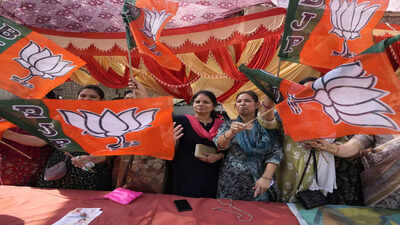
When Mamata Banerjee came to power in 2011, Kolkata was washed in blue and white. Railings, flyovers, government offices, lamp posts, bridges, medians – everything began to resemble a giant municipal tribute to the Argentine football team. In fairness, many Kolkatans would probably vote for Argentina if FIFA ever allowed absentee ballots from Gariahat. (And those who don’t would vote for Brazil.)But Bengal was never merely repainting itself. It performs politics theatrically. Every regime leaves behind a colour palette: the Left left fading red walls and union offices smelling faintly of damp paper and ideological exhaustion; Mamata Banerjee’s Trinamool Congress arrived with blue-and-white optimism, welfare politics, hyperlocal charisma, and a promise that Bengal would finally breathe after 34 years of communist heaviness.
Fifteen years later, the question is no longer whether Bengal changed governments, it is whether Bengal itself is changing. Today’s results suggest something larger than routine anti-incumbency.The BJP, which had won 77 seats and 38.15% vote share in 2021, is now showing a dramatic surge in counting trends. By noon, several live trackers had the BJP crossing or approaching the halfway mark, with leads in the 140–150 range and vote share estimates hovering around 46–48%, while the TMC trailed significantly behind.That swing matters. In Bengal’s first-past-the-post arithmetic, an 8–10% vote swing is not merely statistical movement; it is tectonic drift. Entire districts begin changing colour. South Bengal, south-west Bengal and large belts once considered difficult terrain for the BJP are now heavily saffron on the electoral map. The old Left geography has not disappeared; it has, in many places, migrated. Perhaps that is the first truth one must acknowledge about Bengal: Bengal rarely abandons its anger. It merely transfers it.The cadre culture that once belonged to the CPM did not vanish in 2011. It changed ownership. Even analysts sympathetic to the TMC have admitted that Bengal’s political violence is not episodic but structural; an inheritance from decades of deeply embedded party control over local administration, welfare networks and electoral life. That is why the role of central forces and the Election Commission became such a central subtext in this election. Kolkata Police banning victory processions on counting day is itself an extraordinary reflection of the state’s political temperature.Think about how unusual that is in a democracy: an election where the state is already preparing for the emotional consequences of the verdict before the verdict is fully known. And yet, Bengal has seen this before. Fear has always hovered just outside the polling booth; the flags changed.This may also explain the shift among women voters. The BJP appears to have made significant gains among women, especially outside Kolkata’s elite discourse bubble. The aftermath of the RG Kar rape-murder case lingered politically far longer than the TMC anticipated. The BJP repeatedly foregrounded women’s safety, even fielding the victim’s mother from Panihati.Now, whether one agrees with the BJP’s politics or not is almost secondary. Elections are often less about ideological conversion and more about emotional accumulation. Fatigue, fear, humiliation – it all accumulates. The middle classes, particularly in Bengal, can tolerate inefficiency for astonishingly long periods. What perhaps they cannot tolerate indefinitely is the feeling that institutions themselves are becoming partisan extensions of local power.And this is where one is reminded of a Satyajit Ray film (granted that his 105th birth anniversary has some of his references swirling on top of Bengali minds). Ray seemed to understand authoritarianism better through children’s fantasy than many modern political consultants understand through data dashboards.In Hirak Rajar Deshe, the rhyme was devastatingly simple:অনাচার করো যদি, রাজা তবে ছাড়ো গদিযারা তার ধামাধারী, তাদেরও বিপদ ভারী।Loosely translated:If misrule persists, the king must leave the throne.And those who uphold him will not escape either.That, more than any slogan, may explain today’s verdict in West Bengal.The TMC’s problem is not merely anti-incumbency. Governments survive anti-incumbency all the time. The deeper issue is organisational psychology. The TMC became less a party and more a governing ecosystem. An ecosystem survives while resources, protection and access flow downward. But unlike the CPM of old, much of the TMC’s local machinery is not ideologically hardened. It is politically adaptive, which means if power slips, loyalty may suddenly discover flexibility.That is why the CPM question becomes fascinating again. Can the Left return?Electorally, perhaps not immediately. Socially and psychologically, however, there may be space opening up again. West Bengal’s educated middle class still retains a peculiar nostalgia for ideological seriousness, even while rejecting the economic stagnation that accompanied it. The CPM’s challenge is that nostalgia does not automatically become organisation and adda does not become cadre. Quoting Marx over fish fry in Southern Avenue is not booth management – there is grassroots work that needs to be done.West Bengal’s politics, and its tolerant masses, have historically rewarded parties that can convert moral language into administrative confidence. The BJP has successfully converted grievance into momentum. Whether it can convert momentum into governance is a completely different examination and that examination will begin immediately. Because Bengal is not Uttar Pradesh, Gujarat or Delhi.Bengal absorbs outsiders culturally before resisting them politically. The BJP’s rise here has required the party itself to become more Bengali than it once imagined necessary. The aggressive outsider-insider framing that once benefited the TMC appears weaker today precisely because the BJP no longer feels entirely external in large parts of Bengal.
Poll
What should be the priority for the next government in Bengal?
Yet the Bengali character itself remains curiously intact beneath the shifting colours. The voter turnout crossed 92%, among the highest in Bengal’s electoral history, which tells you something important. Bengal may be cynical about politicians, but it remains emotionally invested in politics itself. Politics here is not merely governance. It is culture, theatre, revenge, poetry, class anxiety, para (locality) gossip, television spectacle and civilisational argument compressed into a ballot paper. And that is why the map alone can mislead.A saffron Bengal does not automatically mean a permanently saffron Bengali mind. Just as blue-and-white flyovers did not erase Bengal’s argumentative instincts, the Bengali voter is perfectly capable of electing a nationalist government in the morning and spending the evening debating whether Tagore would have approved.The colours change. The argument remains. And perhaps that is Bengal’s deepest continuity of all.


