
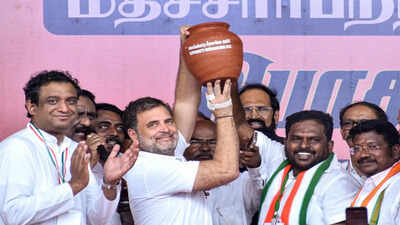
Rahul Gandhi holds a clay pot during a public rally in support of party candidate for Thuraiyur constituency Lenin Prasath in Tiruchirappalli district. (PTI) NEW DELHI: In Tamil Nadu’s tightly structured alliance politics, the verdict is often as much about continuity as it is about change. With voting now complete and results due, attention turns to what the outcome could mean for the balance of power within alliances, particularly for the Indian National Congress.A victory for the Dravida Munnetra Kazhagam(DMK)-led front would be read primarily as an endorsement of the ruling party’s leadership.Chief minister MK Stalin remains the central figure in the state’s political battle, and governance credit is expected to accrue largely to his party. For Congress, which continues as a junior partner in the alliance, such an outcome would ensure representation and continuity, but not necessarily greater political ownership. Watch Tamil Nadu Exit Polls: One Pollster Gives 100+ Seats To Vijay’s TVK, Others Predict DMK ComebackThe alliance with the DMK has offered Congress stability in Tamil Nadu. It provides a defined electoral space, access to governance, and a role within a broader opposition framework. At the same time, it reinforces a structural hierarchy. Congress operates within limits set by seat-sharing arrangements and the dominance of its ally, which constrains its ability to expand independently.The party’s presence in Tamil Nadu has remained steady but modest, and a victory within the alliance would likely maintain that equilibrium rather than alter it significantly.Could Vijay have lifted Congress?The emergence of actor-turned-politician Vijay introduces an important counterfactual to this election as his appeal among younger voters and his positioning outside traditional party structures have added a new variable to the state’s political landscape. While his electoral impact will become clearer over time, his entry has already expanded the range of political possibilities.For Congress, a potential alignment with Vijay could have offered an alternative pathway. Such a move might have helped the party reconnect with sections of the electorate that are not fully aligned with existing alliance structures. It may also have provided an opportunity to negotiate a more balanced role, rather than remaining within the established framework dominated by the DMK.At the same time, such a shift would have carried risks. The existing alliance provides electoral certainty and organisational coordination that a new partnership may not immediately replicate. Questions of vote transfer, leadership clarity, and ideological alignment would have required careful navigation. In a state where voters have historically favoured stable and clearly defined alliances, any reconfiguration would have needed to present a coherent and credible alternative.Congress ultimately chose continuity over experimentation in this election. By remaining within the DMK-led alliance, it opted for a familiar and relatively secure political arrangement.As results are awaited, the broader implications of this choice come into focus. If the alliance returns to power, Congress will continue to be part of the governing framework, benefiting from association with a successful coalition. However, its role is likely to remain secondary, with limited scope to shape the overarching political narrative in the state.The question of long-term growth, therefore, remains open. Congress’s strategy in Tamil Nadu has prioritised stability and alliance cohesion, but it has yet to translate into a significant expansion of its independent base. Whether future electoral cycles prompt a reassessment of this approach, including the possibility of engaging with emerging political forces like Vijay, will be a key factor in determining its trajectory in the state.For now, with the electorate having cast its vote, the focus is on the verdict. The outcome will decide not only the composition of the next government, but also whether existing political arrangements continue to hold or begin to evolve.About the AuthorTOI News DeskThe TOI News Desk comprises a dedicated and tireless team of journalists who operate around the clock to deliver the most current and comprehensive news and updates to the readers of The Times of India worldwide. With an unwavering commitment to excellence in journalism, our team is at the forefront of gathering, verifying, and presenting breaking news, in-depth analysis, and insightful reports on a wide range of topics. The TOI News Desk is your trusted source for staying informed and connected to the ever-evolving global landscape, ensuring that our readers are equipped with the latest developments that matter most.”Read MoreEnd of ArticleFollow Us On Social MediaVideosBJP MP Sandeep Pathak Claims ‘No Information’ On FIRs, Alleges Misuse Of State Machinery In PunjabIndian Startup Launches Mission Drishti, World’s First OptoSAR Satellite, Aboard SpaceX Falcon 9Diljit Dosanjh Confronts Khalistan Supporters at Calgary Concert, Explains KBC AppearanceDelhi Approves ₹48,000 Crore Metro Expansion Plan To Connect Outer Regions With City CoreVietnam President To Lam’s First State Visit To India: What It Means For New Delhi-Hanoi TiesPune Rape-Murder Case: CM Fadnavis Assures Fast-Track Trial, Targets Oppn Over ‘Cash-for-Transfer’Nishant Kumar Begins Sadbhav Yatra from Patna, Says Aim is Worker Outreach & Public ConnectIAF Rescues Two Children Stranded On Water Tank in Siddharthnagar, UP Using Mi-17 HelicopterMassive Fire in Delhi’s Vivek Vihar Building, 9 Dead as Rescue Operations Continue in ShahdaraPune Child Rape-Murder Sparks Protests, Highway Blocked Near Navale Bridge123PhotostoriesRed vs green Apple: How to choose the right one for your health goalsRihanna to Katy Perry: 7 most bizarre Met Gala looks that stole the spotlightBhagavad Gita lessons to overcome life’s challenges and stay happySudden back pain? It might not be muscle strain; here’s how to spot kidney stones early and what to do5 countries where you can drive with your Indian driving licenceFrom six stunning balconies with spectacular views to a lobby with three private lifts, Siddharth Nigam offers a glimpse into his luxurious homeWhy Chennai’s Anna Salai1.5-km flyover section is a big relief for commutersBengaluru’s Namma Metro Pink Line enters crucial testing phase ahead of launch: What you need to knowWhere snakes hide around your home: 7 surprising spots in your house and garden you should never ignore5 best summer fabrics for men to beat the heatwave123Hot PicksAssam key constituenciesKerala key constituenciesPuducherry election resultsTamil Nadu constituenciesAjay Pal SharmaBengal Poll RecordHimanta Biswa SarmaTop TrendingUS Germany relationsBank Holiday MayVande Bharat expressLPG cylinder price hikeMumbai missing linkPetrol, Diesel, LPG priceCBSE Class 12th ResultNEET 2026: Exam-day guideBSE AP SSC Class 10th ResultIPL Orange Cap

NEW DELHI: In Tamil Nadu’s tightly structured alliance politics, the verdict is often as much about continuity as it is about change. With voting now complete and results due, attention turns to what the outcome could mean for the balance of power within alliances, particularly for the Indian National Congress.A victory for the Dravida Munnetra Kazhagam(DMK)-led front would be read primarily as an endorsement of the ruling party’s leadership.Chief minister MK Stalin remains the central figure in the state’s political battle, and governance credit is expected to accrue largely to his party. For Congress, which continues as a junior partner in the alliance, such an outcome would ensure representation and continuity, but not necessarily greater political ownership.
The alliance with the DMK has offered Congress stability in Tamil Nadu. It provides a defined electoral space, access to governance, and a role within a broader opposition framework. At the same time, it reinforces a structural hierarchy. Congress operates within limits set by seat-sharing arrangements and the dominance of its ally, which constrains its ability to expand independently.The party’s presence in Tamil Nadu has remained steady but modest, and a victory within the alliance would likely maintain that equilibrium rather than alter it significantly.
Could Vijay have lifted Congress?
The emergence of actor-turned-politician Vijay introduces an important counterfactual to this election as his appeal among younger voters and his positioning outside traditional party structures have added a new variable to the state’s political landscape. While his electoral impact will become clearer over time, his entry has already expanded the range of political possibilities.For Congress, a potential alignment with Vijay could have offered an alternative pathway. Such a move might have helped the party reconnect with sections of the electorate that are not fully aligned with existing alliance structures. It may also have provided an opportunity to negotiate a more balanced role, rather than remaining within the established framework dominated by the DMK.At the same time, such a shift would have carried risks. The existing alliance provides electoral certainty and organisational coordination that a new partnership may not immediately replicate. Questions of vote transfer, leadership clarity, and ideological alignment would have required careful navigation. In a state where voters have historically favoured stable and clearly defined alliances, any reconfiguration would have needed to present a coherent and credible alternative.Congress ultimately chose continuity over experimentation in this election. By remaining within the DMK-led alliance, it opted for a familiar and relatively secure political arrangement.As results are awaited, the broader implications of this choice come into focus. If the alliance returns to power, Congress will continue to be part of the governing framework, benefiting from association with a successful coalition. However, its role is likely to remain secondary, with limited scope to shape the overarching political narrative in the state.The question of long-term growth, therefore, remains open. Congress’s strategy in Tamil Nadu has prioritised stability and alliance cohesion, but it has yet to translate into a significant expansion of its independent base. Whether future electoral cycles prompt a reassessment of this approach, including the possibility of engaging with emerging political forces like Vijay, will be a key factor in determining its trajectory in the state.For now, with the electorate having cast its vote, the focus is on the verdict. The outcome will decide not only the composition of the next government, but also whether existing political arrangements continue to hold or begin to evolve.


