
NEW DELHI: Rajya Sabha MP Raghav Chadha’s announcement of qutting Aam Aadmi Party and joining Bharatiya Janata Party was not a lone move. It was linked to specific constitutional provisions involving terms such as “two-thirds” and “merger.””We have decided that we, the 2/3rd members belonging to the AAP in Rajya Sabha, exercise the provisions of the Constitution of India and merge ourselves with the BJP,” he said addressing a press conference.Here’s why it matters:If at least two-thirds of the members of a party in the House agree to merge with another party, it is treated as a valid merger and not defection. In such cases, members are not disqualified under the anti-defection law, making this provision crucial in group-level political realignments like the one announced by MPs.Currently, there are 10 MPs in Rajya Sabha from AAP. After this move, two-third, that is, 7 are set to merge with BJP. If this number was any less, those wanting to merge would have to give up their Upper House membership.Hence, if Chadha had quit alone, he would have to give up his Rajya Sabha membership. But that is not the case as the outgoing AAP leader is joined by Swati Maliwal, Harbhajan Singh, Sandeep Pathak, Ashok Mittal, Rajinder Gupta and Vikram Sahni.The anti-defection law, under the Tenth Schedule of the Constitution, is meant to prevent MPs from switching parties after being elected and to maintain stability in Parliament, including the Rajya Sabha. It provides for disqualification if a member voluntarily gives up party membership or votes against the party whip.In Rajya Sabha, the decision on disqualification is taken by the chairman based on a petition from another member. However, the law also includes an exception for mergers, which is where the “two-thirds” condition becomes important. Watch Meet The 7 AAP MPs Who Resigned And Joined BJP In Big Political Shock To KejriwalAbout the AuthorTOI News DeskThe TOI News Desk comprises a dedicated and tireless team of journalists who operate around the clock to deliver the most current and comprehensive news and updates to the readers of The Times of India worldwide. With an unwavering commitment to excellence in journalism, our team is at the forefront of gathering, verifying, and presenting breaking news, in-depth analysis, and insightful reports on a wide range of topics. The TOI News Desk is your trusted source for staying informed and connected to the ever-evolving global landscape, ensuring that our readers are equipped with the latest developments that matter most.”Read MoreEnd of ArticleFollow Us On Social MediaVideosAAP Targets Raghav Chadha & MPs Over Exit, Says they ‘Betrayed The People Of Punjab’Meet The 7 AAP MPs Who Resigned And Joined BJP In Big Political Shock To KejriwalRaghav Chadha Quits AAP, Joins BJP With Six Other MPs | WatchBihar CM Samrat Choudhary Clears Floor Test, NDA Government Proves Majority In AssemblyTamil Nadu Polls See Surge in First-Time Voters, Youth Drive Record TurnoutBJP Declares Yogi Adityanath as CM Face for 2027 UP Assembly ElectionsRSS’ Dattatreya Hosabale In US: “Hindus Not Supremacist, Have Nothing To Apologise For”“Unfair To Drag Armed Forces”: Gen MM Naravane After Rahul Gandhi Cites Unpublished Memoir In LSIndia Urges Citizens Not To Travel To Iran, Asks Nationals To Leave Amid Ongoing Tensions‘Kabhi India Aake Dekho’: Iran Mocks Donald Trump With Maharashtra Video After ‘Hellhole’ Row123PhotostoriesIs your Jamdani saree real or fake? Here’s how to tellHow Rs 7 lakh gaming debt allegedly led to brutal rape-murder in South Delhi homeFrom rift with Rupali Ganguly to almost being cast as Smriti Irani’s daughter in Kyunki Saas Bhi Kabhi Bahu Thi: Anupamaa’s Nidhi Shah gets candidGlobal Property Hotspots: 5 most valuable residential marketsTop 8 beaches in the world in 2026 and why travellers can’t get enoughRaghav Chadha joins BJP: A rift with AAP explainedRed, yellow, and green bell peppers are not the same: What their colours actually tell you about nutritionWhen Sachin Tendulkar cooked this Bihari dish for 50 peopleHow to store fruits and vegetables to keep them fresh longerThe mistake that makes your space look more cluttered than it is123Hot PicksTamil Nadu ElectionWest Bengal voter turnoutAssembly Election 2026Mamata BanerjeeTamil Nadu voter turnoutAmit ShahPM ModiTop TrendingRaghav Chadha Joins BJPTamil Nadu electionAP SSC Class 10 resultsRRB opens qualificationAIIMS B.Sc. coursesJac Class 12 ResultPatrick MahomesBengal PollsNirmala SitharamanIPL Orange Cap

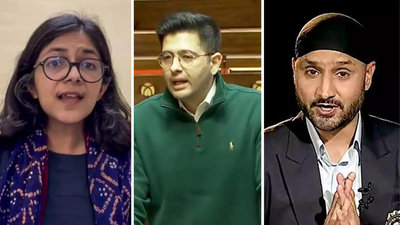
NEW DELHI: Rajya Sabha MP Raghav Chadha’s announcement of qutting Aam Aadmi Party and joining Bharatiya Janata Party was not a lone move. It was linked to specific constitutional provisions involving terms such as “two-thirds” and “merger.”“We have decided that we, the 2/3rd members belonging to the AAP in Rajya Sabha, exercise the provisions of the Constitution of India and merge ourselves with the BJP,” he said addressing a press conference.
Here’s why it matters:
If at least two-thirds of the members of a party in the House agree to merge with another party, it is treated as a valid merger and not defection. In such cases, members are not disqualified under the anti-defection law, making this provision crucial in group-level political realignments like the one announced by MPs.Currently, there are 10 MPs in Rajya Sabha from AAP. After this move, two-third, that is, 7 are set to merge with BJP. If this number was any less, those wanting to merge would have to give up their Upper House membership.Hence, if Chadha had quit alone, he would have to give up his Rajya Sabha membership. But that is not the case as the outgoing AAP leader is joined by Swati Maliwal, Harbhajan Singh, Sandeep Pathak, Ashok Mittal, Rajinder Gupta and Vikram Sahni.The anti-defection law, under the Tenth Schedule of the Constitution, is meant to prevent MPs from switching parties after being elected and to maintain stability in Parliament, including the Rajya Sabha. It provides for disqualification if a member voluntarily gives up party membership or votes against the party whip.In Rajya Sabha, the decision on disqualification is taken by the chairman based on a petition from another member. However, the law also includes an exception for mergers, which is where the “two-thirds” condition becomes important.


