
10,000 years carved in stone: Egypt’s 100-meter rock reveals a lost human timeline | World News

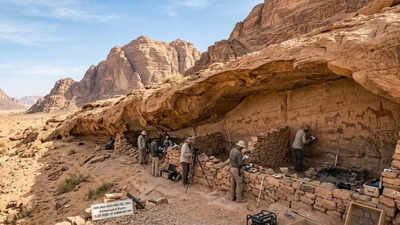
A significant archaeological discovery in Egypt’s Sinai Peninsula has uncovered a vast rock shelter measuring 100 metres long that served as a continual record of humankind’s activities for the past 10,000 years. It is located in proximity to the ancient mining centres of Serabit el-Khadim, where researchers were able to establish an incredible chronology of rock art; from the work of Epipaleolithic hunter-gatherers (approximately early Holocene), through medieval travellers, all the way to today. The archaeological team from Egypt’s Supreme Council of Antiquities discovered many different styles of artwork that were created by these various groups, including iconography depicting animals painted with red pigment and hunting scenes carved into the rock using the technique known as sunken relief.The archaeological shelter also provides evidence of human habitation in the form of structures (such as stone living units, hearths and pottery) that have been dated back to both the Middle Kingdom and Roman times. The significance of this archaeological site is that it provides an unparalleled and uninterrupted window into the adaptive behaviours that multiple cultures have developed within the same geographical location over the span of ten millennia.
Sinai rock art traces human presence from 10,000 BCE to ancient civilisations
Located on the Umm Arak plateau, this rock shelter provides an excellent record of human presence dating back to the beginning of the Holocene, through early-style rock art (painted red silhouettes of animals such as ibexes and wild donkeys), which has been dated by researchers to the period 10,000 to 5,500 BCE, as noted in The Ancient Near East Today. The stratigraphic continuum of these layers extends through the Bronze Age and into the Nabataean period, creating a unique ‘visual library’ of environmental change and cultural evolution in the area.
The shelter’s role in ancient Sinai mining
According to the Archaeology Magazine, the rock shelter measures 100 meters in length, which makes it very advantageous from a strategic perspective to ancient populations who could use the eastern edge of this plateau as a natural lookout place over the plain below, leading to the Tih Plateau. Furthermore, archaeological excavations of this site revealed the presence of stone-built ‘living units’ and multiple layers of ash (hearths), which confirms that this was not only a site of artistic expression but also functioned as a place where miners would live during the time they worked in proximity to the rock shelter.
Changing climate and the rise of Sinai trade routes
Changing climate and politics reflected themselves in changing marks on the cave walls. The later carvings from the late antiquity had not only Nabataean writing but also the image of camels and horses. This indicates that there was now an increase in trade and travel for the people using the cave in the trade area east of Cairo. As noted in Egyptian government records, there were also various ‘Wusum’ (tribal identification) and geometric markings on the rocks at Wadi Batin from the 6th to 15th centuries CE, confirming that medieval traders and Bedouin tribes continued to use this area.


