
2,000-year-old Roman tool discovered in Czech Republic could rewrite ancient engineering history | World News

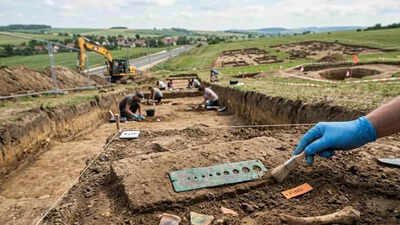
A rare Roman calibration plate was uncovered at Nezamyslice and Kojetín during extensive rescue excavation work connected to the construction of a high-speed railway line. The Archaeological Centre Olomouc (ACO) is conducting rescue excavation work for the project. This extraordinarily well-preserved artefact is believed to have been used to produce wire through the application of wire-drawing techniques. All of the excavation sites have produced over 1,000 archaeological features dated from the Early Bronze Age to the Roman Imperial period. Experts anticipate that this unique tool will provide important insight into ancient manufacturing methods, as well as possibly reveal how Roman legionnaires made their famous chainmail. Current research into the artefact is being performed at the ACO to ascertain its metallurgical composition and to learn about its connection to trade networks in regions outside the formal northern borders of the Roman Empire.
A rare 2,000-year-old Roman metalworking tool uncovered shows advanced technology
The significant discovery of a specialised metalworking calibration plate from the excavated site is of considerable importance in providing evidence of advanced Roman metalworking technology being transmitted or put to use outside of the empire, likely for locally manufacturing or repairing advanced military equipment, such as chainmail, in a region occupied by Germanic tribes, as noted by the Archaeological Centre Olomouc (ACO).
A multi-millennial record of the Haná River valley
The ACO carried out a rescue excavation of the area, which extended over 1.2 kilometres in length as a result of the construction upgrade of the Brno–Přerov railway line, specifically the section of the high-speed railway line from Nezamyslice to Kojetín. In addition to the Roman period tool, the site contained a significant number of remains that demonstrated the history of human occupation in the Haná River valley for thousands of years, and evidence of the Věteřov and Urnfield cultures was discovered at this site. Archaeologists also recorded a diverse range of historical features, including the remains of post-built houses, lime kilns and numerous ritual sites as well.
Mapping economic networks through Bronze Age evidence
The Archaeological Centre Olomouc is now home to all of the artefacts that have been recovered, including calibration plates, stone casting moulds, and crucibles. Due to the large number of items, they are now being prepared for conservation and study. Experts are conducting spectrometric analysis on the calibration plate to look for traces of the materials that the objects may have produced, which might help to show that the item was used to create wire. Researchers are also examining the stone moulds collected during this project and correlating them with the local workshops in order to understand whether or not they were production centres for specialised bronze items, thus creating a better understanding of how ancient communities engaged in larger economic and technological systems.


