
Turkey earthquake mystery: What were the glowing lights seen in the sky? Here’s the truth

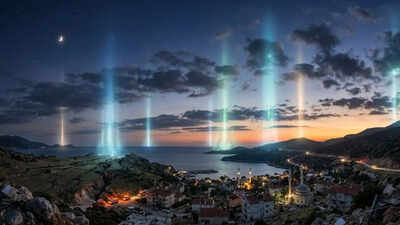
Since the April 2026 earthquake in Turkey, the world has watched in awe as floating lights have appeared following this seismic event. With their origins rooted deeply in folklore, combined with modern geophysical knowledge, these luminous displays can bridge ancient cultural beliefs with new scientific discoveries. While often dismissed as mere optical illusions or UFO sightings, scientists now recognise ‘earthquake lights’ or EQL as rare but real atmospheric phenomena, because they are among the few types of optical events observable in the presence of various tectonic stresses. Generally observed as luminous spheres, vertical beams, or luminous glows over extended periods of time before and/or during extreme movements of the earth’s crust, EQL occur primarily at rift zones where the majority of tectonic stress occurs. This report examines how EQL have transitioned from a myth to being considered an area of scientific investigation while demonstrating how the earth’s internal pressures accumulate to ‘charge’ the atmosphere, producing a silent and luminous atmospheric phenomenon which may occur shortly before or during an earthquake.
What are the floating lights spotted after the earthquake in Turkey
USGS refers to these phenomena as EQL – Earthquake Lights (EQL) – which come in many forms, including sheet lightning, balls of light, streamers, and steady glow. Historically met with scientific scepticism by the scientific community, scientists have now accepted them to be co-seismic or pre-seismic luminous events. Although not all researchers agree on the exact physical mechanisms of EQL, the USGS indicates that most reports of such phenomena come from rift-type environments.
How tectonic pressure powers ‘p-hole’ glows
Research presented via the European Geosciences Union (EGU) describes EQL as caused by electromagnetic precursors. For example, in Turkey, where there is an intense lithospheric stress placed on crustal materials such as igneous-type rocks, stress-activated charge carriers (p-holes) are released when they are subjected to large amounts of stress. When these p-holes travel to the surfaces of these rocks and come into contact with the atmosphere, they create an ionised atmosphere that manifests as a luminous plasma-like discharge.
How satellite sensors track global seismic glows
NASA and other space agencies use satellite sensors to track these changes. There are published scientific papers by URSI (International Union of Radio Science) that describe this process as ‘energetic coupling.’ During an earthquake, there is a massive transient electric potential building up in the Earth’s crust that can couple with the lower atmosphere and the ionosphere. This is what causes the flashes of light, or ‘floating’ lights, documented via global satellite networks and digital observation from the epicentre.
Why 97% of earthquake lights occur at fault lines
According to research published in Seismological Research Letters (available on ResearchGate), approximately 97 per cent of the documented cases of earthquake lights occur at or near rift zone environments, where the Earth’s tectonic plates are separating and producing sub-vertical fault systems. These faults become ‘high-speed conduits’ for the electrical charge generated deep beneath the surface, facilitating the rapid propagation of electromagnetic pulses to the surface during/just before an earthquake and light up the sky.


