
Stage set for Bihar assembly elections 2025 NEW DELHI: The seat-sharing deal for the upcoming 2025 Bihar assembly election revealed a subtle but significant shift in internal power dynamics within the National Democratic Alliance (NDA). For the first time since the early 1990s, the two principal partners — the Janata Dal (United) (JD(U)), led by chief minister Nitish Kumar, and the Bharatiya Janata Party (BJP) — will contest 101 seats each in Bihar’s 243-seat assembly, while the Lok Janshakti Party (Ram Vilas) (LJP(RV)), led by Chirag Paswan, got 29 seats. For the first time, the BJP has secured equal seat-sharing in Bihar, ending the long-standing tradition of Nitish Kumar’s JD(U) playing the “big brother.” This parity between BJP and JD(U) underscores how BJP has shifted from the “junior” to an equal (or perhaps dominant) status in Bihar’s ruling coalition — while continuing to present Nitish as the face of stability.Meanwhile, LJP(RV)’s allocation of 29 seats — though modest in absolute terms — is significantly larger than typical junior-ally shares and includes visibility-rich constituencies: for example, in districts such as Jamui, Hajipur and Khagaria, where Dalit and youth demographics are strong.The logic seems clear: BJP is hedging its bet—maintaining Nitish for his experience and stability, while elevating Chirag as a long-term ally and potentially a future power centre.2020 fallout: When Chirag went soloThe backdrop to this shifting balance lies in the 2020 assembly election. In that election, JD(U) won just 43 seats, down from 71 in 2015 elections. Meanwhile, LJP fielded candidates on its own and acted as a vote-splitter. The result of this vote-cutting was a massive drop in the JD(U)’s seat tally, which fell from 71 seats in 2015 to just 43 seats in 2020. This was the JD(U)’s lowest tally in years and resulted in the party becoming the junior partner to the BJP for the first time in the NDA coalition in Bihar.As Chirag famously declared in October 2020, “I am Prime Minister Modi’s Hanuman… the PM lives in my heart.” His solo campaign was widely seen as an effort to weaken JD(U) while maintaining warmth toward the BJP.Nitish, for his part, responded with restraint. He welcomed the NDA’s overall victory but could not overlook how his party’s reduced tally had shifted the internal arithmetic — paving the way for BJP’s greater influence in coalition decisions.Nitish’s declining arcNitish Kumar’s political journey has been defined by his reputation as “Sushasan Babu” — the administrator who once dominated Bihar’s politics. But by 2020, JD(U)’s footprint had shrunk and its strike rate fell sharply.Now, in 2025, BJP appears to be pursuing a dual strategy: keep Nitish visible as the stabiliser and face of continuity, while also nurturing Chirag as a parallel power centre. For BJP, that solves two problems at once: one, it retains the organisational strength and governance credentials associated with Nitish; two, it prepares for a future in which the LJP’s Dalit-youth base and rising profile may become more central. What’s at stake?For Nitish, the 2025 election is not just about retaining power—it’s about preserving relevance. If JD(U) fails to hold ground, Nitish may become a symbolic leader within his own alliance rather than its fulcrum.For Chirag, the 29-seat allocation marks his political breakthrough. He revealed that his party chose from a “pool of 38 seats” offered by BJP, stressing “quality over quantity.” His negotiation skills were on full display during the seat-sharing talks: engaging in multiple rounds with senior BJP and JD(U) leaders, he held firm until securing favourable terms. As a result, LJP(RV) emerged as the largest junior ally in the NDA. While BJP and JD(U) settled for 101 seats each, smaller allies — Jitan Ram Manjhi’s HAM and Upendra Kushwaha’s RLM — received only six seats apiece.This distribution positions Chirag as a key player in post-poll arithmetic, regardless of how the NDA performs overall.As for the BJP is concerned, the party seems to trying to thread the needle between coalition harmony and long-term dominance. If Nitish remains on board, BJP retains stability; if Chirag’s LJP strengthens, BJP gains leverage and a younger, more dynamic ally with reach into new caste and regional segments.Whether this triangular arrangement can sustain itself through the campaign — and beyond — will test the NDA’s cohesion like never before. Whether Nitish and Chirag truly coexist within the same alliance without their ambitions colliding remains to be seen.About the AuthorTOI News DeskThe TOI News Desk comprises a dedicated and tireless team of journalists who operate around the clock to deliver the most current and comprehensive news and updates to the readers of The Times of India worldwide. With an unwavering commitment to excellence in journalism, our team is at the forefront of gathering, verifying, and presenting breaking news, in-depth analysis, and insightful reports on a wide range of topics. The TOI News Desk is your trusted source for staying informed and connected to the ever-evolving global landscape, ensuring that our readers are equipped with the latest developments that matter most.”Read MoreEnd of ArticleFollow Us On Social MediaVideos’Justin Trudeau Destroyed…’: Ambassador Dinesh Patnaik Questions Safety Of Indians In CanadaA War Cry In Melody: Navy Dedicates Op Sindoor Song To PM During Diwali Celebration on INS Vikrant’Naxal-Maoist Terror Nearly Wiped Out Across India’: PM Modi Hails Police, CRPF, BSF10 Key Facts About Indian Navy’s INS Vikrant, Where PM Modi Celebrated Diwali With Naval Officers’You Gave Sleepless Nights To Pak’: PM Modi Hails INS Vikrant and BrahMos Role in Operation SindoorAyodhya Sets 2 Guinness World Records With Over 26 Lakh Diyas & Largest Saryu Aarti During Deepotsav‘7 Planes Were Shot Down’: Trump Repeats Claim Of Solving India-Pak ‘War’ Using ‘200% Tariff’ ThreatKuala Lumpur’s Little India Bazaar Bursts With Festive Spirit Despite Rising Costs in MalaysiaIndia Upgrades BrahMos Missile Strike Range to 800 Kms, Signals Strategic Shift to Pakistan, China’PM Modi Agreed To Stop Russian Oil’: Donald Trump Issues Harsh Warning To India Over Energy Ties123 Photostories 10 traditional snacks from Italy one needs to tryFrom ‘Vicky Donor’ to ‘Article 15’: Films that prove why ‘Thama’ actor Ayushmann Khurrana is Bollywood’s king of contentAlia Bhatt wore a 30-year-old saree to Kareena Kapoor’s Diwali party and made it 2025’s top festive trendAre you an introvert? 5 smart ways to prepare for an interview without losing yourselfBollywood stars’ best Diwali looks over the years: Alia Bhatt to Allu Arjun, here’s everyone who took desi looks to the next levelFrom Manholes to Machines: Maharashtra Transforms Sewer Cleaning 100 Robotic Sewer-Cleaners, Rs 100 Crore Investment High-Tech Move to End Manual Scavenging (Photos)7 creatures that eat dead animals to keep the ecosystem balanced11 traditional Japanese snacks to try on your next trip to JapanBollywood couples celebrating their first diwali with their newborns: From Parineeti Chopra-Raghav Chadha to Arbaaz Khan-Sshura KhanInside PM Modi’s Diwali celebrations with Navy personnel on INS Vikrant — In pictures123Hot PicksDhanteras Gold PriceVande Bharat SleeperBihar Election 2025Gold rate todaySilver rate todayPublic Holidays OctoberBank Holidays OctoberTop TrendingLauren KyleHow to get Greninjite in Pokemon LegendsAdam SandlerEmiru attackDurgapur Gang RapeLauren KyleDoug Martin Net WorthDaug Martin Cause of DeathChris JonesStephanie Lachances
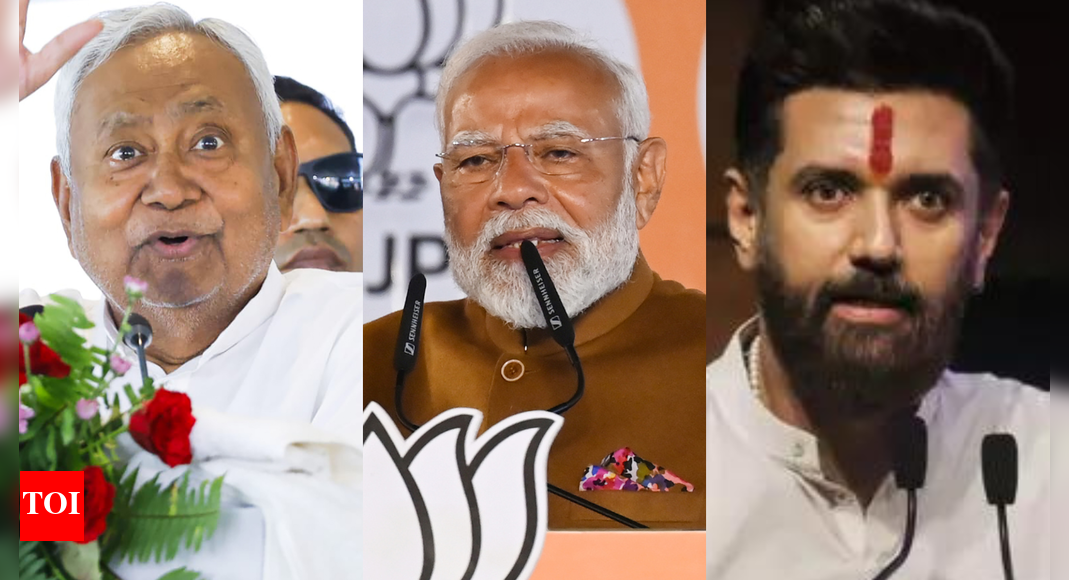
NEW DELHI: The seat-sharing deal for the upcoming 2025 Bihar assembly election revealed a subtle but significant shift in internal power dynamics within the National Democratic Alliance (NDA). For the first time since the early 1990s, the two principal partners — the Janata Dal (United) (JD(U)), led by chief minister Nitish Kumar, and the Bharatiya Janata Party (BJP) — will contest 101 seats each in Bihar’s 243-seat assembly, while the Lok Janshakti Party (Ram Vilas) (LJP(RV)), led by Chirag Paswan, got 29 seats. For the first time, the BJP has secured equal seat-sharing in Bihar, ending the long-standing tradition of Nitish Kumar’s JD(U) playing the “big brother.” This parity between BJP and JD(U) underscores how BJP has shifted from the “junior” to an equal (or perhaps dominant) status in Bihar’s ruling coalition — while continuing to present Nitish as the face of stability.Meanwhile, LJP(RV)’s allocation of 29 seats — though modest in absolute terms — is significantly larger than typical junior-ally shares and includes visibility-rich constituencies: for example, in districts such as Jamui, Hajipur and Khagaria, where Dalit and youth demographics are strong.The logic seems clear: BJP is hedging its bet—maintaining Nitish for his experience and stability, while elevating Chirag as a long-term ally and potentially a future power centre.2020 fallout: When Chirag went soloThe backdrop to this shifting balance lies in the 2020 assembly election. In that election, JD(U) won just 43 seats, down from 71 in 2015 elections. Meanwhile, LJP fielded candidates on its own and acted as a vote-splitter. The result of this vote-cutting was a massive drop in the JD(U)’s seat tally, which fell from 71 seats in 2015 to just 43 seats in 2020. This was the JD(U)’s lowest tally in years and resulted in the party becoming the junior partner to the BJP for the first time in the NDA coalition in Bihar.As Chirag famously declared in October 2020, “I am Prime Minister Modi’s Hanuman… the PM lives in my heart.” His solo campaign was widely seen as an effort to weaken JD(U) while maintaining warmth toward the BJP.Nitish, for his part, responded with restraint. He welcomed the NDA’s overall victory but could not overlook how his party’s reduced tally had shifted the internal arithmetic — paving the way for BJP’s greater influence in coalition decisions.Nitish’s declining arcNitish Kumar’s political journey has been defined by his reputation as “Sushasan Babu” — the administrator who once dominated Bihar’s politics. But by 2020, JD(U)’s footprint had shrunk and its strike rate fell sharply.Now, in 2025, BJP appears to be pursuing a dual strategy: keep Nitish visible as the stabiliser and face of continuity, while also nurturing Chirag as a parallel power centre. For BJP, that solves two problems at once: one, it retains the organisational strength and governance credentials associated with Nitish; two, it prepares for a future in which the LJP’s Dalit-youth base and rising profile may become more central. What’s at stake?For Nitish, the 2025 election is not just about retaining power—it’s about preserving relevance. If JD(U) fails to hold ground, Nitish may become a symbolic leader within his own alliance rather than its fulcrum.For Chirag, the 29-seat allocation marks his political breakthrough. He revealed that his party chose from a “pool of 38 seats” offered by BJP, stressing “quality over quantity.” His negotiation skills were on full display during the seat-sharing talks: engaging in multiple rounds with senior BJP and JD(U) leaders, he held firm until securing favourable terms. As a result, LJP(RV) emerged as the largest junior ally in the NDA. While BJP and JD(U) settled for 101 seats each, smaller allies — Jitan Ram Manjhi’s HAM and Upendra Kushwaha’s RLM — received only six seats apiece.This distribution positions Chirag as a key player in post-poll arithmetic, regardless of how the NDA performs overall.As for the BJP is concerned, the party seems to trying to thread the needle between coalition harmony and long-term dominance. If Nitish remains on board, BJP retains stability; if Chirag’s LJP strengthens, BJP gains leverage and a younger, more dynamic ally with reach into new caste and regional segments.Whether this triangular arrangement can sustain itself through the campaign — and beyond — will test the NDA’s cohesion like never before. Whether Nitish and Chirag truly coexist within the same alliance without their ambitions colliding remains to be seen.


