
Site where Ajit Pawar’s plane crashed MUMBAI: India’s charter aviation sector has grown steadily, filling a crucial gap left by airlines by connecting smaller towns & airports. But industry insiders say safety compliance across non-scheduled operators is uneven and often weaker than airline standards. Implementation of pilots’ flight duty time limits, maintenance standards & weather-related decision-making vary widely between operatorsCharter flying offers speed, flexibility and access to places far beyond an airline’s scheduled network, making it the fastest way to reach remote destinations. But this convenience, which is the very core that defines charter operations, also exposes a fundamental difference in how safety is prioritised. Unlike in airline operations, decisions on whether to operate or land are often taken closer to the cockpit, where passenger urgency and convenience can weigh heavily, sometimes pushing safety to the second place.Ajit Pawar’s Sudden Air Crash Death Sparks Massive Shockwave Across Bollywood and Politics“Non-scheduled flights carry high-net-worth passengers with a fixed objective, an event, a meeting, a function. That creates immense pressure on pilots to land at the intended destination at all costs, even when diversion would be the safer option,” said Capt Manoj Hathi, former senior flight operations inspector at the Directorate General of Civil Aviation (DGCA). Parliament panel on Ajit Pawar’s deathCapt R K Bali of the Business Aircraft Operators Association said India’s non-scheduled aircraft operators have a fleet of about 300 aircraft. “The need of the hour is a pre-flight open, clear communication between pilot and the passenger. The pilot should carry out an objective assessment of the risk involved for a given flight and brief the passenger especially when flying into a small uncontrolled airport with no landing aids in marginal weather conditions. The pilot should be under no duress from anyone to make the landing, because ultimately the buck stops at the pilot”.But that is often not the case. A senior pilot spoke about the pressure the crew comes under. “When a politician travels by road, traffic is stopped, junctions sealed and inconvenience is imposed on everyone else in the name of the VIP safety. When the same politician travels by air, the inconvenience quietly shifts to rest solely on the pilot. A chartered aircraft is expected to get in and get out, often to small airfields and on tight timelines because a meeting, a rally or a public appearance cannot be missed.”Then there are other aspects that influence the safety standards in charter aircraft operations. Unlike scheduled airlines, where pilot flight duty time limitations are tightly monitored and crew can be replaced at short notice, charter operations operate with limited manpower. “There is an expectation that you should be able to fly whenever you want. Passengers are frequently late, and replacement crew are rarely available except at the main base,” said Capt Hathi. Irregular schedules also impact pilot proficiency. Charter pilots often lack the consistency that airline crew benefit from, affecting skill retention and operational discipline. The sector also struggles to retain experienced flight crew. “Many first officers and captains see charter flying as a steppingstone to airlines. Attrition is high. Many captains are older, retired from airlines, or were not selected elsewhere,” said an operator.Capt Hathi said, “Training infrastructure is another weak point. Most non-scheduled operators do not have dedicated training departments comparable to airlines, largely due to cost constraints. Refresher training and procedural updates are often left to self-study. The problem is compounded when operators maintain multiple aircraft types within small fleets, making standardisation of procedures difficult.”Short-notice flights such as medical evacuations or emergency travel add another layer of complexity. “There is often insufficient time for proper briefing or preparation,” said a source. Compounding this, pilots in charter operations are responsible for tasks that airlines distribute across multiple departments. Flight preparation, loading calculations, technical documentation and coordination are often handled solely by pilots, meaning their effective duty begins hours before the recorded reporting time. These factors create a system where compliance depends heavily on individual operators and pilots rather than institutional safeguards as is the case with airlines.About the AuthorManju VManju V, senior Editor at the Times of India in Mumbai writes on civil aviation.End of ArticleFollow Us On Social MediaVideosTrump Announces India-US Trade Deal, Reduces Reciprocal Tariffs On Delhi To 18%; PM Modi ReactsAir India Grounds Dreamliner After Pilot Flags Fuel Control Switch Issue in London-Bengaluru Flight’Nonsense, Lies’: BJP Blasts Rahul Gandhi For Citing Ex-Army Chief Naravane’s Memoir, Oppn Hits BackChina Slams Dalai Lama’s Grammy Win, Calls It Political Manipulation Warns Against Anti-China MovesShowdown In Parliament As Rahul Gandhi Quotes Ex-Army Chief Naravane’s Book on China’Arrogant, Liar’: Bengal CM Mamata Banerjee Attacks CEC Gyanesh After SIR Meet In DelhiPak Analyst Rips Munir Over Trump Minerals Pitch And IMF Loans After US Snubs Pakistan On Pax SilicaBalochistan Crisis: Pakistan-Origin Commentator Takes Apart Islamabad, Exposes Lies On India’India Showed…’: Ex-Army Chief Naravane’s Remarks On Galwan Clash Resurface After Lok Sabha Row’Faster Than BrahMos’: DRDO Calls New Hypersonic Anti Ship Missile A Game Changer For India123Photostories8 baby boy names that are inspired by successful celebritiesFrom Melinda French Gates to Shikhar Dhawan: 5 celebrities whose lives became seemingly better after divorceIs your workplace really toxic or is it you? 5 honest signs to reflect onHow to make South Indian Beetroot and Paneer Paniyaram for breakfast at homeWhy ghosting hurts more than breakups, according to psychology10 best travel ideas for Valentine’s Day 2026 weekend9 comforting amla dishes ideal for winter months10 luxury bikes that blend power, precision, and prestige‘The 50’, ‘Bigg Boss’, ‘Laughter Chef’: Celebrity reality shows that never fail to entertainHrithik Roshan shares his post-workout meal photo and it is plateful of things we all love123Hot PicksBudget 2026Gold Silver PricesCigarette Prices HikeIndia US TradeIncome Tax CalculatorPublic holidays February 2026Bank Holidays februaryTop TrendingSuper Bowl HalftimeMLB Trade RumorsFernando MendozaTom BradyTampa Bay LightningNHL Trade RumorsTop YouTube ChannelsRyan ClarkQuinn HughesJoel Embiid

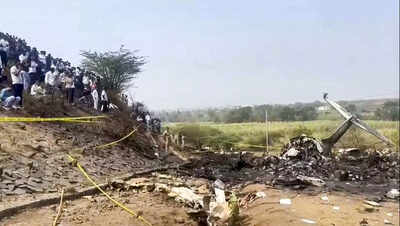
MUMBAI: India’s charter aviation sector has grown steadily, filling a crucial gap left by airlines by connecting smaller towns & airports. But industry insiders say safety compliance across non-scheduled operators is uneven and often weaker than airline standards. Implementation of pilots’ flight duty time limits, maintenance standards & weather-related decision-making vary widely between operatorsCharter flying offers speed, flexibility and access to places far beyond an airline’s scheduled network, making it the fastest way to reach remote destinations. But this convenience, which is the very core that defines charter operations, also exposes a fundamental difference in how safety is prioritised. Unlike in airline operations, decisions on whether to operate or land are often taken closer to the cockpit, where passenger urgency and convenience can weigh heavily, sometimes pushing safety to the second place.
“Non-scheduled flights carry high-net-worth passengers with a fixed objective, an event, a meeting, a function. That creates immense pressure on pilots to land at the intended destination at all costs, even when diversion would be the safer option,” said Capt Manoj Hathi, former senior flight operations inspector at the Directorate General of Civil Aviation (DGCA).
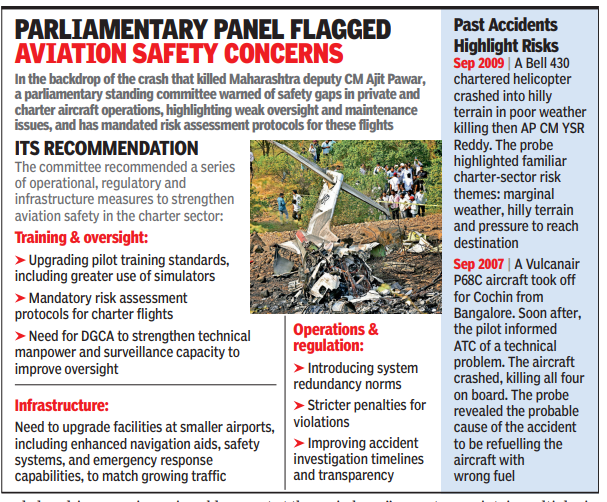
Parliament panel on Ajit Pawar’s death
Capt R K Bali of the Business Aircraft Operators Association said India’s non-scheduled aircraft operators have a fleet of about 300 aircraft. “The need of the hour is a pre-flight open, clear communication between pilot and the passenger. The pilot should carry out an objective assessment of the risk involved for a given flight and brief the passenger especially when flying into a small uncontrolled airport with no landing aids in marginal weather conditions. The pilot should be under no duress from anyone to make the landing, because ultimately the buck stops at the pilot”.But that is often not the case. A senior pilot spoke about the pressure the crew comes under. “When a politician travels by road, traffic is stopped, junctions sealed and inconvenience is imposed on everyone else in the name of the VIP safety. When the same politician travels by air, the inconvenience quietly shifts to rest solely on the pilot. A chartered aircraft is expected to get in and get out, often to small airfields and on tight timelines because a meeting, a rally or a public appearance cannot be missed.”Then there are other aspects that influence the safety standards in charter aircraft operations. Unlike scheduled airlines, where pilot flight duty time limitations are tightly monitored and crew can be replaced at short notice, charter operations operate with limited manpower. “There is an expectation that you should be able to fly whenever you want. Passengers are frequently late, and replacement crew are rarely available except at the main base,” said Capt Hathi. Irregular schedules also impact pilot proficiency. Charter pilots often lack the consistency that airline crew benefit from, affecting skill retention and operational discipline. The sector also struggles to retain experienced flight crew. “Many first officers and captains see charter flying as a steppingstone to airlines. Attrition is high. Many captains are older, retired from airlines, or were not selected elsewhere,” said an operator.Capt Hathi said, “Training infrastructure is another weak point. Most non-scheduled operators do not have dedicated training departments comparable to airlines, largely due to cost constraints. Refresher training and procedural updates are often left to self-study. The problem is compounded when operators maintain multiple aircraft types within small fleets, making standardisation of procedures difficult.”Short-notice flights such as medical evacuations or emergency travel add another layer of complexity. “There is often insufficient time for proper briefing or preparation,” said a source. Compounding this, pilots in charter operations are responsible for tasks that airlines distribute across multiple departments. Flight preparation, loading calculations, technical documentation and coordination are often handled solely by pilots, meaning their effective duty begins hours before the recorded reporting time. These factors create a system where compliance depends heavily on individual operators and pilots rather than institutional safeguards as is the case with airlines.


