
Pandit Ramkishan NEW DELHI: A month ago, Pandit Ramkishan sat on a dharna in Rajasthan, demanding better quality water for his home district, Bharatpur. One of India’s oldest former MPs (he was in Parliament in 1977), he told TOI on Friday, a day before he turned 100, that he will always remain a socialist. “That’s what I learnt from Ram Manohar Lohia.”Sitting in his Bharatpur home, the veteran, “Lohia’s oldest disciple” as he likes to call himself, speaks with the authority of one who has not just witnessed history, but shaped it. Until a recent fall briefly hospitalised him, he was holding three meetings a week.What keeps him going is unfinished work.“The day I stop thinking about a better India, that’s the day I will stop living. Israel Iran WarUS-Israel-Iran War News Live Updates: Blasts reported near Pakistan embassy in Tehran as Israel launches fresh wave of strikesUS-Iran war: India prepares to re-start LNG buys from Russia; seeks Trump admin waiver, says reportMiddle East crisis: Govt levies export duties on diesel, turbine oil; eyes over Rs 1,500 crore collection in fortnightI am alive now and my voice will be heard,” he insists. “The values we fought for — equality, integrity, dialogue — are under strain. We need to speak up.” Aptly named, his autobiography, out last year, said just that — Main Zinda Hoon.First half of life defined by ideology, second has seen its erosion: PanditjiBut why continue agitations that are physically taxing, sitting under the sun, sometimes without food and water, with a failing knee and the weight of a century behind him? “It comes naturally to me,” Pandit Ramkishan says simply.A participant in the Quit India movement of 1942, “and shaped by Lohia and Jayaprakash Narayan”, Panditji, as people call him fondly, was jailed during the Emergency, from which, he says, he came out wiser.Not born into politics, he was a farmer’s son for whom Independence meant “freedom from fear, from ‘lagaan’ and scarcity, and freedom from a system that kept the common man on edge”.He recalls looking for Mahatma Gandhi in his youth. As a student in Bharatpur, he one day travelled to Delhi with a few coins collected among friends, hoping to hear Gandhi speak. Panditji was not impressed. “We had gone looking for revolutionary ideas.”Today, he believes, the idea of freedom itself is unsettled. If the first half of his life was defined by ideology, the second, he says, has seen its erosion. Politics, he argues, has shifted from conviction to convenience.Panditji left the Congress when the socialist bloc split — and never returned. He remembers repeated attempts to bring him over, including offers to head the state of Rajasthan. He refused. “It was difficult — but necessary…opportunity or pressure should never override principle.”So, what are the modern issues he grapples with these days? “Quite a few,” he says. “From problems concerning farmers and Dalits to climate change, unemployment and artificial intelligence.” What unsettles him, though, is “what politics now has lost”. He tells a story. “I was contesting against Union minister Babu Raj Bahadur, who once stopped mid-journey to help me during my campaign when my vehicle broke down. We were fighting elections, but there was no enmity.”Today, he says, the opponent is treated as an enemy, not as part of governance. “Criticism is meant to strengthen democracy — not invite hostility.”Is he hopeful?Panditji pauses. There is pessimism when he speaks of communal polarisation and political opportunism. But also a refusal to give up. “The solution will not come from political parties. It’s the common people who have to understand what affects the country’s progress, and in turn, their own,” he said.About the AuthorIsmat AraAt The Times of India, Ismat Ara covers politics, people, and societies, with a focus on accountability, justice, and lived experience. Shaped by years of rigorous reporting across cities, small towns, and remote villages, she is drawn to the human stories tucked beneath policy and paperwork.Read MoreEnd of ArticleFollow Us On Social MediaVideos’Team India’: PM Modi Meets With CMs, Urges Covid-Like Coordination Amid West Asia CrisisPM Modi Congratulates Balendra Shah On Becoming Nepal PM, Eyes Stronger India-Nepal Ties‘Systemic Victimisation’: India Blasts Munir’s ‘Go To Iran’ Remark, Targets Pakistan On 1971 Denial’Pak Remains In Denial’: India Hits Out Over Op Searchlight Genocide, Backs Dhaka’s Justice Call‘Lockdown Rumours False’: Oil Minister; Centre Slashes Excise Duty On Fuel, Will It Help Consumers?BJP MP Kangana Ranaut Targets Rahul Gandhi, Says ‘Needs Tuition’ Over Economy Claims In ParliamentIndia Signs ₹445 Crore Tunguska Air Defence Deal To Boost Short-Range ProtectionWill Delimitation Change Impact Of Muslim Voters In Assam Election 2026? | Himanta Biswa SarmaIndia Moves To Secure Military Drones With New “Secure-By-Design” Framework“As if Hardeep Puri is giving money from his pocket…”: OPPN STRONG take on fuel excise move123Photostories8 sky events in April 2026 you can’t miss: From a blazing comet to meteor stormsExclusive – The 50: Rajat Dalal opens up on fallout with Prince Narula, says he no longer calls him ‘brother’; reacts to link-up with Chahat PandeyAkshaye Khanna birthday special:‘Dhurandhar’, ‘Chhaava’, ‘Border’, a look at his best performances5 sacred flowers of Goddess Lakshmi you must grow at home to attract wealth and prosperityHow to make Soy and Mushroom Fried Rice for dinner at home5 famous modern-day princesses, from Sheikha Mahra to Kate MiddletonAlmost 50% of Indians have vitamin B12 deficiency: Top foods for vegetarians and non-vegetarians to boost energy and avoid long-term health risks5 off-road cars designed for extreme conditions5 island destinations to visit in summer, and why they shouldn’t be skipped5 beautiful relationship lessons to learn from Priyanka Chopra and Nick Jonas123Hot PicksStock Market TodayDonald TrumpIran Strike on IsraelUS Iran WarIncome Tax CalculatorPublic holidays April 2026Bank Holidays AprilTop TrendingTiger Woods CrashJill BidenH-1B lotteryVanathi SrinivasanMirwaiz Umar FarooqZojila Pass avalancheNoelia CastilloUS travel advisoryAnti-vaccine rowH-1B visa

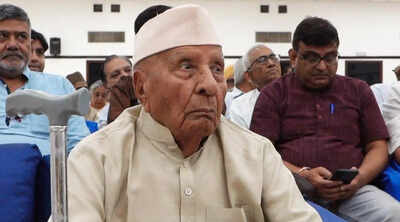
NEW DELHI: A month ago, Pandit Ramkishan sat on a dharna in Rajasthan, demanding better quality water for his home district, Bharatpur. One of India’s oldest former MPs (he was in Parliament in 1977), he told TOI on Friday, a day before he turned 100, that he will always remain a socialist. “That’s what I learnt from Ram Manohar Lohia.”Sitting in his Bharatpur home, the veteran, “Lohia’s oldest disciple” as he likes to call himself, speaks with the authority of one who has not just witnessed history, but shaped it. Until a recent fall briefly hospitalised him, he was holding three meetings a week.What keeps him going is unfinished work.“The day I stop thinking about a better India, that’s the day I will stop living. I am alive now and my voice will be heard,” he insists. “The values we fought for — equality, integrity, dialogue — are under strain. We need to speak up.” Aptly named, his autobiography, out last year, said just that — Main Zinda Hoon.
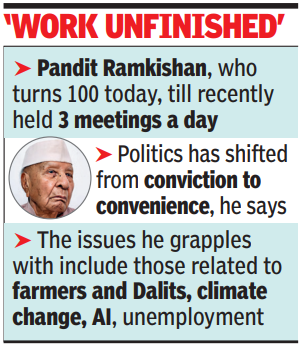
First half of life defined by ideology, second has seen its erosion: PanditjiBut why continue agitations that are physically taxing, sitting under the sun, sometimes without food and water, with a failing knee and the weight of a century behind him? “It comes naturally to me,” Pandit Ramkishan says simply.A participant in the Quit India movement of 1942, “and shaped by Lohia and Jayaprakash Narayan”, Panditji, as people call him fondly, was jailed during the Emergency, from which, he says, he came out wiser.Not born into politics, he was a farmer’s son for whom Independence meant “freedom from fear, from ‘lagaan’ and scarcity, and freedom from a system that kept the common man on edge”.He recalls looking for Mahatma Gandhi in his youth. As a student in Bharatpur, he one day travelled to Delhi with a few coins collected among friends, hoping to hear Gandhi speak. Panditji was not impressed. “We had gone looking for revolutionary ideas.”Today, he believes, the idea of freedom itself is unsettled. If the first half of his life was defined by ideology, the second, he says, has seen its erosion. Politics, he argues, has shifted from conviction to convenience.Panditji left the Congress when the socialist bloc split — and never returned. He remembers repeated attempts to bring him over, including offers to head the state of Rajasthan. He refused. “It was difficult — but necessary…opportunity or pressure should never override principle.”So, what are the modern issues he grapples with these days? “Quite a few,” he says. “From problems concerning farmers and Dalits to climate change, unemployment and artificial intelligence.” What unsettles him, though, is “what politics now has lost”. He tells a story. “I was contesting against Union minister Babu Raj Bahadur, who once stopped mid-journey to help me during my campaign when my vehicle broke down. We were fighting elections, but there was no enmity.”Today, he says, the opponent is treated as an enemy, not as part of governance. “Criticism is meant to strengthen democracy — not invite hostility.”Is he hopeful?Panditji pauses. There is pessimism when he speaks of communal polarisation and political opportunism. But also a refusal to give up. “The solution will not come from political parties. It’s the common people who have to understand what affects the country’s progress, and in turn, their own,” he said.


