
Iran issues US troops will be ‘set on fire’ warning; Pakistan to hosts talk to end war: 10 things to know

Pakistan is preparing to host negotiation talks between the United States, Iran and Israel after a month of war marked by military escalation, diplomatic backchannels and competing claims of progress toward a ceasefire. Islamabad has emerged as a potential mediator, even as Iran hardened its rhetoric against possible US ground operations and President Donald Trump claimed negotiations were advancing.Meanwhile, Iran’s parliament speaker Mohammad Bagher Qalibaf dismissed the proposed talks in Pakistan as a cover following the arrival of around 2,500 US Marines trained in amphibious landings in the Middle East. He accused the United States of sending messages about possible negotiations while simultaneously preparing to deploy troops, adding that Tehran was ready to respond if US soldiers were deployed. At the same time, Donald Trump said Washington was negotiating with Iran both directly and indirectly.Speaking to reporters aboard Air Force One, Trump said Iran has given the United States a “tribute” of 20 oil tankers that are expected to begin crossing Monday morning through the Strait of Hormuz. He also claimed that there have already been two “regime changes” in Iran, adding that the members of both the first and second regimes are all dead, while the third regime has been “very reasonable.” More than 3,000 people have been killed so far in the conflict, which began with US and Israeli strikes on Iran and spiralled into retaliatory attacks across the region. The war has disrupted global energy markets, threatened key shipping routes and widened into multiple theatres, including Lebanon and the Red Sea.
Pakistan steps in as mediator amid silence from US, Iran
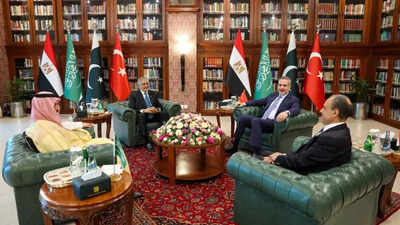
Pakistan announced it will host talks between the US and Iran, positioning itself as a diplomatic bridge between the two adversaries. Foreign Minister Ishaq Dar said, “Pakistan is very happy that both Iran and the US have expressed their confidence in Pakistan to facilitate the talks. Pakistan will be honoured to host and facilitate meaningful talks between the two sides in the coming days.”The announcement followed meetings in Islamabad involving regional powers including Turkey, Egypt and Saudi Arabia. Egypt’s foreign minister indicated the effort aims at opening a “direct dialogue” between Washington and Tehran.However, there has been no official confirmation from either the US or Iran, and it remains unclear whether the talks would be direct or conducted through intermediaries. Pakistan’s emergence follows weeks of quiet diplomacy, leveraging its ties with both sides.
Iran dismisses talks, warns US troops would be targeted
Even as mediation efforts gathered pace, Iran publicly rejected the premise of negotiations under pressure. Parliament Speaker Mohammad Bagher Qalibaf dismissed the proposed talks in Pakistan as a cover for US military deployment.He said Iranian forces were “waiting for the arrival of American troops on the ground to set them on fire and punish their regional partners forever.”Iran also escalated threats, warning it could target homes of US and Israeli officials in the region. Military spokesperson Ebrahim Zolfaghari cited attacks on Iranian residential areas as justification for retaliation.
Ground situation worsens as strikes intensify across region
On the battlefield, hostilities continued to intensify. Israel expanded its military operations in Lebanon, with Prime Minister Benjamin Netanyahu announcing plans to widen the invasion and extend a security buffer zone targeting Hezbollah.In Iran, Israeli airstrikes hit Tehran, with over 120 munitions dropped on sites linked to weapons development. Power outages were reported before being partially restored.The conflict has displaced over a million people in Lebanon. Civilians continue to bear the brunt, with one displaced resident describing Israel as “an expansionist state.”Meanwhile, Iranian-backed Houthi rebels entered the conflict, launching missiles and drones toward Israel and threatening shipping routes near the Red Sea.
Strait of Hormuz tensions shake global energy markets
The strategic Strait of Hormuz has emerged as a critical flashpoint. Iran’s control over the passage has rattled global oil and gas supplies, while disruptions have spread to air travel and fertiliser markets.Iran signalled limited de-escalation by allowing select vessels to pass through the strait. Pakistani-flagged ships were among those permitted, seen by some analysts as a diplomatic signal amid ongoing tensions.At the same time, the risk of further escalation remains high, especially with the Houthis threatening the Bab el-Mandeb strait, another crucial global shipping route.
Iran proposes alternative peace terms, rejects US framework
Diplomatically, both sides appear far apart. The US has proposed a 15-point ceasefire plan, but Iran has rejected it and instead floated a five-point proposal.According to Iranian state media, Tehran’s plan includes halting the killing of Iranian officials, guarantees against future attacks, reparations, and recognition of Iran’s sovereignty over the Strait of Hormuz.Iran has also publicly dismissed negotiating under coercion, signalling that talks, if any, would require significant concessions from Washington.
Trump claims progress, signals oil flow deal from Air Force One
Speaking aboard Air Force One, Donald Trump struck an optimistic tone on negotiations, even as he issued stark warnings.He said Iran had agreed to allow 20 oil tankers through the Strait of Hormuz “out of a sign of respect.”“I would only say that we’re doing extremely well in that negotiation but you never know with Iran because we negotiate with them and then we always have to blow them up,” Trump said.He added that Iran had responded to the US ceasefire proposal, saying, “They gave us most of the points. Why wouldn’t they?”“They’re agreeing with us on the plan,” Trump said, though he did not provide details.
Trump claims ‘regime change’ in Iran amid war
Trump also suggested that the conflict had reshaped Iran’s leadership structure.“I think we’ll make a deal with them, pretty sure…but we’ve had regime change,” he said.“We’re dealing with different people than anybody’s dealt with before. It’s a whole different group of people. So I would consider that regime change.”He further claimed that Iran’s Supreme Leader Mojtaba Khamenei “may be alive but he’s obviously, very seriously in trouble. He’s seriously wounded.”
Civilian fear and displacement mount across conflict zones
On the ground, fear among civilians continues to grow. In Iran, residents described relentless airstrikes and uncertainty.“We don’t know at what moment our homes could be targeted,” said Razzak Saghir al-Mousawi, who fled to Iraq. “I am definitely afraid.”The humanitarian toll is rising across multiple countries, with displacement, infrastructure damage and shortages of essentials worsening conditions.
Regional powers push for guarantees and de-escalation
Gulf countries have called for security guarantees as part of any peace deal. UAE adviser Anwar Gargash said any settlement must ensure that Iranian attacks on neighbouring countries are not repeated.He described Iran as “the main threat” to regional security and called for compensation for civilian infrastructure damage.
War expands beyond battlefield into cyber and economic fronts
Beyond conventional warfare, the conflict is also playing out digitally and economically. Cyber operations have intensified, while sanctions and supply disruptions continue to strain global markets.With multiple actors involved and no clear breakthrough yet, the conflict remains fluid, with diplomacy and escalation unfolding simultaneously.


