
How China’s deepest sinkhole formed its own microclimates

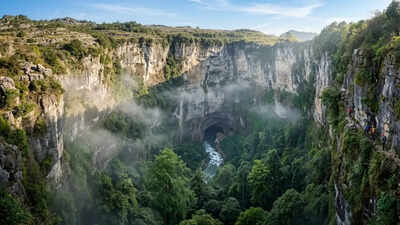
China’s incredible ‘Heavenly Pits’ (also called Tiankeng) are the result of carbonate bedrock dissolved over time by underground water. As these underground rivers carved large caves, they finally collapsed, creating vertical chasms, or giant dolines, 500 to 600 meters deep. These areas are like giant greenhouses – they trap heat and moisture so that the climate is stable and humid. The absence of outside winds, along with extreme temperature changes from day to night, provides a perfect environment for ancient forests, as well as a unique type of biodiversity. According to the scientific community and UNESCO, the deep karst landscape provides a ‘thermal buffer,’ allowing many rare species to thrive in distinct primitive ecosystems that act as prehistorical biological refuges.
How China’s deepest sinkhole formed its own microclimates
According to the research paper published on ResearchGate, with such great depth and verticality, ‘Heavenly Pits’ like the Xiaozhai Tiankeng create a semi-isolated physical barrier that maintains a ‘thermal buffer’ due to the constant temperature differential between the cooler summer/warmer winter bottom and the air outside. Furthermore, the enormous depressions also hold humidity created by the underground river systems that run through them. Their deep, enclosed structure allows them to operate like naturally occurring, self-sustaining greenhouses with stable environments, regardless of what is happening in the atmosphere outside them.Tiankengs are formed through ‘collapse-type’ formation of karst through the slow dissolution of carbonate rock (mostly limestone) by powerful underground rivers that run through the area over thousands of years, creating enormous underground voids. When the roof of one of these voids loses its structural integrity due to prolonged erosion or tectonic uplift, it collapses, resulting in a vertical cave that exceeds 500 meters deep, as noted on the UNESCO World Heritage Centre.
How the pits guard ancient life
Sinkholes are also known as ‘evolutionary islands’ or biological refugia because they are isolated from other habitats by sheer vertical cliffs and significant depth. More than 1,200 species of animal and plant life have been found in sinkholes, including more primitive forms such as ginkgo trees and some rare animal species, including the Chinese giant salamander.
Safeguarding the world’s lost species
According to the Journal of Karst Mountain Sinkhole, many of the species that exist in sinkholes have either gone extinct or been significantly altered in the exterior world due to the effects of climate change or human activity. These unique ecosystems preserve species that have been devastated by climate change or have been significantly altered to meet human needs or desires.
How trapped air feeds giant forests
Air quality within a Tiankeng is much different from the air above it. The dense vegetation and the fact that every sinkhole has a significant source of moisture (usually from internal waterfalls and rivers) create an atmosphere with a large quantity of negative oxygen ions and a very high level of humidity from the constant presence of moisture. This stable micro-atmosphere prevents soil erosion and allows the growth of massive trees (some over 40 meters tall) that are shielded from the destructive winds found on the plateau surrounding the Tiankeng.


