
Foreign brokerages cut India Inc’s earnings, index targets


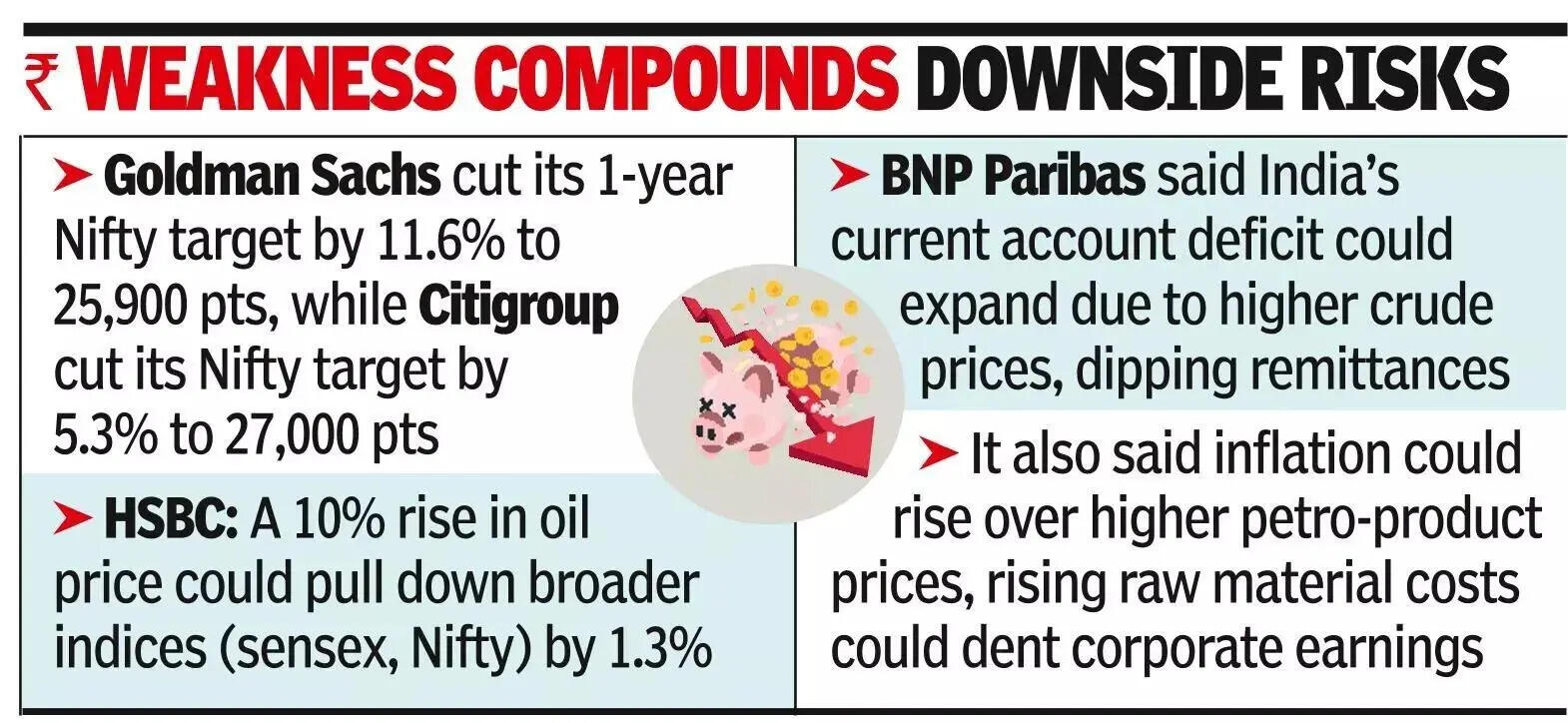
MUMBAI: Thanks to the war in West Asia and the ensuing oil price-led shock that the Indian economy is currently facing, top foreign brokerages and analysts have cut earnings estimates for India Inc as well as targets for Nifty by nearly 12%. They also warned that if the war continues for long and the oil price surges to a new all-time peak, the impact on the economy and the market could be severe.Foreign broking major Goldman Sachs has cut the Nifty target to 25,900 points from 29,300 points earlier while Citigroup has revised down their target for the index to 27,000 points from 28,500 points earlier. On its part, HSBC said that historical trend shows that a 20% rise in oil price could drag down earnings of India Inc by 1.3 percentage points. Since the war started crude oil prices are up about 50-55%.
Rs weakness compounds
Goldman Sachs downgraded India to ‘market weight’ from ‘overweight’ on a less attractive risk-reward matrix compared to some of the other Asian markets, amid worsening macro and slowing earnings growth, a note from the financial services major said. Analysts expect India Inc would show earnings growth of 8% in 2026 and 13% in 2027. “We see risks tilted to the downside in the next three to six months, as we think the market may not be pricing in the full extent of earnings cuts. (The potential) upside catalysts include earlier-than-assumed resumption of oil flows, and a clear recovery in India’s earnings cycle.”In its report, HSBC said that data shows a 10% supply-driven rise in oil price has led to about a 1.3% decline in the broader Indian equity index, with consumer discretionary, tech services, and financials typically more exposed. “The risk gets compounded by currency weakness: A 1% (rupee) depreciation tends to translate into a further 1% market drag. These relationships are broadly consistent with recent performance: oil has risen about 55% since the outbreak of the conflict, while the (rupee) has depreciated about 3.5%, this implies an overall market impact of around 11%.”The BNP Paribas report said that “A 10% increase in oil price leads to about 35 basis points (bps) rise in current account deficit (CAD).” It also noted that with the war continuing, remittances from West Asia could slow down, further impacting CAD.


