
File photo- Chabahar port New Delhi: As bombs fall and sanctions bite across West Asia, Iran has said its economic engagement with India will remain steady during the war and grow faster once conditions stabilise. Iran’s ambassador to India, Mohammad Fathali, indicated to TOI that wartime disruptions are “mere speed bumps” and that Tehran’s “outlook on the future of Iran-India economic relations—even during wartime and especially in the post-war period—remains positive and expansive”. Fathali said, “Economic cooperation between our two nations is built on mutual interests and trust, and there is significant potential for further development.” Placing spotlight on the Chabahar Port project, he added it is a key project in this relationship. “In this regard, the Chabahar Port, as a strategic project, plays a key role in strengthening trade and transit links between Iran, India, and the region,” he said. Watch ‘Chabahar Port Symbol Of…’: Iranian Envoy Fathali’s Strong Message On India-Iran Partnership Positioned on Iran’s southeastern coast, Chabahar has long been New Delhi’s strategic bypass to landlocked Afghanistan and Central Asia, sidestepping Pakistan’s choke points, which does not allow overland transit for Indian goods. Al-Biruni, the 10th-century Persian scholar and writer, described the coastal area near the town of Chabahar, then known as Tiz or Tis, as the “entry point or beginning of coastal India” in his Kitab Tarikh Al-Hind (A History of India).For Tehran, the port is a lifeline to global reintegration, countering decades of Western isolation. Fathali, emphasizing its regional pivot, said: “We believe Chabahar can become a vital hub connecting Central Asia to open waters.”The Chabahar Port project dates back to the 1970s, when Iran’s last Shah, Mohammad Reza Pahlavi, proposed it as a deep-sea hub in the Gulf of Oman. During the Islamic revolution of 1979 in Iran and subsequent leadership transitions, work on the project slowed down. In the 1980s, when the Iran-Iraq War left Iran’s Persian Gulf routes vulnerable, Iran doubled up its focus to shift its trade and expand Chabahar.When India entered a conversation to develop the port around 2003, it mainly meant access to Afghanistan and Central Asia bypassing Pakistan. But it was also in response to the initial construction in Pakistan’s Gwadar, under Beijing’s flagship $62-billion China-Pakistan Economic Corridor (CPEC).The partnership was formalised in 2015 with an MoU, with India committing up to $500 million during PM Narendra Modi’s 2016 visit to Tehran. The pact, renewed for 10 years in 2024 (earlier renewed annually), promises India a direct maritime-land corridor to Central Asia and beyond—vital for trade in minerals, grains, and energy.Through Chabahar, goods can be shipped from Indian ports to Iran and then transported by road and rail further inland, and into Russia, Central Asia, Europe.India has invested in port equipment and operations, while Iran has worked on expanding connectivity from the port to its internal transport network. Progress has been uneven due to sanctions on Iran and delays in infrastructure development.In the port’s current phase, India committed over $350+ million in core investment as well as credit lines including for equipment, berths, and the proposed next phase involves additional berths and rail connectivity, and is estimated to require additional funds. The Iranian envoy’s statement lands at a knife-edge moment when India is weighing its options under US sanctions on Iran. A waiver deadline on April 26, 2026, is approaching.Amid continued uncertainty in the regional security environment, Fathali’s remarks indicate optimism and assurance that the project will remain on track despite ongoing geopolitical tensions and gather pace after it ends.About the AuthorIsmat AraAt The Times of India, Ismat Ara covers politics, people, and societies, with a focus on accountability, justice, and lived experience. Shaped by years of rigorous reporting across cities, small towns, and remote villages, she is drawn to the human stories tucked beneath policy and paperwork.Read MoreEnd of ArticleFollow Us On Social MediaVideosDRDO Begins Work On Next-Generation Missile To Replace Prithvi Series : Reports“Adani Is BJP’s Financial Structure”: Rahul Gandhi Tears Into PM ModiPakistan To Return $3.5 Billion UAE Debt In April Despite Reserve StrainOil India Posts Record Crude Output From Rajasthan’s Thar Desert Amid West Asia Crisis‘True Friendship’: Iran Envoy Lauds India Ties, Clarifies Deleted Thank You PostsPM Modi Assures No Seat Cut For Southern States, Pushes Women’s Quota Bill‘Will Take It To Kolkata’: Pak Minister Khawaja Asif’s Fresh Threat After Rajnath’s Stern WarningBig Reveal: ISI Behind Chandigarh Attack, Global Terror Links Surface”Living In Fear”: Indian Family In Bahrain Amid Escalating Iran War‘Genius Move’: Ex-US Pilot Hails India’s Ploy To Use Rafale Decoys In Op Sindoor To Fool Pakistan123PhotostoriesFSSAI shares how much oil you should consume in a day and effective steps to track oil intake; easy zero-oil dishes insideMeet 5 Indian singers who are setting the nation’s hottest fashion trendsTop K-pop songs from the most romantic K-dramas: ‘Goblin’, ‘Descendants of the Sun’ and moreYou don’t have diabetes, but your blood sugar may still be unstable: What to watch and how to fix itTop 5 premium localities in Greater Noida attracting affluent buyers and long-term investorsIs clay pot (matka) water safe? 5-step cleaning tips & summer benefits of matka waterFrom Carmen Electra to Eddie Murphy: Looking back at the most shocking short-lived celebrity weddingsBest Angelina Jolie movies of all time: ‘Girl, Interrupted’, ‘Maleficent’ and moreShiney Ahuja, Rimi Sen to Uday Chopra : The 2000s Bollywood faces who faded away from the big screenBefore age 10, these 12 simple things parents say can shape a child’s confidence and emotional strength for life123Hot PicksIPL ScoreUpdated IPL Points TableApp Leader Raghav ChadhaLPG ShortageStephen CurryPublic holidays April 2026Bank Holidays AprilTop TrendingYesterday IPL match resultVaibhav SooryavanshiStrait of HormuzIPL 2026Saudi Arabia travel ban rulesToll PaymentIran Drone StrikeHailee SteinfeldSchool Holidays in AprilIran war news

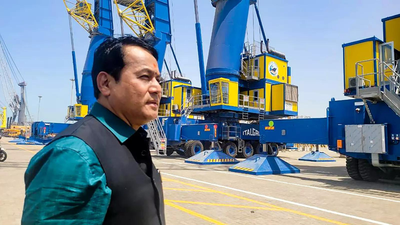
New Delhi: As bombs fall and sanctions bite across West Asia, Iran has said its economic engagement with India will remain steady during the war and grow faster once conditions stabilise. Iran’s ambassador to India, Mohammad Fathali, indicated to TOI that wartime disruptions are “mere speed bumps” and that Tehran’s “outlook on the future of Iran-India economic relations—even during wartime and especially in the post-war period—remains positive and expansive”. Fathali said, “Economic cooperation between our two nations is built on mutual interests and trust, and there is significant potential for further development.” Placing spotlight on the Chabahar Port project, he added it is a key project in this relationship. “In this regard, the Chabahar Port, as a strategic project, plays a key role in strengthening trade and transit links between Iran, India, and the region,” he said.
Positioned on Iran’s southeastern coast, Chabahar has long been New Delhi’s strategic bypass to landlocked Afghanistan and Central Asia, sidestepping Pakistan’s choke points, which does not allow overland transit for Indian goods. Al-Biruni, the 10th-century Persian scholar and writer, described the coastal area near the town of Chabahar, then known as Tiz or Tis, as the “entry point or beginning of coastal India” in his Kitab Tarikh Al-Hind (A History of India).For Tehran, the port is a lifeline to global reintegration, countering decades of Western isolation. Fathali, emphasizing its regional pivot, said: “We believe Chabahar can become a vital hub connecting Central Asia to open waters.”The Chabahar Port project dates back to the 1970s, when Iran’s last Shah, Mohammad Reza Pahlavi, proposed it as a deep-sea hub in the Gulf of Oman. During the Islamic revolution of 1979 in Iran and subsequent leadership transitions, work on the project slowed down. In the 1980s, when the Iran-Iraq War left Iran’s Persian Gulf routes vulnerable, Iran doubled up its focus to shift its trade and expand Chabahar.When India entered a conversation to develop the port around 2003, it mainly meant access to Afghanistan and Central Asia bypassing Pakistan. But it was also in response to the initial construction in Pakistan’s Gwadar, under Beijing’s flagship $62-billion China-Pakistan Economic Corridor (CPEC).The partnership was formalised in 2015 with an MoU, with India committing up to $500 million during PM Narendra Modi’s 2016 visit to Tehran. The pact, renewed for 10 years in 2024 (earlier renewed annually), promises India a direct maritime-land corridor to Central Asia and beyond—vital for trade in minerals, grains, and energy.Through Chabahar, goods can be shipped from Indian ports to Iran and then transported by road and rail further inland, and into Russia, Central Asia, Europe.India has invested in port equipment and operations, while Iran has worked on expanding connectivity from the port to its internal transport network. Progress has been uneven due to sanctions on Iran and delays in infrastructure development.In the port’s current phase, India committed over $350+ million in core investment as well as credit lines including for equipment, berths, and the proposed next phase involves additional berths and rail connectivity, and is estimated to require additional funds. The Iranian envoy’s statement lands at a knife-edge moment when India is weighing its options under US sanctions on Iran. A waiver deadline on April 26, 2026, is approaching.Amid continued uncertainty in the regional security environment, Fathali’s remarks indicate optimism and assurance that the project will remain on track despite ongoing geopolitical tensions and gather pace after it ends.


