
Evacuating the ‘Dudes’: How US pulled off a high-risk rescue of F-15 pilots in Iran

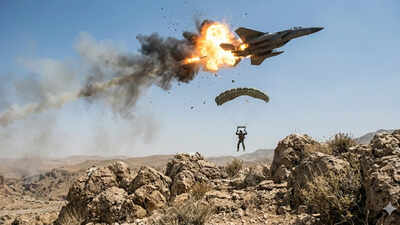
It began before dawn on April 3, when a US Air Force F-15E Strike Eagle, call sign Dude 44, was struck mid-air over Iran. Within minutes, the two crew members ejected into hostile territory, triggering one of the most complex combat search and rescue missions in recent military history.What followed was a two-day, high-risk operation involving hundreds of personnel and nearly 176 aircraft, described by US officials as an “air armada” that penetrated deep into Iranian territory to bring back the stranded airmen, known by their call signs Dude 44A and Dude 44B.
The crash: A ‘lucky hit’ over hostile skies
The aircraft was hit in the early hours by what US President Donald Trump described as a shoulder-fired heat-seeking missile that struck the engine.At 4:40 am local time, the US military confirmed both crew members had ejected safely but were now isolated behind enemy lines. Their emergency beacons were active, but Iranian forces were already searching the area.The downing marked the first loss of a manned US aircraft to enemy fire during Operation Epic Fury.
Phase 1: Saving Dude 44A under heavy fire
Within hours, the US launched its first rescue wave. Around 21 aircraft entered Iranian airspace in broad daylight, flying low and drawing heavy enemy fire.The rescue package included A-10 Warthogs for close air support, HC-130 Combat King II aircraft for refuelling, HH-60 Jolly Green II helicopters for extraction, and drones for surveillance.A-10 pilots carried out “Sandy” missions, placing themselves between the survivor and advancing enemy forces, firing suppressive rounds to keep Iranian troops at bay.Despite intense gunfire, the first rescue team reached Dude 44A, the pilot, and extracted him using a Jolly Green II helicopter. The extraction itself came under heavy fire, with helicopters taking multiple hits and one crew member sustaining minor injuries.“This was an incredibly dangerous mission,” Joint Chiefs Chairman Gen. Dan Caine said, adding that the promise to never leave a soldier behind drove the operation.
Phase 2: The hunt for Dude 44B
The second crew member, Dude 44B, landed miles away in far more dangerous terrain. Injured and alone, he evaded Iranian forces that included the Islamic Revolutionary Guard Corps and local militias.He moved away from his landing site, climbing into mountainous terrain despite heavy bleeding. Using survival training, he treated his wounds and eventually transmitted his location from a concealed position.Iranian forces, meanwhile, launched a massive manhunt, with reports of a bounty placed on his capture.
The deception playbook: Seven locations, one real target
Rescuing Dude 44B required a far larger and more complex operation. According to Trump, nearly 155 aircraft were deployed in the second phase, including bombers, fighters, refuelling tankers, helicopters and drones.A key element was deception.US intelligence, supported by the CIA, created confusion by simulating rescue attempts at multiple locations. Aircraft were deliberately sent to at least seven different sites to mislead Iranian forces.“They said, ‘Well, wait a minute. They’ve got groups here. They’ve got groups there,’” Trump said.Only one location was real.While Iranian forces were diverted, US aircraft descended on the actual extraction zone, engaging hostile elements and clearing the area.
The final extraction: A race against time
The rescue of Dude 44B took place under cover of darkness after nearly 48 hours on the run. US special operations aircraft transported small helicopters to a forward location, assembling them on-site for the mission.Even weather posed a challenge, with aircraft struggling in difficult terrain. Some equipment, including aircraft, had to be destroyed after the mission to prevent it from falling into enemy hands.In what Trump described as “a breathtaking show of skill and precision,” US forces secured the area, reached the WSO’s mountain hideout, and successfully extracted him.
The bigger picture: Scale, risk and message
The operation involved bombers, fighters, drones, helicopters and refuelling aircraft working in coordination across hostile airspace. Some aircraft were hit, one A-10 was lost, and multiple crews operated under direct fire.“The courage demonstrated by both the pilot and the weapon-system officer, while isolated and evading the enemy, cannot be overstated,” Caine said.For nearly two days, Dude 44B remained hidden, injured and alone, relying on training and endurance until rescue forces reached him.
A mission that will ‘go down in the books’
Trump called the operation “one of the largest, most complex, most harrowing combat search and rescue missions ever attempted.”“This is a rescue that’s very historic,” he said. “It’ll go down in the books.”Beyond the scale of firepower and coordination, officials said the mission underscored a core military doctrine: no soldier is left behind.In the end, both Dude 44A and Dude 44B were brought home safely, closing a mission defined by precision, deception, and survival against overwhelming odds.


