
Representative image NEW DELHI: He had no red flags. No “high-risk” tag. By standard medical calculators, he was not the kind of patient doctors worry about. Then came the heart attack — sudden and without warning. Doctors say this is no longer unusual. A major Indian study suggests it may be the norm.In a retrospective analysis of more than 5,000 Indian patients, widely used global heart risk calculators failed to identify most people at risk, with around 80% of those who suffered a first heart attack not flagged as high-risk beforehand. Researchers led by Dr Mohit Dayal Gupta at GB Pant Hospital, Delhi, says Western models miss India-specific risk patterns, often placing patients in low or moderate categories despite underlying danger.Israel Iran War‘A tremendous mistake’: Trump says he’ll cut spending on Nato over Iran war snubStrait Of Hormuz Standoff: Trump pauses Iran strikes; Tehran tightens oil leverageThese models are used by doctors to decide who needs treatment, but the study found they often misclassify risk and sometimes give conflicting results. Across models, only 11%-20% of patients were labelled high-risk, even though all eventually had a heart attack.“Indian patients and population behave totally differently. We have different risk factors, different patterns and hence Western scores may not always be appropriate,” said Dr Gupta.‘80% Of Those Who Suffered First Heart Attack Not Labelled High-Risk’At the core of the problem is a mismatch. Most of these risk calculators were designed using Western populations, where heart disease tends to occur later. In India, it strikes earlier and behaves differently — the study found the average age of patients was just 54, underscoring how premature heart disease has become.Researchers say Indians show a distinct “South Asian phenotype”. Heart risk appears earlier, often with diabetes and insulin resistance even at normal body weight. Cholesterol patterns are misleading — low HDL and high triglycerides, while LDL may not be very high. Many also have hidden abdominal fat despite appearing lean, a risk missed by BMI-based assessments. Smoking and psychosocial stress, along with traditional risk factors like diabetes, smoking and dyslipidemia, further add to this hidden burden.This is why Western risk scores underperform. They rely heavily on age and LDL cholesterol, leading to underestimation in younger Indians. As a result, many patients fall into an “intermediate risk” category — a grey zone that often delays preventive treatment. Crucially, these models ignore key drivers like insulin resistance, lipoprotein(a), ApoB, central obesity and chronic kidney disease.The impact is significant. These scores determine who gets preventive drugs and closer monitoring. When risk is underestimated, intervention often comes only after a major event.The findings have renewed calls for customised risk scores, as Indian populations remain poorly represented in global datasets. Experts say that until such tools are developed, risk calculators must be used alongside clinical judgment, including family history, diabetes, psychosocial stress and early screening.About the AuthorAnuja JaiswalAnuja Jaiswal is a Senior Assistant Editor at The Times of India, with an impressive 18-year career in narrative journalism. She specializes in health and heritage reporting, expertly simplifying complex health information to make it engaging and understandable for readers. Her deep dives into heritage topics are well-researched, resulting in captivating narratives that resonate with her audience. Over the years, she has worked in Chandigarh, Chhattisgarh and West UP, gaining diverse on-ground experience that shapes her storytelling.Read MoreEnd of ArticleFollow Us On Social MediaVideosLearning From Iran War, India Clears Strike Drone Squadrons For Indian Air ForceIndia’s Fourth S-400 System Undergoing Final Trials In Russia, Delivery Expected SoonJag Vasant LPG Vessel Docks At Gujarat Port After Hormuz Passage DelayAdani Delivers 2000 Prahar LMGs Early, Signalling New Speed In India’s Defence Push Forward’Taking Every Step’: PM Modi’s BIG Assurance To Tackle Global Shock Without Hurting CitizensIAF’s Surya Kiran Aerobatic Team Displays India’s Air Power In Stunning Chandigarh Air ShowAmid Tensions, Iran Allows Two Indian LPG Ships Carrying 90,000 MT Fuel To Sail Out Safely’Turned Noida Into ATM For Loot’: PM Modi Blasts Akhilesh Yadav For Delay In Jewar Airport OpeningPakistan’s Terror Links Under Global Lens, US Congressional Report Echoes India’s Claim On TerrorismIndia’s Clears ₹2.38 Lakh Crore Defence Proposals Across Services In Major Procurement Push123PhotostoriesThe love lives of ‘Grey’s Anatomy’: Inside their real-life romancesMomo for dinner: How this can help in reducing inflammation and the right under 20-minute recipe5 countries where euthanasia is legal: Stories of choice, dignity, and debateBroccoli to Dark Chocolate: 6 brain-boosting superfoods for kids to consume daily and the right way to eat themFrom Sania Mirza-Shoaib Akhtar to Sheikha Mahra-Sheikh Mana Al Maktoum: 5 ugly public divorces that shocked the worldLeg cramps, swelling, or heaviness? Doctors decode what your body may be lacking, and simple ways to find reliefCapsicum to Cabbage: 6 vegetables you shouldn’t eat raw and what to do insteadIs everything okay between Kate Middleton and Prince William? Why are they reducing their Royal schedule in AprilPrincess Diana to Grace Kelly: 5 most beautiful royal bridal veils of all time’Harry Potter and the Sorcerer’s Stone’to ‘Harry Potter Deathly Hallows – Part 2’: Plot recap ahead of TV series release123Hot PicksE-chequesIndia-US trade dealNoida International AirportUS Iran WarIncome Tax CalculatorPublic holidays April 2026Bank Holidays AprilTop TrendingTiger Woods CrashBabar AzamH-1B lotteryVaibhav SooryavanshiMadhya Pradesh High CourtRoyal Challengers Bengaluru vs Sunrisers Hyderabad Live ScoreNoelia CastilloUS travel advisoryAnti-vaccine rowH-1B visa


NEW DELHI: He had no red flags. No “high-risk” tag. By standard medical calculators, he was not the kind of patient doctors worry about. Then came the heart attack — sudden and without warning. Doctors say this is no longer unusual. A major Indian study suggests it may be the norm.In a retrospective analysis of more than 5,000 Indian patients, widely used global heart risk calculators failed to identify most people at risk, with around 80% of those who suffered a first heart attack not flagged as high-risk beforehand. Researchers led by Dr Mohit Dayal Gupta at GB Pant Hospital, Delhi, says Western models miss India-specific risk patterns, often placing patients in low or moderate categories despite underlying danger.These models are used by doctors to decide who needs treatment, but the study found they often misclassify risk and sometimes give conflicting results. Across models, only 11%-20% of patients were labelled high-risk, even though all eventually had a heart attack.“Indian patients and population behave totally differently. We have different risk factors, different patterns and hence Western scores may not always be appropriate,” said Dr Gupta.
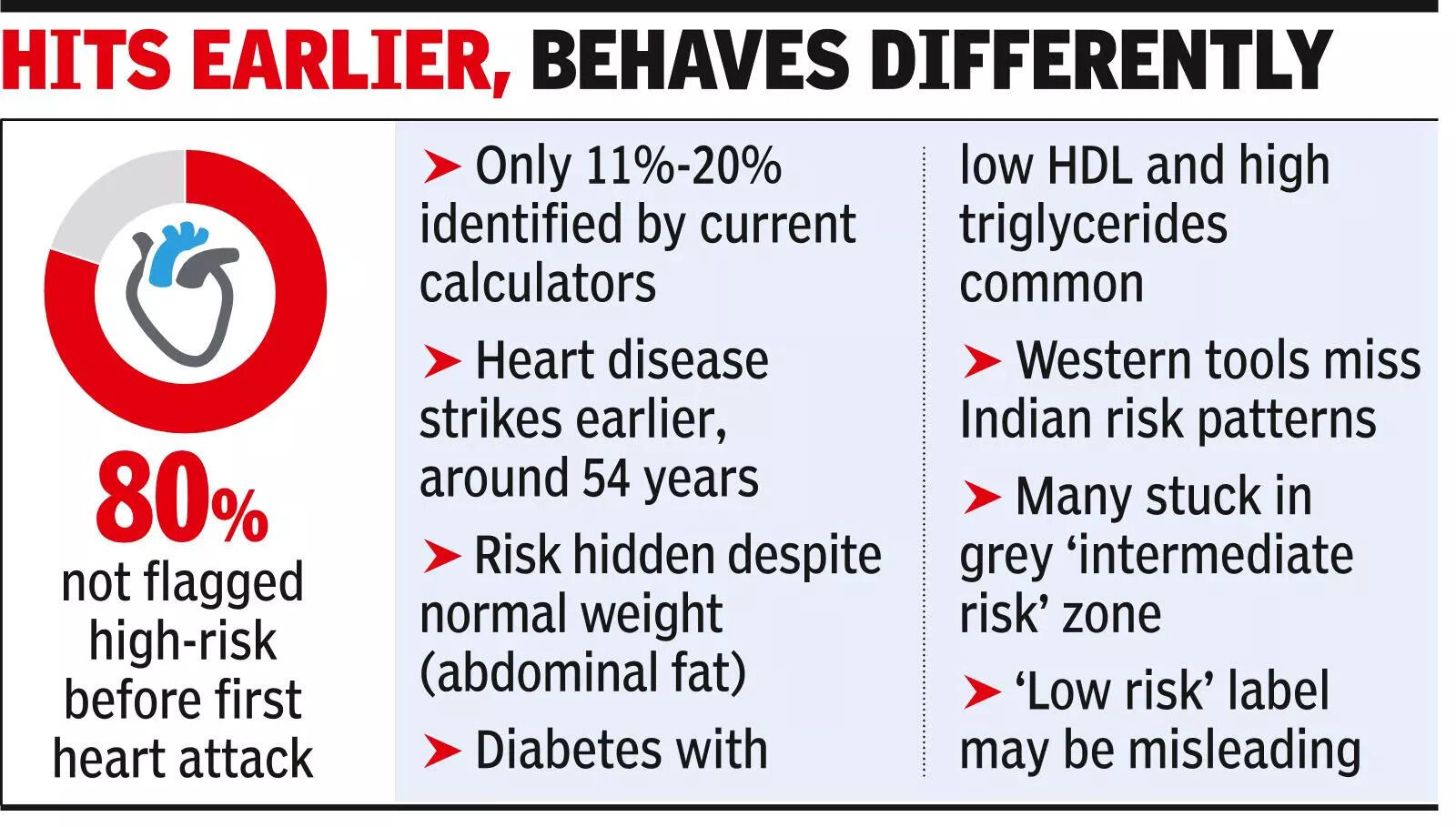
‘80% Of Those Who Suffered First Heart Attack Not Labelled High-Risk’
At the core of the problem is a mismatch. Most of these risk calculators were designed using Western populations, where heart disease tends to occur later. In India, it strikes earlier and behaves differently — the study found the average age of patients was just 54, underscoring how premature heart disease has become.Researchers say Indians show a distinct “South Asian phenotype”. Heart risk appears earlier, often with diabetes and insulin resistance even at normal body weight. Cholesterol patterns are misleading — low HDL and high triglycerides, while LDL may not be very high. Many also have hidden abdominal fat despite appearing lean, a risk missed by BMI-based assessments. Smoking and psychosocial stress, along with traditional risk factors like diabetes, smoking and dyslipidemia, further add to this hidden burden.This is why Western risk scores underperform. They rely heavily on age and LDL cholesterol, leading to underestimation in younger Indians. As a result, many patients fall into an “intermediate risk” category — a grey zone that often delays preventive treatment. Crucially, these models ignore key drivers like insulin resistance, lipoprotein(a), ApoB, central obesity and chronic kidney disease.The impact is significant. These scores determine who gets preventive drugs and closer monitoring. When risk is underestimated, intervention often comes only after a major event.The findings have renewed calls for customised risk scores, as Indian populations remain poorly represented in global datasets. Experts say that until such tools are developed, risk calculators must be used alongside clinical judgment, including family history, diabetes, psychosocial stress and early screening.


