
FSSAI NEW DELHI: When questions are raised about the safety of any food article, India’s food regulator will now ask for proof, not promises. From what a product contains and how much Indians actually eat to whether it’s safe over time, every claim will have to be backed by data to assess its safety. From Jan 1, 2026, Food Safety and Standards Authority of India (FSSAI) has made it mandatory for all submissions seeking a food safety review or changes in food standards to follow a single, standardised format supported by scientific evidence. The move comes after the regulator found that many past requests lacked basic data or a uniform structure, making proper risk assessment difficult. The new rule does not trigger an automatic re-examination of all foods already in the market. It applies only when a stakeholder approaches FSSAI seeking a scientific risk assessment – either for introducing a new product or reviewing an existing one. In such cases, the burden of proving safety will rest with the applicant. Under the new format, submissions must spell out nutritional information, how much Indians consume the product, results of toxicological studies, and evidence on safe intake limits, along with allergy risks and supporting scientific studies. The data will be reviewed by FSSAI’s Science and Standards Division and assessed by expert panels, which will decide whether a product can be cleared, continued, restricted or subjected to tighter limits. Proof needed, not promises Officials say the sharper focus on Indian eating habits is crucial as packaged foods become more common and overseas data may not reflect real exposure. “This is an important step to protect public health. Earlier, many foods were approved using limited or incomplete information. Since Indian food habits, portion sizes and sensitivities are very different from those in other countries, asking for proper proof about long-term safety, how much people eat and possible allergy risks helps make food rules more practical, science-based and safer for Indian consumers,” said Anjali Bhola, dietician at National Cancer Institute, Jhajjar, All India Institute of Medical Sciences. FSSAI has also assured stakeholders that data submitted for risk assessment will be treated as confidential and used only for scientific evaluation and policy decisions. For consumers, the message is simple: when food safety is questioned, evidence will now decide what stays on the plate.About the AuthorAnuja JaiswalAnuja Jaiswal is a Senior Assistant Editor at The Times of India, with an impressive 18-year career in narrative journalism. She specializes in health and heritage reporting, expertly simplifying complex health information to make it engaging and understandable for readers. Her deep dives into heritage topics are well-researched, resulting in captivating narratives that resonate with her audience. Over the years, she has worked in Chandigarh, Chhattisgarh and West UP, gaining diverse on-ground experience that shapes her storytelling.Read MoreEnd of ArticleFollow Us On Social MediaVideosJaishankar To Attend Khaleda Zia’s Funeral In Dhaka Amid Strained India-Bangladesh TiesDRDO Successfully Tests Pinaka Long-Range Guided Rocket In Odisha, To Be Inducted In Indian Army’UPSC Is Complete Waste Of Time’: PM’s Economic Advisor Sanjeev Sanyal On AI Era EducationHindu Guard Killed By Colleague In Bangladesh, Third Death In Days Raises Minority Safety Fears’Deeply Concerned’: PM Modi Reacts To Reports Of Attack On Putin’s House, Ukraine Responds“No Racial Angle”: SSP Rules Out Alleged Slurs in Angel Chakma KillingCongress’ Adhir Ranjan Chowdhury Flags Attacks on Migrant Workers to PM Modi’Will Rid Bengal Of Infiltrators’: Amit Shah Slams Mamata Banerjee’s 14-Year Rule, Sounds Poll BugleFrom Defence To Civil Skies: HAL’s Dhruv-NG Helicopter Takes Flight In India’s Aviation PushJapanese Tourist Harassed in Varanasi on Christmas, Netizens Slam ‘Mob Culture’123Photostories5 iconic New Year markets in the USA that keep the holiday magic alive for long!3 reasons to consume Papaya smoothie and the right way to make it as per AIIMS doctor10 types of Pasta dishes from around the world6 best indoor exercises for people who are planning to build muscle strength‘Dhurandhar’: Saumya Tandon aka Ulfat Hasin Baloch says, ‘Aditya Dhar was always on my wish list’ – Exclusive7 weekly routines common among people who live to 100Healthiest fruits of 2025: These 5 fruits are richest in key nutrientsWhich Hindu Idol You Should Bring Home On January 1, 2026From Osho to Swami Vivekananda – Real names of spiritual leadersWinter Special: How to make Maharashtrian Kala Sukha Mutton for dinner123Hot PicksIndigo flight DisruptionsPAN-Aadhaar link statusKhaleda ZiaGold rate todayIncome Tax RefundBahrain Golden Visa 2025Bank Holidays DecemberTop TrendingErika KirkTravis KelceJEE Advanced RegistrationAnjel ChakmaMumbai Bhandup Bus AccidentRobert Kraft vs Gayle Benson Net WorthMLB Trade RumorsAntonio BrownBengaluru PG BlastWWE Raw Highligths


NEW DELHI: When questions are raised about the safety of any food article, India’s food regulator will now ask for proof, not promises. From what a product contains and how much Indians actually eat to whether it’s safe over time, every claim will have to be backed by data to assess its safety. From Jan 1, 2026, Food Safety and Standards Authority of India (FSSAI) has made it mandatory for all submissions seeking a food safety review or changes in food standards to follow a single, standardised format supported by scientific evidence. The move comes after the regulator found that many past requests lacked basic data or a uniform structure, making proper risk assessment difficult. The new rule does not trigger an automatic re-examination of all foods already in the market. It applies only when a stakeholder approaches FSSAI seeking a scientific risk assessment – either for introducing a new product or reviewing an existing one. In such cases, the burden of proving safety will rest with the applicant. Under the new format, submissions must spell out nutritional information, how much Indians consume the product, results of toxicological studies, and evidence on safe intake limits, along with allergy risks and supporting scientific studies. The data will be reviewed by FSSAI’s Science and Standards Division and assessed by expert panels, which will decide whether a product can be cleared, continued, restricted or subjected to tighter limits.
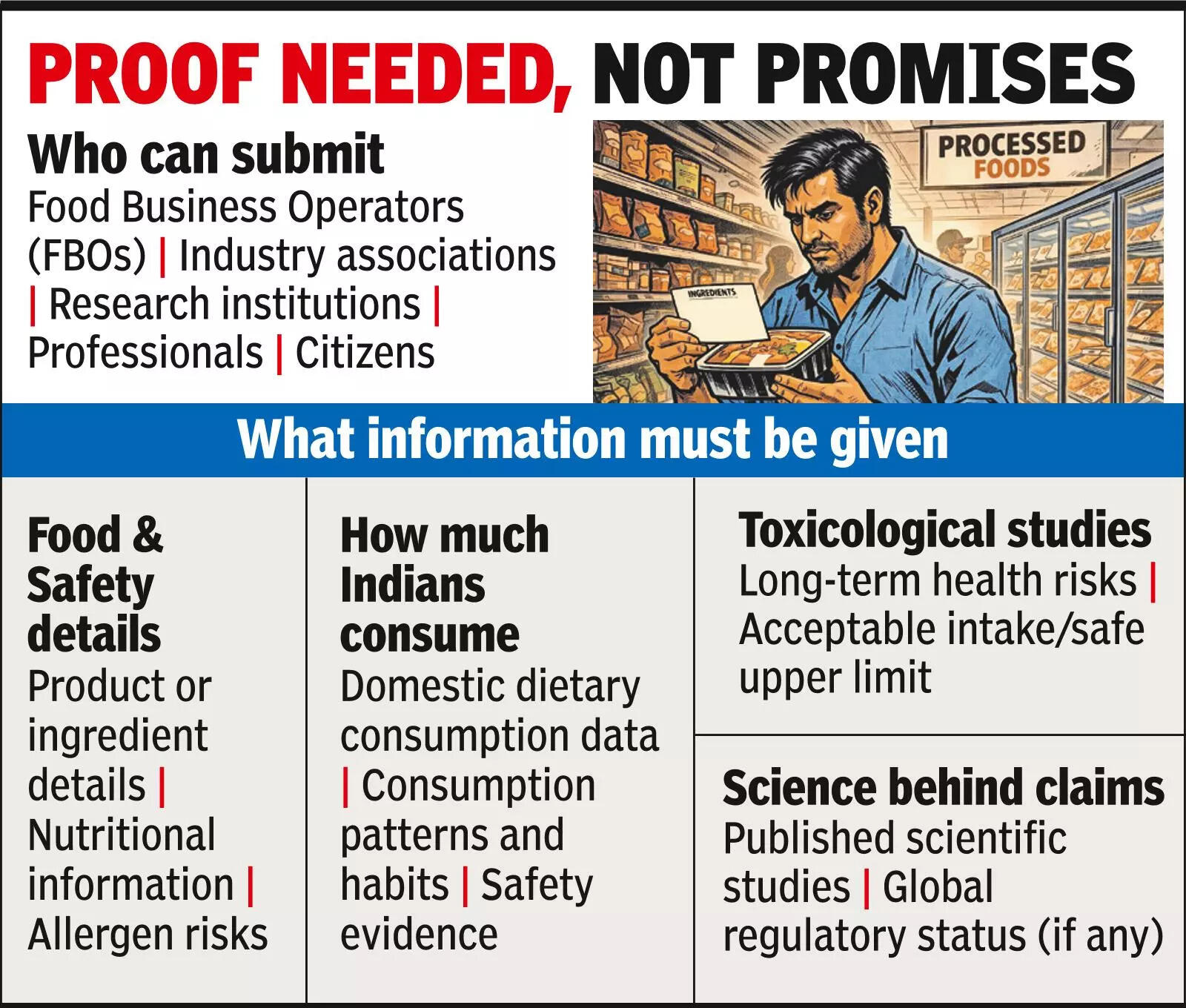
Proof needed, not promises
Officials say the sharper focus on Indian eating habits is crucial as packaged foods become more common and overseas data may not reflect real exposure. “This is an important step to protect public health. Earlier, many foods were approved using limited or incomplete information. Since Indian food habits, portion sizes and sensitivities are very different from those in other countries, asking for proper proof about long-term safety, how much people eat and possible allergy risks helps make food rules more practical, science-based and safer for Indian consumers,” said Anjali Bhola, dietician at National Cancer Institute, Jhajjar, All India Institute of Medical Sciences. FSSAI has also assured stakeholders that data submitted for risk assessment will be treated as confidential and used only for scientific evaluation and policy decisions. For consumers, the message is simple: when food safety is questioned, evidence will now decide what stays on the plate.


