
NEW DELHI: The Indian Navy’s stitched sailing vessel INSV Kaundinya will embark on her maiden overseas voyage on Monday, sailing from Porbandar in Gujarat to Muscat in Oman. The journey will symbolically retrace ancient maritime routes that once connected India with West Asia and the wider Indian Ocean world, testing traditional shipbuilding techniques that predate modern navigation by more than a millennium.The voyage marks a rare operational deployment of a vessel built entirely using ancient stitched-plank technology, with no engine, no metal fastenings and no modern propulsion systems. The ship will rely solely on wind and sails, recreating the conditions under which Indian mariners once undertook long-distance oceanic voyages.A ship built without engines or metal INSV Kaundinya is a non-combat sailing vessel constructed using a shipbuilding technique believed to date back to at least the 5th century CE. Unlike modern naval platforms, the wooden planks of the vessel are stitched together using coir rope made from coconut fibre and sealed with natural resins, cotton and oils to ensure seaworthiness.This stitched construction allows flexibility in the hull, enabling the ship to absorb wave energy rather than resist it rigidly. Such flexibility was crucial for ancient sailors navigating rough seas across the Arabian Sea, the Bay of Bengal and beyond.Inspired by ancient Indian sourcesThe vessel’s design draws inspiration from depictions of ships found in the Ajanta cave paintings, descriptions in ancient Indian texts and accounts left by foreign travellers. With no surviving blueprints, the Indian Navy reconstructed the design through visual interpretation and scientific validation.Hydrodynamic testing and stability studies were conducted with the support of academic institutions, including IIT Madras, to ensure the vessel could safely undertake open ocean voyages despite its ancient design.Dimensions and crewINSV Kaundinya measures approximately 19.6 metres in length and 6.5 metres in width, with a draft of around 3.33 metres. The ship is powered entirely by sails and is crewed by about 15 sailors trained to operate the vessel under traditional sailing conditions.The construction follows the Tankai method, an indigenous Indian shipbuilding practice in which the hull is stitched first and ribs are added later, avoiding the use of metal entirely.A collaborative revival projectThe project was initiated in July 2023 under a tripartite memorandum of understanding between the Ministry of Culture, the Indian Navy and Hodi Innovations, with funding provided by the Ministry of Culture. Traditional artisans from Kerala, led by master shipwright Babu Sankaran, stitched the vessel entirely by hand.The ship was launched in February 2025 and formally inducted into the Indian Navy in May at Karwar in Karnataka, marking a milestone in the revival of indigenous maritime knowledge systems.Cultural symbols on boardINSV Kaundinya carries several motifs associated with India’s maritime and civilisational heritage. These include the Gandabherunda, the two-headed eagle of the Kadamba dynasty, sun motifs on the sails, a Simha Yali mythical lion figure on the bow, and a Harappan-style stone anchor placed on the deck.Each symbol reflects different periods of India’s seafaring past and its long-standing engagement with overseas trade and cultural exchange.Named after a legendary marinerThe vessel is named after Kaundinya, a first-century Indian mariner referenced in Southeast Asian and Chinese records. According to these accounts, Kaundinya sailed to the Mekong Delta, married Queen Soma and helped establish the Kingdom of Funan in present-day Cambodia.The kingdom became one of the earliest Indian-influenced states in Southeast Asia, with later Khmer and Cham dynasties believed to trace their origins to this union. Although Indian records do not mention him, Kaundinya is regarded as the earliest named Indian sailor with a documented global historical impact.Recreating ancient maritime highwaysThe Porbandar to Muscat route was once a vital corridor for trade and cultural exchange. Indian merchants and sailors used these sea lanes to transport spices, textiles and ideas across West Asia, Africa and Southeast Asia.By sailing this route again, INSV Kaundinya seeks to demonstrate the sophistication of ancient Indian shipbuilding and navigation while reaffirming India’s long-standing identity as a maritime civilisation.About the AuthorTOI News DeskThe TOI News Desk comprises a dedicated and tireless team of journalists who operate around the clock to deliver the most current and comprehensive news and updates to the readers of The Times of India worldwide. With an unwavering commitment to excellence in journalism, our team is at the forefront of gathering, verifying, and presenting breaking news, in-depth analysis, and insightful reports on a wide range of topics. The TOI News Desk is your trusted source for staying informed and connected to the ever-evolving global landscape, ensuring that our readers are equipped with the latest developments that matter most.”Read MoreEnd of ArticleFollow Us On Social MediaVideosBangladesh Faces Political Rupture As Student Leaders Back Jamaat While Minority Attacks ContinueAt Least One Dead After Fire Engulfs 2 Coaches Of Ernakulam Express With 158 On Board In Andhra“Violence Being Used to Stop Polls”: Ex-Spy Lucky Bisht on Bangladesh KillingsOwaisi Urges Protection of Bangladesh Minorities Ahead of February Polls‘Love Jihad Claim False’: UP Woman Speaks Out After Bajrang Dal Crashes BirthdayUnnao Rape Case: Activists Protest Outside Delhi High Court Over Sengar BailShashi Tharoor Responds To Digvijaya Singh, Says Congress Needs Discipline, Not Lessons From RSSPakistan FM Says Islamabad Will Proactively Rebuild Relations With Bangladesh Post PollsHadi Killing: Dhaka Police Say Main Accused Escaped to India via MeghalayaPakistan FM Ishaq Dar Admits India Hit Nur Khan Air Base In Operation Sindoor Strikes123Photostories5 major wedding trends of 2025 that might be seen in 2026 too10 most ordered dishes of 2025Asthma vs bronchitis: Key differences in symptoms and treatment methods10 countries with the highest number of snake species in the worldHow to make South Indian Spinach Idli for breakfastCeleb babies who broke the internet with their arrival in 2025Gadar, Border, Masti; Bollywood sequels that turned one film into sequelsDisturbing facts about common things in your homeHow to use AI to create romantic couple poses and pictures: 5 effective prompts5 Bangkok facts you probably didn’t know123Hot PicksSilver price todayPAN-Aadhaar linkingCristiano RonaldoGold rate todayIncome Tax RefundIndian Railways fareBank Holidays DecemberTop TrendingMatt Hardy and Reby Sky Net WorthTravis KelcePatrick MahomesRobert Kraft & Gayle Benson Net WorthAjit PawarLebron JamesPatrick MahomesNavjot Singh SidhuChloe KimNew York Yankees
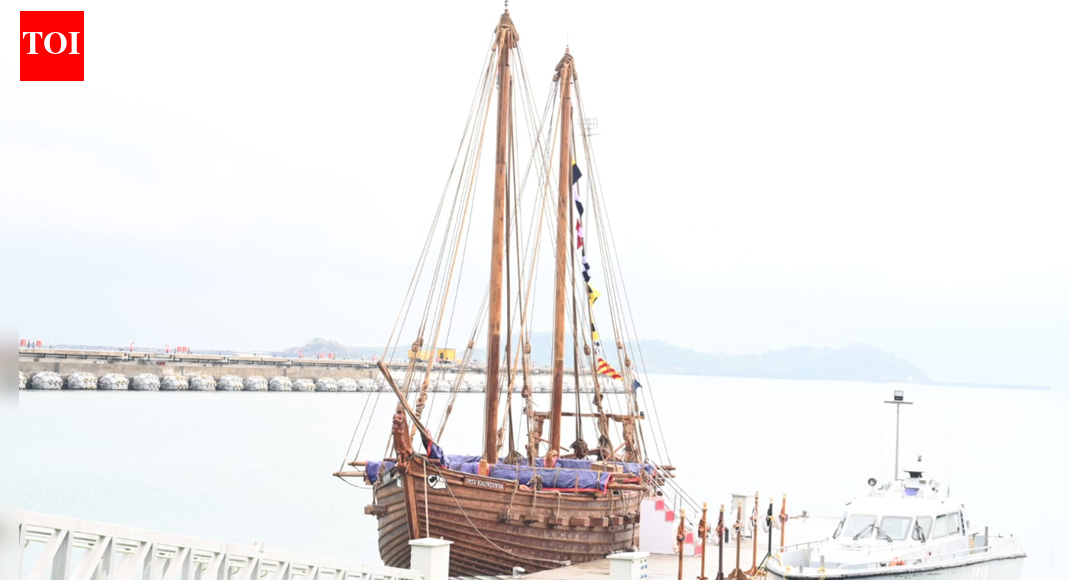
NEW DELHI: The Indian Navy’s stitched sailing vessel INSV Kaundinya will embark on her maiden overseas voyage on Monday, sailing from Porbandar in Gujarat to Muscat in Oman. The journey will symbolically retrace ancient maritime routes that once connected India with West Asia and the wider Indian Ocean world, testing traditional shipbuilding techniques that predate modern navigation by more than a millennium.The voyage marks a rare operational deployment of a vessel built entirely using ancient stitched-plank technology, with no engine, no metal fastenings and no modern propulsion systems. The ship will rely solely on wind and sails, recreating the conditions under which Indian mariners once undertook long-distance oceanic voyages.
A ship built without engines or metal
INSV Kaundinya is a non-combat sailing vessel constructed using a shipbuilding technique believed to date back to at least the 5th century CE. Unlike modern naval platforms, the wooden planks of the vessel are stitched together using coir rope made from coconut fibre and sealed with natural resins, cotton and oils to ensure seaworthiness.
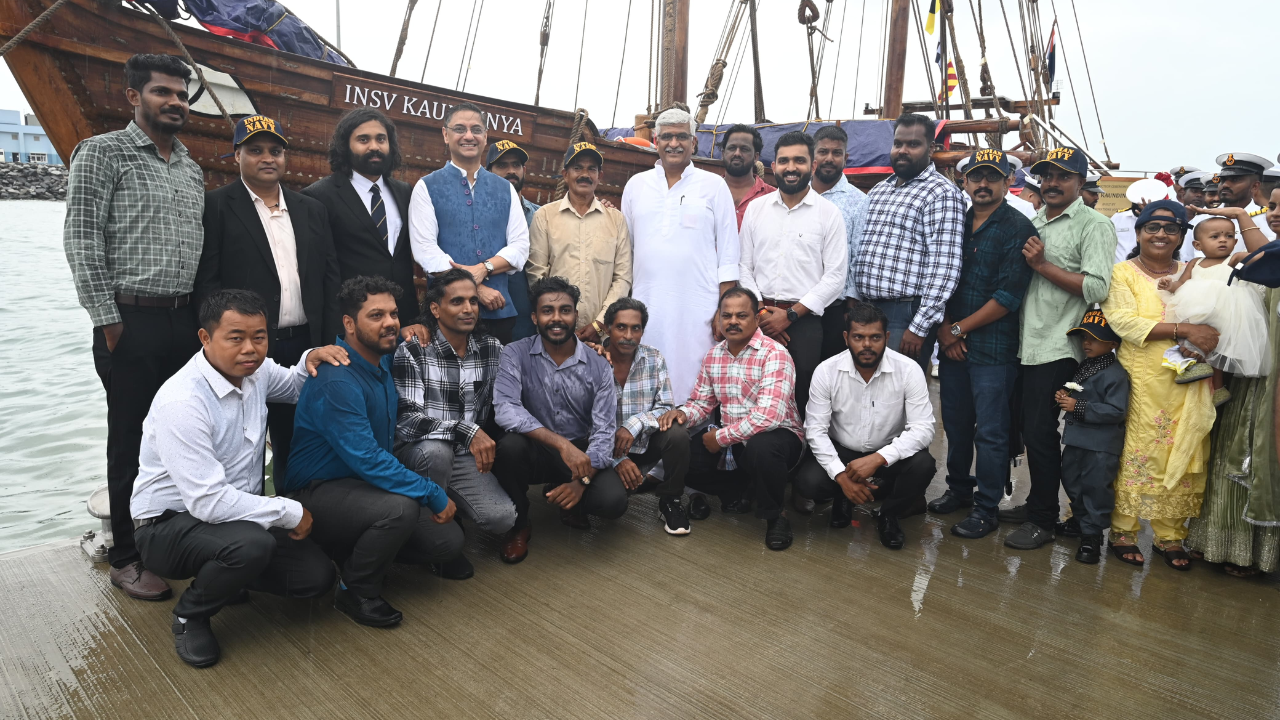
This stitched construction allows flexibility in the hull, enabling the ship to absorb wave energy rather than resist it rigidly. Such flexibility was crucial for ancient sailors navigating rough seas across the Arabian Sea, the Bay of Bengal and beyond.
Inspired by ancient Indian sources
The vessel’s design draws inspiration from depictions of ships found in the Ajanta cave paintings, descriptions in ancient Indian texts and accounts left by foreign travellers. With no surviving blueprints, the Indian Navy reconstructed the design through visual interpretation and scientific validation.Hydrodynamic testing and stability studies were conducted with the support of academic institutions, including IIT Madras, to ensure the vessel could safely undertake open ocean voyages despite its ancient design.
Dimensions and crew
INSV Kaundinya measures approximately 19.6 metres in length and 6.5 metres in width, with a draft of around 3.33 metres. The ship is powered entirely by sails and is crewed by about 15 sailors trained to operate the vessel under traditional sailing conditions.
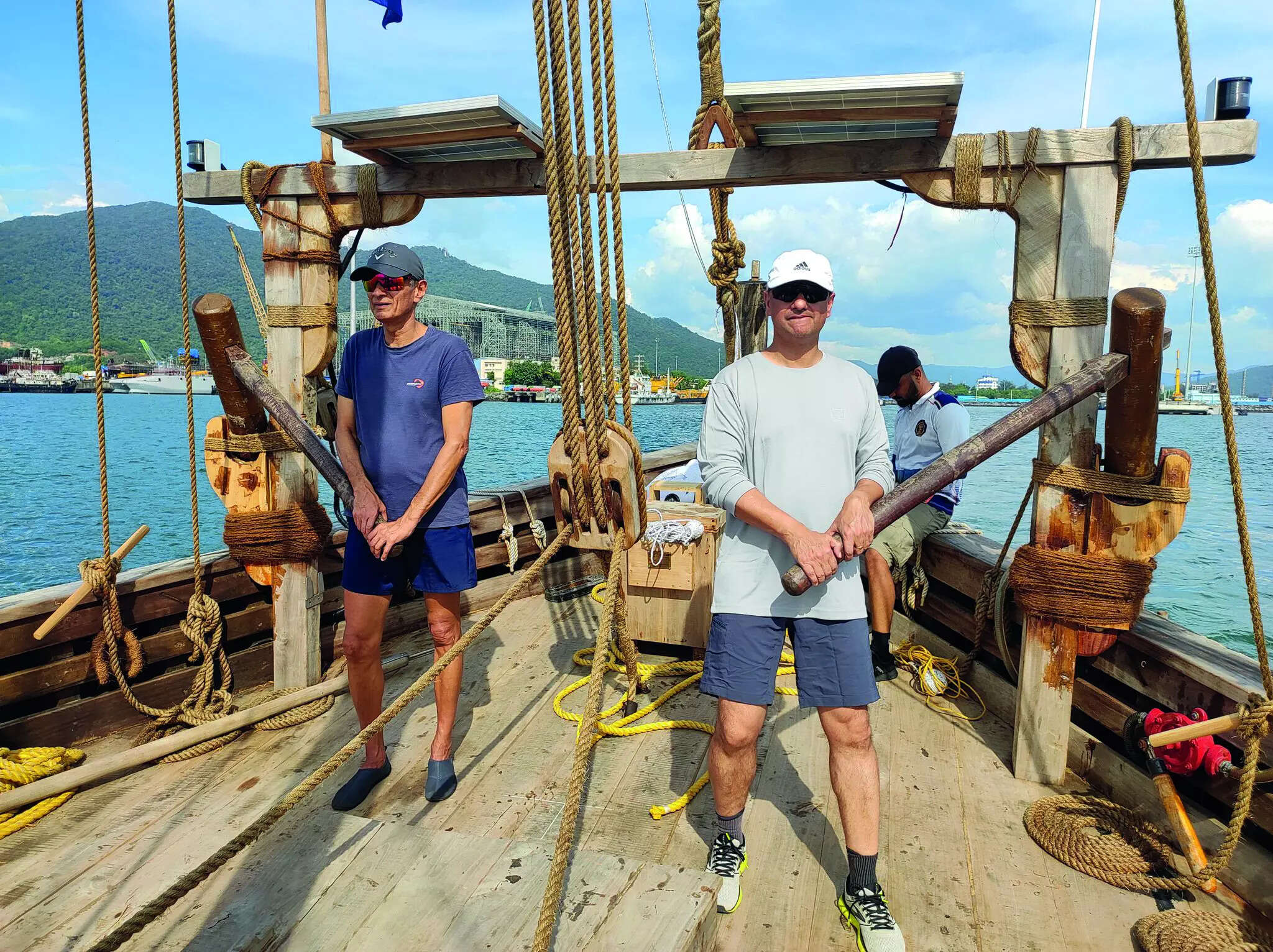
The construction follows the Tankai method, an indigenous Indian shipbuilding practice in which the hull is stitched first and ribs are added later, avoiding the use of metal entirely.
A collaborative revival project
The project was initiated in July 2023 under a tripartite memorandum of understanding between the Ministry of Culture, the Indian Navy and Hodi Innovations, with funding provided by the Ministry of Culture. Traditional artisans from Kerala, led by master shipwright Babu Sankaran, stitched the vessel entirely by hand.The ship was launched in February 2025 and formally inducted into the Indian Navy in May at Karwar in Karnataka, marking a milestone in the revival of indigenous maritime knowledge systems.
Cultural symbols on board
INSV Kaundinya carries several motifs associated with India’s maritime and civilisational heritage. These include the Gandabherunda, the two-headed eagle of the Kadamba dynasty, sun motifs on the sails, a Simha Yali mythical lion figure on the bow, and a Harappan-style stone anchor placed on the deck.Each symbol reflects different periods of India’s seafaring past and its long-standing engagement with overseas trade and cultural exchange.
Named after a legendary mariner
The vessel is named after Kaundinya, a first-century Indian mariner referenced in Southeast Asian and Chinese records. According to these accounts, Kaundinya sailed to the Mekong Delta, married Queen Soma and helped establish the Kingdom of Funan in present-day Cambodia.The kingdom became one of the earliest Indian-influenced states in Southeast Asia, with later Khmer and Cham dynasties believed to trace their origins to this union. Although Indian records do not mention him, Kaundinya is regarded as the earliest named Indian sailor with a documented global historical impact.
Recreating ancient maritime highways
The Porbandar to Muscat route was once a vital corridor for trade and cultural exchange. Indian merchants and sailors used these sea lanes to transport spices, textiles and ideas across West Asia, Africa and Southeast Asia.By sailing this route again, INSV Kaundinya seeks to demonstrate the sophistication of ancient Indian shipbuilding and navigation while reaffirming India’s long-standing identity as a maritime civilisation.


