
AI-generated image The world is a small place. Technology, especially social media, has made it even smaller. Today, from one corner of the globe, one can connect instantly with a stranger thousands of miles away. Yet, this unprecedented connectivity has its own pitfalls. These concerns prompted Australia to introduce a landmark reform prohibiting users aged below 16 from holding an account on certain social media platforms, marking the first such measure anywhere in the world.Can India usher in similar reforms? Are there sufficient grounds to keep minors away from social media? What potential challenges would such a move invite—and is there an alternative to an outright ban?These questions lie at the heart of the Indian debate.Australia’s social media banThe Online Safety Amendment (Social Media Minimum Age) Act was made effective December 10, over a year after it was passed by the Australian Parliament. The November 2024 legislation amended the 2021 Online Safety Act and introduced a minimum age requirement for access to social media platforms.Australia’s social media banAs per Digital 2025: Australia report, the island-continent had 20.9 million social media user identities (as of February 2025), representing 78% of its population. Senior journalist Dr. Alok Kumar, who runs a YouTube channel, told The Times of India, “The ban is enforceable in a country like Australia, which sits in one corner of the world and has a small population despite its vast landmass.”Though the Australian government has stated that the measures are meant only for minors, Kumar suggested the move may also be aimed at addressing concerns raised by Jewish groups regarding “rising antisemitism” in Australia—similar claims have been made about the rest of the West—an issue underscored by the recent terror attack targeting Jews in Sydney.“Exposure to social networking sites has radicalised many who already harboured anti-Jewish sentiment,” Kumar said, referring to the Israel–Hamas war.Support, criticism and pushbackA recent survey by the Melbourne-based Monash University found broad public approval for the measure, with 79% of the 1,598 adult respondents in favour. In contrast, an ABC News survey of the target age group, involving 17,000 respondents, found that 70% clearly opposed the ban, while 21% were unsure.This is a world-leading move by Australia and it is a change driven, overwhelmingly, by Australian parents. Our social media ban is about providing greater peace of mind for Australian parents. It’s also about making sure that Australian children have a childhood. Australian kids will have more time to be kids and Australian parents will have greater peace of mind.Anthony Albanese, Australian PMX (formerly Twitter), owned by the world’s richest person, Elon Musk, was the last to accept the regulation. In a statement, the company said, “It’s not our choice—it’s what the Australian law requires.”While Unicef welcomes the growing commitment to children’s online safety, age restrictions must be part of a broader approach that protects children from harm, respects their rights to privacy and participation, and avoids pushing them into unregulated, less safe spaces. Regulation should not be a substitute for platforms investing in child safety. Laws introducing age restrictions are not an alternative to companies improving platform design and content moderation.UnicefReddit, another platform covered under the law, has already filed a legal challenge, arguing that the legislation is “ineffective” and violates the freedom of political communication. The Digital Freedom Project, which describes itself as a “group of Australians concerned about increasing government intervention in the digital space,” has also filed a legal challenge against the legislation.Australia first, others next?In May, neighbouring New Zealand introduced a draft bill proposing a ban on social media for under-16s. In the UK, although the Online Safety Act has been in place since July, a recent YouGov poll found that 74% of adults support a full ban on minors’ accounts. Other European countries—including Denmark, Norway, Ireland, Spain, and the Netherlands—have also proposed age-based restrictions. In the US, such regulations exist at the state level, while Brazil has raised Instagram’s minimum age from 14 to 16. Closer to home, a similar ban in Nepal sparked “Gen Z”–led protests that ultimately culminated in the government’s collapse.Nepal ‘Gen Z’ protestsSocial media penetration in IndiaAustralia’s ban applies to a demographic of roughly 1.5 million people out of a total population of about 27.5 million; the corresponding age group in India—the world’s most populous country—alone far exceeds Australia’s entire population.Official data shows that India had 1,017.81 million internet subscribers as of September, up from 251.5 million in March 2014.According to DataReportal’s Digital 2025: India report, the country had around 806 million internet users at the start of the year, including approximately 491 million social media user identities.How social media grew in IndiaSocial media use in India has grown rapidly, fuelled by affordable smartphones and cheap data. Platforms such as WhatsApp, Instagram, YouTube, and Facebook now form a central part of daily life—especially for young users—often doubling as gateways to the internet itself. Its popularity among youth, as well as its overall rise, can be attributed to:Low-cost access: Affordable smartphones and some of the world’s cheapest mobile data plans.Multifunctional use: Beyond communication, platforms are used for learning, entertainment, content creation, and informal commerce.Speed, reach, and convenience: Information can be shared across the world within seconds, often without users having to leave their homes.Ease of access: Minimal age verification and hassle-free sign-up processes.Fame and virality factor: Content can go viral unpredictably, offering instant visibility and recognition even to first-time creators.Economic opportunities: Influencer culture, creator monetisation, and small-scale digital entrepreneurship.Drive to do something “different”: Many users, particularly young people, turn to content creation—such as vlogging or short-form videos—either alongside full-time careers or as an alternative livelihood.‘Fatigue’ of traditional news platforms: Many users are moving to social media, citing “fatigue” with traditional news platforms. Internet/social media regulation in IndiaIndia does not impose a blanket ban on platforms but regulates them through the Information Technology Act, 2000, and the Information Technology Rules, 2021.IT Act: The parent law for digital regulation in India; classifies social media platforms as “intermediaries” and provides the legal framework for intermediary liability and enforcement.IT Rules: Issued under the IT Act; imposes due-diligence obligations on intermediaries, requires large platforms (5 million+ users) to appoint local officers, and mandates regular compliance reports.The Rules also prescribe a “Code of Ethics” to regulate and address harmful content on over-the-top (OTT) platforms.Recent bans Notable actions include the June 2020 ban on TikTok and 58 other Chinese apps on national security grounds, followed by 118 additional apps in September and 43 in November; the blocking of 63 pornographic websites in October 2022 for violations of the IT Rules; and the July 2025 ban on 43 OTT apps for streaming “soft porn” and “indecent content.”Feasibility of Australia-like model in IndiaIs the Australia model feasible in India? No, according to Kumar, as any such move could not only lead to mass unrest but also undo the country’s digital advancements, such as digital wallet payments.“If the government wanted, it would have already banned social media. The common man is busy consuming jokes or some entertaining content on social media. His mind is diverted from daily issues. Why would the government then impose a ban? A mass ban, in any case, is not possible,” he explained.Instagram Reels: Case for social media regulationStill, the availability of child abuse material online could be one possible ground, while another could be Instagram Reels.Launched in August 2020, Reels quickly became a global phenomenon. The craze is hardly surprising in India, which, with its massive youth population and highly engaged social media users, hosts Instagram’s largest user base, over 480 million.However, influencers often take extreme risks for Reels: some hang precariously from buildings, while others perform dangerous stunts on vehicles or park their vehicles in the middle of roads, disrupting commuters. This example raises the question of if at least some form of regulation is warranted.On this point, Kumar suggested refraining from punitive action, saying, “It is the state’s responsibility to sensitise the youngsters doing such acts or those uploading harmful content. Don’t treat them as criminals.”Potential hurdles/challengesSize of population/user base: A ban would be extremely difficult to enforce given India’s massive population and massive user base.Legal challenges: Any such policy would almost certainly face court challenges and could be struck down on constitutional or legal grounds.Youth/civil society pushback: A ban could trigger large-scale protests from youths and civil society, as seen in other countries (Nepal, for example).Global perception: A social media ban in the world’s largest democracy could attract negative international attention and be seen as poor optics.VPN circumvention: Blocked websites can often be accessed through Virtual Private Networks (VPNs), undermining the effectiveness of any ban.Economic and educational impact: Since such platforms are increasingly used for learning, entrepreneurship, and digital livelihoods, a ban could have unintended economic and educational consequences. The way aheadSo, what’s the way forward? Is some alternative solution better than a ban?Kumar agreed: “A ban is never a solution. It’s better to monitor platforms. If some harmful content is found, the government should talk to the operator and get it removed. Secondly, social media has many good qualities too – people should be made aware and encouraged to use it in a positive way.” Platforms like Instagram Reels highlight the opportunities and risks of social media in India. With usage growing among a vast youth population, the global debate over regulation reflects broader concerns about safety, well-being, and public responsibility, setting the stage for ongoing discussions in the years ahead.End of ArticleFollow Us On Social MediaVideosAssam Tragedy: Rajdhani Express Hits Elephant Herd, Eight Killed, Engine And Coaches DerailSeven Held In Hindu Man’s Lynching in Bangladesh As Yunus Faces Scrutiny Over Minority SafetyUS Thanks Pakistan For Gaza Troop Offer But Islamabad Insists No Final Decision Has Been Taken YetMarco Rubio Hails Donald Trump As Global Peacemaker Amid Dispute Over India Pakistan Ceasefire ClaimChina Reviving Air, Submarine Bases In Bangladesh Amid Unrest, Ex-Envoy Warns Of Strategic TrapUN Warns Bangladesh Against Violence After Protest Leader Osman Hadi Shot, Seeks Accountability Now’Yoga Is Medicine, Not Just Practice’: PM Modi’s Global Message At WHO Traditional Medicine SummitVaping, Bhow-Bhow & Shouting Match: A Look At Viral Moments Of Parl As Chaotic Winter Session EndsBondi Beach Terror Suspect Visited Hyderabad Six Times After Leaving India, Telangana Police Reveal’To Delay Elections, Instigate India’: Former Minister Blames Yunus Govt For Bangladesh Violence123PhotostoriesBig investment, cleaner commute: Chennai spends Rs 258 crore on EV depot and busesWant to attract good luck on January 1, 2026? Visit these spiritual places according to your birth date’Princess of Jaipur’ Gauravi Kumari’s style era has officially arrivedChennai infrastructure push: Okkiyam Maduvu bridge expansion to enhance connectivity and flood controlDo these 6 things and strangers will feel like they have known you for years5 nutrients that should be an essential part of every child’s meals and simple and delicious dishes that help boost immunityToo much sweating: Is it stress, hormones, or something worse? Top psychiatrist answersChristmas 2025: Best Christmas books to gift your childBollywood’s green brigade, Amitabh Bachchan, John Abraham, Shahid Kapoor, go plant-poweredThese places can bring bad luck based on your birth date123Hot Picksvb g ram gEpstein files releasedUAE RainGold rate todaySilver rate todayPublic Holidays DecemberBank Holidays DecemberTop TrendingJosh Allen Luxury Car CollectionRandi MahomesAuston MatthewsWho is Nicole LundersJeremy Doku and Shireen Doku Net WorthRBSE Rajasthan Board Exam Time TableWalker Buehlers WifeSibley ScolesAssam Rajdani Express TragedyUS Strikes

The world is a small place. Technology, especially social media, has made it even smaller. Today, from one corner of the globe, one can connect instantly with a stranger thousands of miles away. Yet, this unprecedented connectivity has its own pitfalls. These concerns prompted Australia to introduce a landmark reform prohibiting users aged below 16 from holding an account on certain social media platforms, marking the first such measure anywhere in the world.Can India usher in similar reforms? Are there sufficient grounds to keep minors away from social media? What potential challenges would such a move invite—and is there an alternative to an outright ban?These questions lie at the heart of the Indian debate.
Australia’s social media ban
The Online Safety Amendment (Social Media Minimum Age) Act was made effective December 10, over a year after it was passed by the Australian Parliament. The November 2024 legislation amended the 2021 Online Safety Act and introduced a minimum age requirement for access to social media platforms.
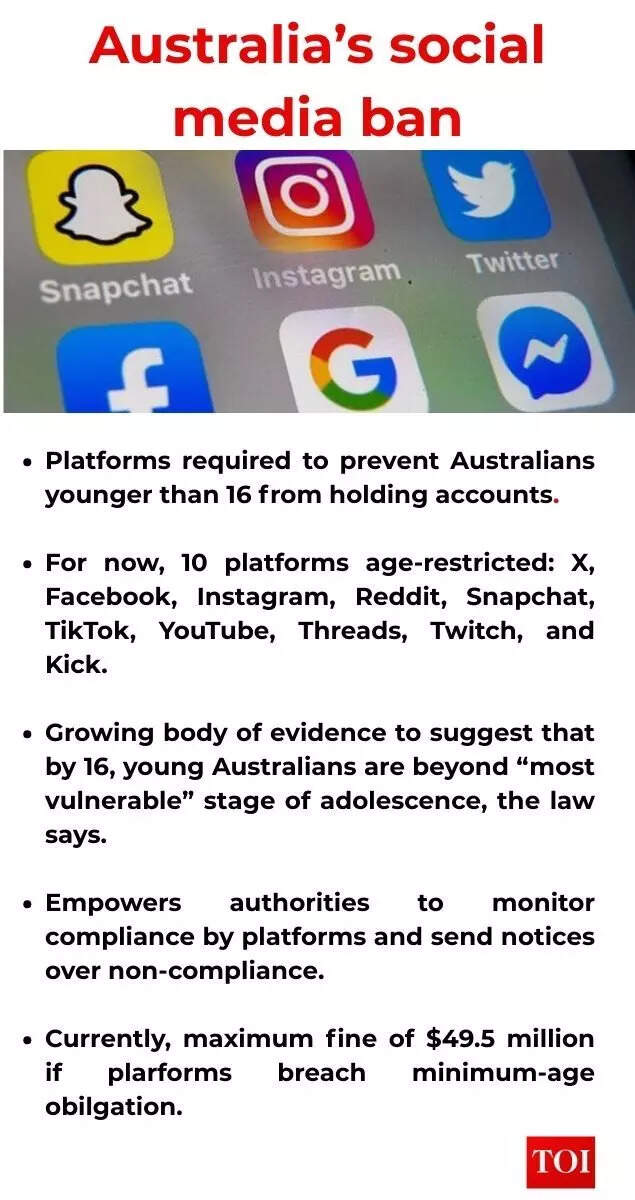
Australia’s social media ban
As per Digital 2025: Australia report, the island-continent had 20.9 million social media user identities (as of February 2025), representing 78% of its population. Senior journalist Dr. Alok Kumar, who runs a YouTube channel, told The Times of India, “The ban is enforceable in a country like Australia, which sits in one corner of the world and has a small population despite its vast landmass.”Though the Australian government has stated that the measures are meant only for minors, Kumar suggested the move may also be aimed at addressing concerns raised by Jewish groups regarding “rising antisemitism” in Australia—similar claims have been made about the rest of the West—an issue underscored by the recent terror attack targeting Jews in Sydney.“Exposure to social networking sites has radicalised many who already harboured anti-Jewish sentiment,” Kumar said, referring to the Israel–Hamas war.Support, criticism and pushbackA recent survey by the Melbourne-based Monash University found broad public approval for the measure, with 79% of the 1,598 adult respondents in favour. In contrast, an ABC News survey of the target age group, involving 17,000 respondents, found that 70% clearly opposed the ban, while 21% were unsure.
This is a world-leading move by Australia and it is a change driven, overwhelmingly, by Australian parents. Our social media ban is about providing greater peace of mind for Australian parents. It’s also about making sure that Australian children have a childhood. Australian kids will have more time to be kids and Australian parents will have greater peace of mind.
Anthony Albanese, Australian PM
X (formerly Twitter), owned by the world’s richest person, Elon Musk, was the last to accept the regulation. In a statement, the company said, “It’s not our choice—it’s what the Australian law requires.”
While Unicef welcomes the growing commitment to children’s online safety, age restrictions must be part of a broader approach that protects children from harm, respects their rights to privacy and participation, and avoids pushing them into unregulated, less safe spaces. Regulation should not be a substitute for platforms investing in child safety. Laws introducing age restrictions are not an alternative to companies improving platform design and content moderation.
Unicef
Reddit, another platform covered under the law, has already filed a legal challenge, arguing that the legislation is “ineffective” and violates the freedom of political communication. The Digital Freedom Project, which describes itself as a “group of Australians concerned about increasing government intervention in the digital space,” has also filed a legal challenge against the legislation.
Australia first, others next?
In May, neighbouring New Zealand introduced a draft bill proposing a ban on social media for under-16s. In the UK, although the Online Safety Act has been in place since July, a recent YouGov poll found that 74% of adults support a full ban on minors’ accounts. Other European countries—including Denmark, Norway, Ireland, Spain, and the Netherlands—have also proposed age-based restrictions. In the US, such regulations exist at the state level, while Brazil has raised Instagram’s minimum age from 14 to 16. Closer to home, a similar ban in Nepal sparked “Gen Z”–led protests that ultimately culminated in the government’s collapse.
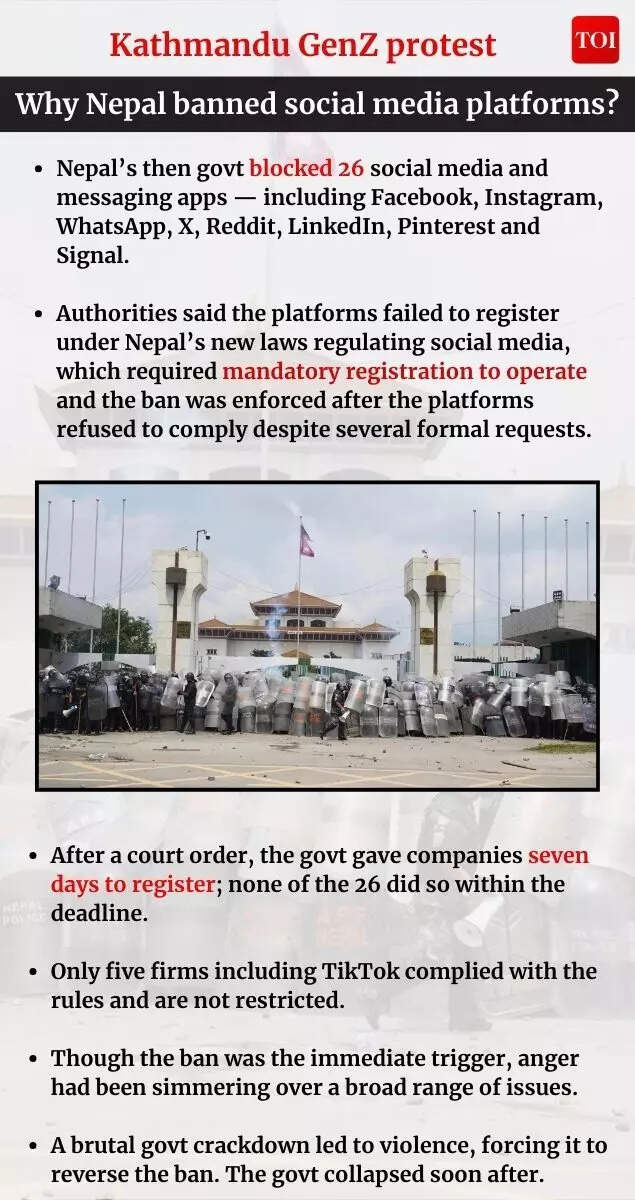
Nepal ‘Gen Z’ protests
Social media penetration in India
Australia’s ban applies to a demographic of roughly 1.5 million people out of a total population of about 27.5 million; the corresponding age group in India—the world’s most populous country—alone far exceeds Australia’s entire population.Official data shows that India had 1,017.81 million internet subscribers as of September, up from 251.5 million in March 2014.According to DataReportal’s Digital 2025: India report, the country had around 806 million internet users at the start of the year, including approximately 491 million social media user identities.How social media grew in IndiaSocial media use in India has grown rapidly, fuelled by affordable smartphones and cheap data. Platforms such as WhatsApp, Instagram, YouTube, and Facebook now form a central part of daily life—especially for young users—often doubling as gateways to the internet itself. Its popularity among youth, as well as its overall rise, can be attributed to:
- Low-cost access: Affordable smartphones and some of the world’s cheapest mobile data plans.
- Multifunctional use: Beyond communication, platforms are used for learning, entertainment, content creation, and informal commerce.
- Speed, reach, and convenience: Information can be shared across the world within seconds, often without users having to leave their homes.
- Ease of access: Minimal age verification and hassle-free sign-up processes.
- Fame and virality factor: Content can go viral unpredictably, offering instant visibility and recognition even to first-time creators.
- Economic opportunities: Influencer culture, creator monetisation, and small-scale digital entrepreneurship.
- Drive to do something “different”: Many users, particularly young people, turn to content creation—such as vlogging or short-form videos—either alongside full-time careers or as an alternative livelihood.
- ‘Fatigue’ of traditional news platforms: Many users are moving to social media, citing “fatigue” with traditional news platforms.
Internet/social media regulation in India
India does not impose a blanket ban on platforms but regulates them through the Information Technology Act, 2000, and the Information Technology Rules, 2021.IT Act: The parent law for digital regulation in India; classifies social media platforms as “intermediaries” and provides the legal framework for intermediary liability and enforcement.IT Rules: Issued under the IT Act; imposes due-diligence obligations on intermediaries, requires large platforms (5 million+ users) to appoint local officers, and mandates regular compliance reports.The Rules also prescribe a “Code of Ethics” to regulate and address harmful content on over-the-top (OTT) platforms.Recent bans Notable actions include the June 2020 ban on TikTok and 58 other Chinese apps on national security grounds, followed by 118 additional apps in September and 43 in November; the blocking of 63 pornographic websites in October 2022 for violations of the IT Rules; and the July 2025 ban on 43 OTT apps for streaming “soft porn” and “indecent content.”
Feasibility of Australia-like model in India
Is the Australia model feasible in India? No, according to Kumar, as any such move could not only lead to mass unrest but also undo the country’s digital advancements, such as digital wallet payments.“If the government wanted, it would have already banned social media. The common man is busy consuming jokes or some entertaining content on social media. His mind is diverted from daily issues. Why would the government then impose a ban? A mass ban, in any case, is not possible,” he explained.Instagram Reels: Case for social media regulationStill, the availability of child abuse material online could be one possible ground, while another could be Instagram Reels.Launched in August 2020, Reels quickly became a global phenomenon. The craze is hardly surprising in India, which, with its massive youth population and highly engaged social media users, hosts Instagram’s largest user base, over 480 million.However, influencers often take extreme risks for Reels: some hang precariously from buildings, while others perform dangerous stunts on vehicles or park their vehicles in the middle of roads, disrupting commuters. This example raises the question of if at least some form of regulation is warranted.On this point, Kumar suggested refraining from punitive action, saying, “It is the state’s responsibility to sensitise the youngsters doing such acts or those uploading harmful content. Don’t treat them as criminals.”Potential hurdles/challenges
- Size of population/user base: A ban would be extremely difficult to enforce given India’s massive population and massive user base.
- Legal challenges: Any such policy would almost certainly face court challenges and could be struck down on constitutional or legal grounds.
- Youth/civil society pushback: A ban could trigger large-scale protests from youths and civil society, as seen in other countries (Nepal, for example).
- Global perception: A social media ban in the world’s largest democracy could attract negative international attention and be seen as poor optics.
- VPN circumvention: Blocked websites can often be accessed through Virtual Private Networks (VPNs), undermining the effectiveness of any ban.
- Economic and educational impact: Since such platforms are increasingly used for learning, entrepreneurship, and digital livelihoods, a ban could have unintended economic and educational consequences.
The way ahead
So, what’s the way forward? Is some alternative solution better than a ban?Kumar agreed: “A ban is never a solution. It’s better to monitor platforms. If some harmful content is found, the government should talk to the operator and get it removed. Secondly, social media has many good qualities too – people should be made aware and encouraged to use it in a positive way.” Platforms like Instagram Reels highlight the opportunities and risks of social media in India. With usage growing among a vast youth population, the global debate over regulation reflects broader concerns about safety, well-being, and public responsibility, setting the stage for ongoing discussions in the years ahead.


