
How women in Morocco are turning desert fog into drinking water

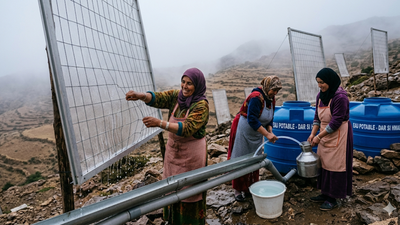
In the drought-ridden Anti-Atlas Mountains of Morocco, women have adopted fog-harvesting technology to extract potable water from clouds that pass over the fringes of the Sahara Desert. In the villages surrounding Ait Baamrane, a lack of water sources, desertification, climate change, and the drying up of wells previously made it necessary for women and children to spend hours each day fetching water in large containers. Thanks to the installation of enormous fog-collection nets on Mount Boutmezguida, the lives of many have been changed forever. It is an initiative led by the women of the Dar Si Hmad Foundation that has become one of the world’s best-known fog-collection ventures.
Fog harvesting in Morocco: How the system works
The fog harvesting process is both simple and efficient. Huge mesh nets are suspended in mountainous areas where there is a high probability of thick fog from the Atlantic Ocean passing through. Tiny droplets are collected in the net, converted to water, and then transported to storage tanks via pipes.According to a report released by the UNFCCC titled “Women-led Fog Harvesting for a Resilient, Sustainable Ecosystem,” the process was created to benefit remote communities in southwest Morocco, where water supply systems do not exist. This report explains the process as “a well-known and scientifically proven technology [that] can yield a considerable amount of drinking water in foggy locations.” According to research conducted by the University of La Laguna, the initiative integrates engineering solutions with community participation to address complex problems such as climate change, poverty, and female discrimination in rural Morocco.
Women at the heart of Morocco’s water revolution
Before the installation of the fog nets, women in the area would have to walk long distances to collect water daily for about four hours.The United Nations Framework Convention on Climate Change’s climate change program mentioned that this initiative is now ensuring safe drinking water for hundreds of people residing in different villages. Furthermore, the program has helped illiterate rural women gain literacy through training sessions.Speaking with The Guardian, Jamila Bargach, the founder of the project, said:“Everyone was leaving the village where I grew up, and it was all because of water.”These words show the impact of water scarcity on the lives of communities residing near the expanding Sahara Desert.
Climate change and desertification in the Anti-Atlas region
Over the last few decades, Southwest Morocco has had to contend with increasingly severe drought and depletion of water sources from the ground. The scientific community and environmental organisations have stated that global warming is hastening desertification in North Africa, which would cause even more stress on water supplies in the area.Fog harvesting has been a good demonstration of climate adaptation. In the UNFCCC Momentum for Change program, this initiative is recognised as being a climate solution that has a grassroots approach and is environmentally sustainable.This has led to the initiative growing and developing over the years. As stated on Dar Si Hmad’s project page, their fog harvesting system now reaches more than 16 villages in the Anti-Atlas mountain range.
A model for sustainable water solutions
In many places where drought is becoming increasingly common along with decreasing freshwater supplies, Morocco’s fog harvesting attempt is attracting much attention worldwide. The success of this initiative reveals how traditional knowledge about the environment and contemporary engineering skills can be combined to produce viable solutions.The importance of the story is highlighted by its human dimension. Water, which was being simply wasted in the form of fog in the mountainous areas, became a life-saving resource. For thousands of Moroccan villagers, and particularly for women in rural areas of Morocco, fog ceased to be just a weather phenomenon but a water source.


