
In 1799, a New York farmer’s shovel hit a ‘monster’ tooth that triggered an American obsession with Ice Age giants

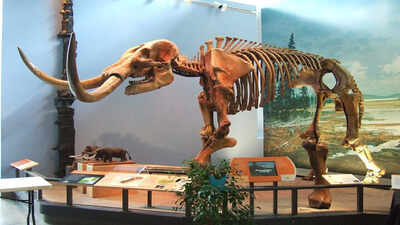
In the late 18th century, New York farmer John Masten discovered enormous prehistoric bones in marl pits. Artist Charles Willson Peale acquired these remains, embarking on a monumental effort to excavate and assemble America’s first mounted fossil exhibit. Image Credits: Wikimedia Commons
History happens in the strangest of places. For John Masten, a farmer from Newburgh, New York, history began in the slimy marl pits on his land. It was during the last decade of the eighteenth century that farmers working in the dark, muddy pits dug by hand discovered bones that resembled stones but were actually bones. It was evident to them that what they had unearthed was not the bone of any ordinary mammal. It was an enormous tooth resembling a brick of a human being and a femur bone towering above a fully-grown man.At the time, the young United States was struggling to prove it was more than just a backwater colony. Finding a giant, prehistoric “monster” in the backyard of New York was exactly the kind of evidence people needed to show that the American wilderness was home to grand, powerful things. Word of the discovery travelled quickly from the rural farm to the intellectual circles of Philadelphia, catching the ear of a famous artist and polymath named Charles Willson Peale.It was then a matter of trying to retrieve the bones before they got lost once again beneath the swamp. However, it was never Peale’s objective merely to collect these bones, but rather to employ them in building America’s first major museum. Peale would later go on to acquire the bones for $200, together with a firearm from Masten.A gigantic engineering exercise in the middle of a mud pitIn 1801, the retrieval of a prehistoric animal from a swamp was no small feat. According to Charles Willson Peale’s Exhumation of the Mastodon, an article in the Smithsonian American Art Museum, there was a necessity of creating a means of draining the pit since it kept flooding. Therefore, Peale invented a gigantic wheel driven by manpower in order to drain the pit.It marked one of the first major archaeological expeditions ever conducted in America, and the whole affair was a painstaking and manual one. Men laboured round-the-clock in the mud, hoisting the huge ribs and tusks from the depths of the marsh through sheer labour, employing ropes and winch machines. The task was such an extraordinary accomplishment that Peale eventually captured the whole event in an immortal painting, illustrating just how difficult it was to drag an entire Ice Age beast out of the earth. More than simply unearthing fossils, it was proof positive that Americans were capable of discovering the ancient past.
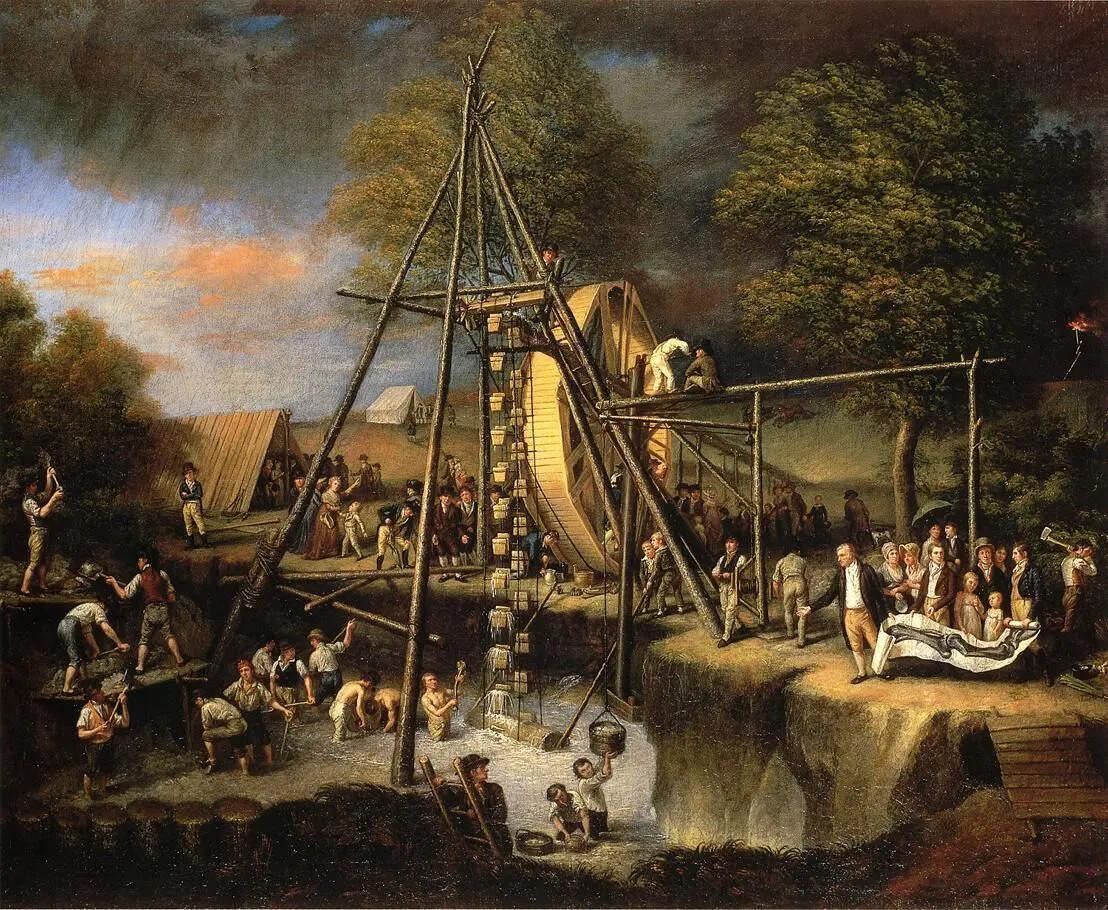
This discovery of an American Mastodon challenged European notions of American degeneracy and showcased the nation’s capacity for grand discoveries. Image Credits: Wikipedia
The beast that sparked thousands of museum fantasiesAfter cleaning the bones and transporting them to Philadelphia, Peale and his men faced a new task: putting it all together. According to the historical document Account of the Skeleton of the Mammoth published by the Smithsonian Libraries and Archives, the skeleton found at Newburg went on to form the world’s first mounted fossil exhibit for the public to see. Since there weren’t enough bones to create a complete structure, the men used pieces of wood and papier-mache to finish off the mammoth skeleton.However, when the skeleton was revealed to the world, everyone was amazed by its appearance. There was nothing quite like it. At that time, it was categorised as a “mammoth,” although subsequent science has identified it as an American Mastodon. It solved a very controversial issue of that time. There were certain European scientists who had the opinion that the weather in America was “degenerate” and therefore produced tiny, feeble creatures. The mastodon in Newburgh provided a clear response to such opinions.Whereas today, the mastodon is viewed as a gentle creature that feeds off plants, back then, the mastodon represented a sign of national power and the endless enigmas that existed within the New World. This discovery shows how a single day’s work while farming on the land may result in a discovery that will remain in history for generations. It brings about the realisation of other artefacts lying dormant not far from the surface within the rural areas.


