
NEW DELHI: External Affairs Minister S Jaishankar on Thursday took a veiled swipe at the US over its sanctions-led foreign policy, cautioning against “unilateral coercive measures” as India voiced concern over the worsening West Asia crisis and its fallout on global energy and trade routes.Speaking at the opening session of the BRICS foreign ministers’ conclave, Jaishankar said sanctions and coercive measures that bypass international law end up hurting developing nations the most.“Such measures disproportionately affect developing countries. These unjustifiable measures cannot substitute dialogue, nor can pressure replace diplomacy,” he said, without naming any country directly.The minister also warned that continuing tensions in Middle East, particularly around key shipping lanes and energy infrastructure, were creating serious global risks.“The conflict in West Asia merits particular attention. Continuing tensions, risks to maritime traffic, and disruptions to energy infrastructure highlight the fragility of the situation,” Jaishankar said.He stressed that uninterrupted maritime movement through critical waterways such as the Strait of Hormuz and the Red Sea was essential for global economic stability. Pitching for diplomacy over confrontation, Jaishankar said respect for sovereignty and territorial integrity must remain the foundation of international relations.“Stability cannot be selective, and peace cannot be piecemeal. It is essential to uphold international law, protect civilians, and avoid targeting public infrastructure,” he said.Jaishankar added that India was ready to support efforts aimed at reducing tensions in the region and restoring stability.The external affairs minister also raised concerns over Gaza, calling for a sustained ceasefire, humanitarian access and progress towards a two-state solution.Besides Gaza, he referred to the crises in Lebanon, Syria, Sudan, Yemen and Libya, urging coordinated international engagement to address them.The India-hosted BRICS meeting comes amid mounting concerns over energy supply disruptions and wider economic uncertainty triggered by the ongoing West Asia conflict.Among those attending the conclave are Iranian Foreign Minister Abbas Araghchi, Russian Foreign Minister Sergey Lavrov, Brazilian Foreign Minister Mauro Vieira, Indonesian Foreign Minister Sugiono and South African minister Ronald Lamola.Jaishankar also reiterated India’s position on terrorism, saying “cross-border terrorism violates the basic principles of international relations” and that “zero tolerance must remain an uncompromising and universal norm.”About the AuthorTOI News DeskThe TOI News Desk comprises a dedicated and tireless team of journalists who operate around the clock to deliver the most current and comprehensive news and updates to the readers of The Times of India worldwide. With an unwavering commitment to excellence in journalism, our team is at the forefront of gathering, verifying, and presenting breaking news, in-depth analysis, and insightful reports on a wide range of topics. The TOI News Desk is your trusted source for staying informed and connected to the ever-evolving global landscape, ensuring that our readers are equipped with the latest developments that matter most.”Read MoreEnd of ArticleFollow Us On Social MediaVideosEx-Bengal CM Mamata Banerjee In Lawyer’s Gown Argues Post-poll Violence Case In High CourtKC Venugopal Backs VD Satheesan as Kerala CM, Says Congress Fully United Behind HimCongress Picks VD Satheesan as Kerala CM After 10 Days of Talks and Leadership BattleRBI Governor Warns Fuel Price Hike Possible If Middle East Crisis Continues LongerAIMIM Corporator’s Home Razed In Sambhajinagar Amid TCS Conversion Case Row EscalationKerala CM Race Ends as Congress Picks VD Satheesan Amid Venugopal Backing and Internal TensionsBJP Questions Rahul Gandhi Over Alleged Rs 60 Crore Foreign Travel Spending ClaimsIran Signals More Safe Passage For Indian Ships As BRICS Meet Faces West Asia DivideIndia-Bound 46,000 TONNES LPG Ship Cross Strait Of Hormuz, Two Ships In 48 Hours | WatchKabul Partners With Indian Company, Signs $46MN Deal To Upgrade Quality Control Across Trade Routes123Photostories10 destinations in India that became viral sensations after featuring in Bollywood moviesThese Indian fruits have surprisingly different English names5 Indian states that consume the most petrol per person and why travellers should pay attentionCan Hantavirus spread between humans? Doctors reveal why this rare infection is nothing like Covid-197 foods Indian grandparents ate regularly that are suddenly trendy againThis Indian kitchen waste is secretly the best fertiliser for terrace gardensJupiter and Venus Come Together : These Star Signs Might Get A Text From Their Ex7 garden trends to steal from British gardeners and plant enthusiastsThe ‘cool roof garden’ trend taking over Indian apartments: Here’s how to start one5 smart ways to give children the freedom to make choices without losing control123Hot PicksCBSE class 12 resultUS Iran warPrateek YadavHaryana election resultForeign outflowNEET exam cancelledTamil Nadu assemblyTop TrendingWB Class 12 Result 2026WB Board 12th ResultIPL Points TablePM Internship SchemeCalcutta High CourtMI vs PBKS IPL MatchIPL Orange Cap 2026Haryana Board ResultAir India FlightsPrateek Yadav

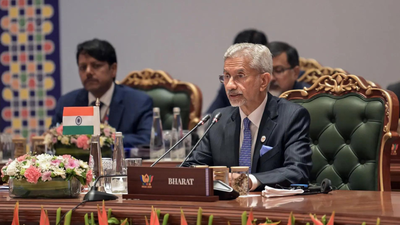
NEW DELHI: External Affairs Minister S Jaishankar on Thursday took a veiled swipe at the US over its sanctions-led foreign policy, cautioning against “unilateral coercive measures” as India voiced concern over the worsening West Asia crisis and its fallout on global energy and trade routes.Speaking at the opening session of the BRICS foreign ministers’ conclave, Jaishankar said sanctions and coercive measures that bypass international law end up hurting developing nations the most.“Such measures disproportionately affect developing countries. These unjustifiable measures cannot substitute dialogue, nor can pressure replace diplomacy,” he said, without naming any country directly.The minister also warned that continuing tensions in Middle East, particularly around key shipping lanes and energy infrastructure, were creating serious global risks.“The conflict in West Asia merits particular attention. Continuing tensions, risks to maritime traffic, and disruptions to energy infrastructure highlight the fragility of the situation,” Jaishankar said.He stressed that uninterrupted maritime movement through critical waterways such as the Strait of Hormuz and the Red Sea was essential for global economic stability. Pitching for diplomacy over confrontation, Jaishankar said respect for sovereignty and territorial integrity must remain the foundation of international relations.“Stability cannot be selective, and peace cannot be piecemeal. It is essential to uphold international law, protect civilians, and avoid targeting public infrastructure,” he said.Jaishankar added that India was ready to support efforts aimed at reducing tensions in the region and restoring stability.The external affairs minister also raised concerns over Gaza, calling for a sustained ceasefire, humanitarian access and progress towards a two-state solution.Besides Gaza, he referred to the crises in Lebanon, Syria, Sudan, Yemen and Libya, urging coordinated international engagement to address them.The India-hosted BRICS meeting comes amid mounting concerns over energy supply disruptions and wider economic uncertainty triggered by the ongoing West Asia conflict.Among those attending the conclave are Iranian Foreign Minister Abbas Araghchi, Russian Foreign Minister Sergey Lavrov, Brazilian Foreign Minister Mauro Vieira, Indonesian Foreign Minister Sugiono and South African minister Ronald Lamola.Jaishankar also reiterated India’s position on terrorism, saying “cross-border terrorism violates the basic principles of international relations” and that “zero tolerance must remain an uncompromising and universal norm.”


