
NEW DELHI: Defence minister Rajnath Singh on Monday urged “people to remain calm and avoid any kind of panic as all concrete steps are being taken to prevent shortages or disruptions in supply chains”. The minister, who chaired the 5th meeting of the informal group of ministers (IGoM) on the West Asia developments, said his “govt’s primary focus is to ensure that energy flows remain uninterrupted, economic stability is maintained and maritime trade routes remain secure”. He, however, urged people to rationalise use of fuel.The IGoM, attended by several ministers, including Jagat Prakash Nadda, Hardeep Singh Puri, Ashwini Vaishnaw, Kiren Rijiju, K R Rammohan Naidu, S Sonowal and Jitendra Singh, was informed that the country is secure, and there is no shortage of any petroleum product, even as most other nations have taken emergency measures to dramatically reduce domestic consumption.The ministers were also informed that there is a surplus amount of essential commodities for the people and the present conservation is intended towards long-run capacity building if the crisis prolongs. The supply management has been good, and the people need not panic or resort to over purchase of fuel and other products.“India has 60 days of crude oil, 60 days of natural gas and 45 days of LPG rolling stock. The foreign exchange reserves stand at a comfortable $703 billion. India is the world’s third largest oil refiner and fourth largest exporter of petroleum products, exporting to over 150 countries and is meeting domestic demand in full. But there is a huge cost being borne by the nation as international crude prices are continuing at very high levels. Fuel conservation can ease this burden,” a govt release said after the meeting.Rajnath, however, directed officials to take concrete steps to implement the PM’s appeal (to rationalise use of fuel) at the ground level. “Ministries and states must identify, in a coordinated manner, measures to institutionalise fuel efficiency, public awareness, and responsible consumption behaviour,” he said, adding, we “need to focus on strategic crisis anticipation, early warning assessment, scenario planning and timely whole-of-govt preparedness”.On Sunday, PM Modi appealed to the people for collective participation to help the country deal with global economic disruptions, supply chain challenges and rising prices caused by international conflicts by prudently using petroleum products and by reducing wasteful consumption so that the fiscal burden on the nation is reduced.India is among a few countries where petroleum prices have held steady through this period of global volatility even after more than 70 days since the conflict started. In many countries, prices have increased by 30 to 70%. However, India’s oil marketing companies have absorbed losses of close to Rs 1,000 crore a day, with under-recoveries running to nearly Rs 2 lakh crore in Q1 ’26 so that the burden of global astronomical prices is not passed to the Indian citizens.End of ArticleFollow Us On Social MediaVideosFormer TMC Minister Sujit Bose Arrested By ED In Municipality Recruitment ‘Scam’PM Modi Slams Destination Weddings Abroad, Urges Indians To Avoid Foreign Travel’Voted For Whistle’: MDMK Chief Vaiko’s House Helps’ Meeting With CM Vijay Goes ViralRahul Slams PM Modi’s Crisis Appeal | NIA Probes Bengaluru Security Scare IntensifyTMC Leaders Turn On I-PAC After Bengal Poll Rout, Raise Explosive Claims Against FirmAfter PM Modi’s ‘Save Oil’ Appeal, Rajnath Singh Chairs Key Energy Security Review Meeting’Deeply Shocking’: TVK Ally Questions Vijay Over Vande Mataram Priority At Oath CeremonyTVK Blames Governor’s Office As Tamil Anthem Row Explodes After Vijay’s Oath CeremonySC Asks Mamata To File Fresh Pleas Regarding Victory Margin Being Less Than SIR DeletionsCM Vijay Meets MK Stalin Amid Treasury Row, Fuels Buzz Over Tamil Nadu’s Political Reset123PhotostoriesMorning affirmation at 5 AM: One small shift that changes everythingGold price inflation: Trending alternatives to traditional gold jewellery in 2026Ripe vs Raw Papaya: Which has more nutrition and 5 ways to consume them during summerWhy Kumar Vishwas doesn’t keep these 2 things in his kitchen and shares his Aloo Tamatar Sabzi recipe10 wise quotes by Sudha Murty on love, life and marriageThese 10 daily habits could be the real reason you feel tired, stuck, and brokeAishwarya to Tara: Indian celebrities expected to shine at Cannes Film Festival 20265 stunning flowering plants that can cause Hay Fever7 shocking facts about lions that prove they are far more dangerous than most people think5 summer dinner sabzis you can make with just 2 tbsp of mustard oil123Hot PicksCBSE class 12 resultModi on buying goldOil prices todayPune child rape-murder casePerambur election resultIndia-New Zealand FTASugarcane price hikeTop TrendingRCBYesterday Match ResultIPL Points TableUS Iran warTilak VarmaChandranath Rath MurderIPL Orange Cap 2026AIADMK splitPM Modi WFHPBKS vs DC Match Preview

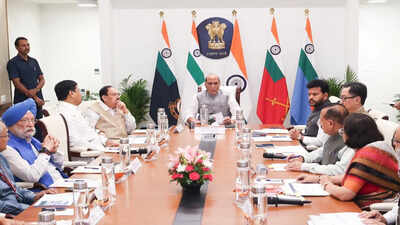
NEW DELHI: Defence minister Rajnath Singh on Monday urged “people to remain calm and avoid any kind of panic as all concrete steps are being taken to prevent shortages or disruptions in supply chains”. The minister, who chaired the 5th meeting of the informal group of ministers (IGoM) on the West Asia developments, said his “govt’s primary focus is to ensure that energy flows remain uninterrupted, economic stability is maintained and maritime trade routes remain secure”. He, however, urged people to rationalise use of fuel.The IGoM, attended by several ministers, including Jagat Prakash Nadda, Hardeep Singh Puri, Ashwini Vaishnaw, Kiren Rijiju, K R Rammohan Naidu, S Sonowal and Jitendra Singh, was informed that the country is secure, and there is no shortage of any petroleum product, even as most other nations have taken emergency measures to dramatically reduce domestic consumption.The ministers were also informed that there is a surplus amount of essential commodities for the people and the present conservation is intended towards long-run capacity building if the crisis prolongs. The supply management has been good, and the people need not panic or resort to over purchase of fuel and other products.“India has 60 days of crude oil, 60 days of natural gas and 45 days of LPG rolling stock. The foreign exchange reserves stand at a comfortable $703 billion. India is the world’s third largest oil refiner and fourth largest exporter of petroleum products, exporting to over 150 countries and is meeting domestic demand in full. But there is a huge cost being borne by the nation as international crude prices are continuing at very high levels. Fuel conservation can ease this burden,” a govt release said after the meeting.Rajnath, however, directed officials to take concrete steps to implement the PM’s appeal (to rationalise use of fuel) at the ground level. “Ministries and states must identify, in a coordinated manner, measures to institutionalise fuel efficiency, public awareness, and responsible consumption behaviour,” he said, adding, we “need to focus on strategic crisis anticipation, early warning assessment, scenario planning and timely whole-of-govt preparedness”.On Sunday, PM Modi appealed to the people for collective participation to help the country deal with global economic disruptions, supply chain challenges and rising prices caused by international conflicts by prudently using petroleum products and by reducing wasteful consumption so that the fiscal burden on the nation is reduced.India is among a few countries where petroleum prices have held steady through this period of global volatility even after more than 70 days since the conflict started. In many countries, prices have increased by 30 to 70%. However, India’s oil marketing companies have absorbed losses of close to Rs 1,000 crore a day, with under-recoveries running to nearly Rs 2 lakh crore in Q1 ’26 so that the burden of global astronomical prices is not passed to the Indian citizens.


