
Mamata Banerjee NEW DELHI: Constitutional position is unambiguous on a CM refusing to resign after her defeat in an assembly election — once the polls have been concluded and certificates issued to the elected MLAs by the EC, the outgoing House automatically stands dissolved and its successor has to be constituted with the appointment of a new CM by the governor, who invites the representative of the largest party, or an alliance, to form govt. On Tuesday, outgoing Bengal CM Mamata Banerjee stoked a controversy by claiming, in a first, that she would not resign since she has not lost the elections, disregarding TMC’s debacle and her defeat in the Bhabanipur constituency to BJP’s Suvendu Adhikari by more than 15,000 votes.Also Read | With Mamata’s nemesis Suvendu Adhikari, Amit Shah plotted her downfall Legal experts, however, are of the view that Banerjee has no option but to go and pave the way for a new govt after the tenure of the assembly expires on May 8. “Any person dissatisfied with the results can file an election petition qua individual position and constituency within 45 days of the declaration of results. Obviously, there can be no mass or mega election petitions. Equally, and obviously, the power to file such challenges in court cannot detract from the unquestionable obligation to resign and vacate CM’s chair the moment the election certificates are issued by the Election Commission. . Maybe it is a rhetorical outburst, but the legal position is clear that she has to resign (on her party being defeated in the assembly elections),” constitutional expert and senior advocate Abhishek Manu Singhvi told TOI. “This is the inexorable cycle of democracy and necessarily must be followed by all without exception. The continuance of an incumbent chief minister, after an election defeat, unfortunately will be consequentially legally void,” he added. Senior advocate Rakesh Dwivedi, an expert on constitutional laws, said that if the CM does not resign, then the governor of the state concerned has the power to dismiss her. “There is no question of two CMs under the constitutional scheme. Constitutional morality and electoral mandate make it a must for the incumbent CM to resign and make way for the political party, which secured a majority, to form govt under their representative,” he said. “The moment a new assembly is constituted, the party which won the majority in the polls will elect its representative, who will stake its claim to form govt before the governor. The governor has no option but to call the party commanding a majority in the House to form govt. If Mamata does not resign, the governor can dismiss her,” he said. Article 172(1) of the Constitution says the legislative assembly shall continue for five years from the date appointed for its first meeting, and no longer, and the expiration of the said period of five years shall operate as a dissolution of the assembly.Follow the latest election results 2026, live updates, winner lists, constituency-wise results, party-wise trends and full coverage for Tamil Nadu election results, West Bengal election results, Kerala election results, Assam election results and Puducherry election results results on Times of India.End of ArticleFollow Us On Social MediaVideosDMK Hits Out As Congress Directs TNCC To Take Final Call On Vijay’s Support Request’Historic, Decisive’: Trump Congratulates PM Modi Over BJP’s Win In Bengal ElectionsDefeat but ‘Moral Win’? Mamata Targets EC, Hints At BIGGER Opposition AlliancePower Bank Catches Fire On IndiGo Hyderabad-Chandigarh Flight, All Passengers And Crew EvacuatedIndia Seeks To Lease Three Ultra Heavy Lift Helicopters To Boost CapabilityAIMIM Chief Owaisi Says Muslim Votes Wasted on Secular Parties, Calls for ShiftKejriwal Alleges BJP “Robbed” Punjab of Rajya Sabha Seats, Vows Political Revenge“Democracy Being Mocked”: Bhagwant Mann Meets President Over Defection of 7 AAP Rajya Sabha MPsNCERT Clears Revised Class 8 Textbook After Judiciary Chapter Row And Public ApologyPM Modi call Fujairah Attack ‘Unacceptable’, Three Indians Injured In UAE123PhotostoriesMorning affirmation at 5 AM: What your mind needs to hear todayWatermelon vs. mango: Which is better for summer nutrition and the right way to consume5 unique national parks in South America where waterfalls, wildlife and wilderness come aliveHow to make Chef Ranveer Brar-Style Lucknowi Dal Falaknuma at homeOlder than dinosaurs? 5 prehistoric-era animals that still walk the Earth todayKaran Johar to Ananya Birla:Indian stars who stole the show at Met Gala 2026From ‘The Dark Knight’ to ‘Brokeback Mountain’: Heath Ledger’s top films to stream on OTT right nowA fresh, green home without the effort: Plants that thrive even when you forget8 ‘weird’ dog behaviours explained: What your pet is really trying to tell youSubtle signs you’re outgrowing a friendship– And how to deal with it123Hot PicksBarrackpore election resultTiruchirappalli election resultMettupalayam election resultsEttumanoor election resultPerambur election resultBagnan election resultKazhakkoottam election resultTop TrendingNFL Trade RumorsRahul GandhiBadruddin AjmalIPL Playoff Qualification ScenariosIPL 2026 Points TableMI IPL Playoff Qualification ScenariosJalandhar BlastNEET 2026: Exam-day guideSRMJEEE 2026 Phase 1 ResultTVK Chief Vijay


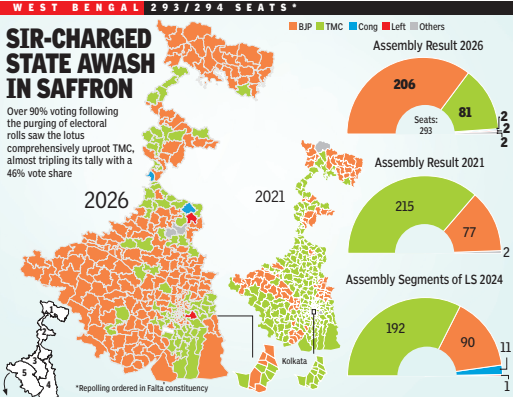
NEW DELHI: Constitutional position is unambiguous on a CM refusing to resign after her defeat in an assembly election — once the polls have been concluded and certificates issued to the elected MLAs by the EC, the outgoing House automatically stands dissolved and its successor has to be constituted with the appointment of a new CM by the governor, who invites the representative of the largest party, or an alliance, to form govt. On Tuesday, outgoing Bengal CM Mamata Banerjee stoked a controversy by claiming, in a first, that she would not resign since she has not lost the elections, disregarding TMC’s debacle and her defeat in the Bhabanipur constituency to BJP’s Suvendu Adhikari by more than 15,000 votes.Also Read | With Mamata’s nemesis Suvendu Adhikari, Amit Shah plotted her downfall Legal experts, however, are of the view that Banerjee has no option but to go and pave the way for a new govt after the tenure of the assembly expires on May 8. “Any person dissatisfied with the results can file an election petition qua individual position and constituency within 45 days of the declaration of results. Obviously, there can be no mass or mega election petitions. Equally, and obviously, the power to file such challenges in court cannot detract from the unquestionable obligation to resign and vacate CM’s chair the moment the election certificates are issued by the Election Commission.
.
Maybe it is a rhetorical outburst, but the legal position is clear that she has to resign (on her party being defeated in the assembly elections),” constitutional expert and senior advocate Abhishek Manu Singhvi told TOI. “This is the inexorable cycle of democracy and necessarily must be followed by all without exception. The continuance of an incumbent chief minister, after an election defeat, unfortunately will be consequentially legally void,” he added. Senior advocate Rakesh Dwivedi, an expert on constitutional laws, said that if the CM does not resign, then the governor of the state concerned has the power to dismiss her. “There is no question of two CMs under the constitutional scheme. Constitutional morality and electoral mandate make it a must for the incumbent CM to resign and make way for the political party, which secured a majority, to form govt under their representative,” he said. “The moment a new assembly is constituted, the party which won the majority in the polls will elect its representative, who will stake its claim to form govt before the governor. The governor has no option but to call the party commanding a majority in the House to form govt. If Mamata does not resign, the governor can dismiss her,” he said. Article 172(1) of the Constitution says the legislative assembly shall continue for five years from the date appointed for its first meeting, and no longer, and the expiration of the said period of five years shall operate as a dissolution of the assembly.


