
BJP supporters celebrating after party’s massive victory in West Bengal. (PTI photo) NEW DELHI: Bengal on May 4 felt the pulse of its politics and what was seemingly inevitable – the poriborton.The 2026 Bengal assembly verdict wasn’t just decisive — it was transformative. The once-puny BJP morphed into an invincible force, surging past the 200-mark to claim 207 seats with a commanding 45.84% vote share.The Trinamool Congress (TMC), which once dominated the state with 225 seats, was reduced to double digits, with its vote share slipping to 40.8 percent. The scale of this reversal told a deeper story than numbers alone. This was not a narrow swing or a fragmented mandate as the verdict roared out loud across Banga, echoing the deep rooted anti-incumbency against the Mamata regime.The signal was unmistakable when over 92.5 percent of Bengal’s electorate turned up to vote, a level of participation unseen since Independence. Such surges in turnout rarely occur without a powerful undercurrent of sentiment and emotion.9 out of 10 voters turning up in a contest against a 15-year incumbent could not have been read as routine without a serious misjudgment, especially when the dispensation faced allegations of corruption, unemployment, and above all, a collapse of law and order.The structural shift across regions, communities, and classes, from North Bengal to the industrial belts of Howrah and the urban clusters around Kolkata, the message was consistent. Bengal and its Bhadralok voted not just for pivot, but for a shompurno poriborton! Saffron surge in West BengalA complete resetThis outcome felt inevitable for reasons that go well beneath the final numbers where lies layers of discontent, recalibration, and political strategy that unfolded over years.At the heart of the verdict was a powerful and deeply embedded anti incumbency sentiment. Fifteen years of TMC rule under Mamata Banerjee had created fatigue that cut across rural and urban Bengal. What began in 2011 as a movement against the Left Front’s stagnation had, by 2026, come full circle. Mamata Banerjee had once represented disruption and hope. Over time, her regime became associated with a different vocabulary. Words like “cut money”, “syndicate control”, and “tolabazi” became shorthand for everyday governance failures. A stark atmosphere in and around West Bengal Chief Minister Mamata Banerjee’s residence on the counting day of West Bengal Assembly elections, in Kolkata on Monday. (ANI)This was not merely opposition rhetoric, it was a lived experience. From construction projects to small household repairs, local syndicates were perceived to control economic activity. For many citizens, governance appeared outsourced to local intermediaries, considered the foot soldiers of the Trinamool, rather than directed by the state. The gap between Mamata’s image as a grassroots leader and the functioning of her party machinery widened steadily. That disconnect proved politically fatal.Strong stains of corruptionCorruption scandals played a crucial role in hardening this sentiment as Bengal had already seen controversies before, from Saradha to Narada, but the teacher recruitment scam struck a different chord. The cancellation of over 25,000 teaching and non teaching appointments by the Supreme Court transformed corruption from an abstract charge into a personal crisis for thousands of families. In a state where government jobs carry immense social value, the scandal symbolised a breakdown of trust. Vote Share in West Bengal electionsAlongside corruption came a pervasive concern about law and order. The rape and murder of a trainee doctor at RG Kar Medical College in 2024 became a turning point in the public psyche. The outrage that followed was not confined to Kolkata as it resonated to every Indian and made space for social media feeds, especially among women voters who had long been the backbone of Trinamool’s electoral strength. The perception that the government’s response lacked urgency or empathy deepened the damage. For a leadership that had built its legitimacy on emotional connection, this rupture was profound.Women’s safetyWomen voters did turn out in large numbers, even higher than men. However, the turnout did not translate into votes for TMC. Welfare schemes like Lakshmi Bhandar and Kanyashree had once secured unwavering support in favour of Mamata but by 2026, that backing had become conditional. Women voters began to weigh safety, employment, and long term prospects alongside financial assistance. The BJP recognised this shift early and responded with a calibrated strategy. Schemes and promises It promised higher cash transfers, effectively doubling existing benefits, while simultaneously foregrounding issues of safety and dignity. The result was not a complete realignment but a crucial erosion of Trinamool’s advantage.Crisis of ‘chakri’ Economic anxiety formed another pillar of the BJP’s unprecedented performance in the non-Hindi speaking state. Bengal’s long narrative of de-industrialisation had reached a tipping point in the public imagination. Migration became a powerful symbol of failure. Families spoke openly about children leaving the state for work in other regions, including those governed by the BJP. This was not just about chakris (jobs). It was about dignity and aspiration. The promise of industrial revival and employment creation gave the BJP a credible economic plank, even if it remained aspirational. How the regions votedThe impact of this narrative was particularly visible in industrial belts like Barrackpore and Howrah. These regions, once dominated by labour politics, had experienced decades of decline. Factories closed, jobs disappeared, and political networks shifted towards control of local economies rather than production. Voters in these areas responded to the BJP’s promise of disruption. The party’s success here was not just electoral. It was symbolic of a broader shift from nostalgia to impatience.Counter consolidation of HindusIdentity politics played a huge role in paving the way for Hindutva politics to make inroads in Bengal. The consolidation of Hindu votes, cutting across caste and linguistic lines, provided the BJP with a stable electoral base. Allegations of appeasement by the ruling party, whether fully grounded or politically amplified, created fertile ground for this consolidation. The BJP’s messaging was clear and consistent as it positioned itself as a party that would restore balance, enforce rule of law, and address concerns around illegal immigration and demographic change. Saffron shiftHowever, the party did not rely solely on polarisation, but complemented this narrative with a conscious effort to localise its appeal. The outsider tag that had hurt it in 2021 was systematically dismantled with campaigns invoking Bengali culture, from references to Maa Kali to the use of local idioms and symbols. Leaders engaged with everyday cultural markers, whether through fish, jhalmuri or festivals, to signal familiarity rather than distance. This recalibration helped the BJP embed itself within Bengal’s socio-cultural landscape.Relentless campaignsPrime Minister Narendra Modi and Union home minister Amit Shah, who stayed in the state for 15 days, maintained a constant presence on the ground, adding another layer to the relentless campaign by the local BJP cadre that was seemingly weak in substantial pockets of Bengal, especially rural Bengal. 110 days of campaigns Their messaging evolved from broad ideological appeals to hyper local issues. The call for poriborton became both a slogan and a sentiment that resonated with voters already inclined towards change.The Special Intensive RevisionThe role of institutional factors cannot be ignored as the revision of electoral rolls under the SIR process became a contentious issue. While the Trinamool framed it as a targeted exclusion of its voter base, the BJP argued it was a necessary correction of inflated lists. Regardless of where the truth lies, the outcome was clear. The issue did not translate into a political advantage for the ruling party. Instead, improved polling conditions and the presence of central forces appeared to embolden voters who might otherwise have hesitated. Strike rate in 2026 Bengal pollsThe BJP’s targeted reachout among its voter base further strengthened its position as Matua community, a significant electoral bloc, largely remained aligned with the party despite concerns over citizenship and voter list revisions. This continuity ensured that key constituencies in North 24 Parganas and Nadia stayed within the BJP’s fold.Urban and suburban voters too emerged as the decisive factor. The decimation of Trinamool’s dominance in the Kolkata belt and surrounding districts marked the tipping point. These areas had historically delivered the margins needed for victory. Their shift towards the BJP reflected a convergence of factors. Economic dissatisfaction, concerns over governance, and a desire for change combined to produce a decisive swing.The perception warWhat tilted this election decisively towards the BJP was Mamata Banerjee’s failure to set her own narrative. Instead, the chief minister played on her rival’s turf, reacting to their attacks. In the social media era, such a perceptual dent can prove irredeemable.The most striking aspect of the election was the BJP’s ability to craft a multi-layered narrative that addressed different constituencies simultaneously. Prime Minister Narendra Modi arrives to celebrate victory with BJP supporters after the party’s massive win in the West Bengal, Assam and Puducherry Assembly election 2026 at BJP headquarters, in New Delhi on Monday. BJP National President Nitin Nabin also present. For welfare beneficiaries, it offered higher financial support. For the unemployed, it promised jobs and industrial revival. For women, it highlighted safety and dignity. For Hindu voters, it emphasised identity and security. This broad based approach created a coalition that was difficult for the TMC to counter.In contrast, the ruling party struggled to adapt. Its welfare model, once innovative, had become predictable. Its narrative of Bengali identity, which had effectively countered the BJP in earlier elections, lost some of its resonance in the face of economic and governance concerns. Attempts at course correction, such as stipends for priests or increased support for cultural events, appeared reactive rather than strategic.Gratitude based politics gave way to transactional expectations as beneficiaries of welfare schemes began to see themselves as consumers of political offerings rather than loyal supporters and that shift made them more open to alternatives that promised better returns.Migration, industrial decline, corruption, safety concerns, and identity politics all converged to create a political environment in which change became not just desirable but inevitable. The BJP did not create these conditions. It recognised and capitalised on them more effectively than its opponent.Even incidents during the campaign hinted at the direction of the verdict. Localised confrontations, shifts in turnout patterns, and the changing tone of public discourse suggested that the ground was shifting. By the time votes were cast, the momentum had already moved decisively in one direction.The phrase “set in stone” may sound deterministic, but in the context of Bengal’s 2026 verdict, it captures a reality that unfolded over years. The BJP’s victory was not just the result of a successful campaign, but the product of accumulated grievances, politically prudent adaptation, and a changing consciousness among voters.By the time votes were cast, the outcome was no longer in doubt. As the results showed, the signs were visible in the anger, in the silence, and in the unprecedented turnout. Bengal did not wake up on counting day to choose change, it had made that choice long before. The result only confirmed what had already been “set in stone”, May the 4th be Poriborton!Follow the latest election results 2026, live updates, winner lists, constituency-wise results, party-wise trends and full coverage for Tamil Nadu election results, West Bengal election results, Kerala election results, Assam election results and Puducherry election results results on Times of India.About the AuthorRajeev SinghRajeev Singh is a Digital Content Producer with The Times of India. He covers politics, policies, defence, and conflicts for readers curious to know their implications. He loves digging into legal maxims and political trivia. On off days, when not turning pages or learning русский, he lives in the reverie of “what ifs” and “how abouts.”Read MoreEnd of ArticleFollow Us On Social MediaVideos“Democracy Being Mocked”: Bhagwant Mann Meets President Over Defection of 7 AAP Rajya Sabha MPsNCERT Clears Revised Class 8 Textbook After Judiciary Chapter Row And Public ApologyPM Modi call Fujairah Attack ‘Unacceptable’, Three Indians Injured In UAEPunjab Showdown: AAP MLAs Head to President Over Rajya Sabha RowIndia Rejects Nepal’s Objection To Kailash Mansarovar Yatra Route Via Lipulekh PassNepal Objects To India-China Plan To Conduct Kailash Mansarovar Yatra Via LipulekhIndia-Linked LPG Tanker MT Sarv Shakti Heads To Visakhapatnam After Crossing HormuzPassenger Opens Emergency Exit Door On Air Arabia Flight While Taxiing At Chennai Airport, ArrestedAhead Of Counting, Gunmen Open Fire At BJP Leader’s House In Bengal’s Noapara‘I Am Also A Victim’: Vinesh Phogat Identifies As Complainant In Brij Bhushan Sexual Harassment Case123PhotostoriesAfter BJP’s Bengal sweep, all eyes on CM face: Who will take charge?From fight with Rupali Ganguly to shocking casting couch experience: Anupamaa’s Madalsa Sharma gets candid5 most common places where snakes can hide in homes in the US (You might miss some out, right in front of your eyes)Met Gala debuts: From Sunday Rose to Lila Moss, the most iconic celeb kids debut over the yearsWhich are the most common surnames around the world? Things travellers should know10 early signs your child may be exceptionally brightVenus Williams to Naomi Osaka: Best dressed athletes at Met Gala 2026″I do enjoy cooking at times”: R.Madhavan on his connection with cooking and his 10 vegetarian South Indian breakfast choices5 common parenting mistakes that create emotional distanceBengaluru’s traffic puzzle grows bigger: Another key flyover marked for demolition123Hot PicksBarrackpore election resultTiruchirappalli election resultMettupalayam election resultsEttumanoor election resultPerambur election resultBagnan election resultKazhakkoottam election resultTop TrendingKiran MazumdarRahul GandhiBadruddin AjmalIPL Playoff Qualification ScenariosIPL 2026 Points TableMI IPL Playoff Qualification ScenariosPM ModiNEET 2026: Exam-day guideSRMJEEE 2026 Phase 1 ResultTVK Chief Vijay

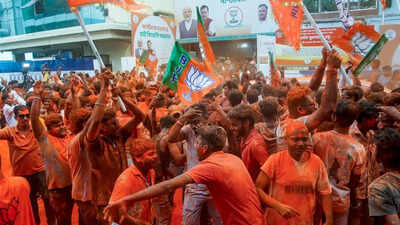
NEW DELHI: Bengal on May 4 felt the pulse of its politics and what was seemingly inevitable – the poriborton.The 2026 Bengal assembly verdict wasn’t just decisive — it was transformative. The once-puny BJP morphed into an invincible force, surging past the 200-mark to claim 207 seats with a commanding 45.84% vote share.The Trinamool Congress (TMC), which once dominated the state with 225 seats, was reduced to double digits, with its vote share slipping to 40.8 percent. The scale of this reversal told a deeper story than numbers alone. This was not a narrow swing or a fragmented mandate as the verdict roared out loud across Banga, echoing the deep rooted anti-incumbency against the Mamata regime.The signal was unmistakable when over 92.5 percent of Bengal’s electorate turned up to vote, a level of participation unseen since Independence. Such surges in turnout rarely occur without a powerful undercurrent of sentiment and emotion.9 out of 10 voters turning up in a contest against a 15-year incumbent could not have been read as routine without a serious misjudgment, especially when the dispensation faced allegations of corruption, unemployment, and above all, a collapse of law and order.The structural shift across regions, communities, and classes, from North Bengal to the industrial belts of Howrah and the urban clusters around Kolkata, the message was consistent. Bengal and its Bhadralok voted not just for pivot, but for a shompurno poriborton!
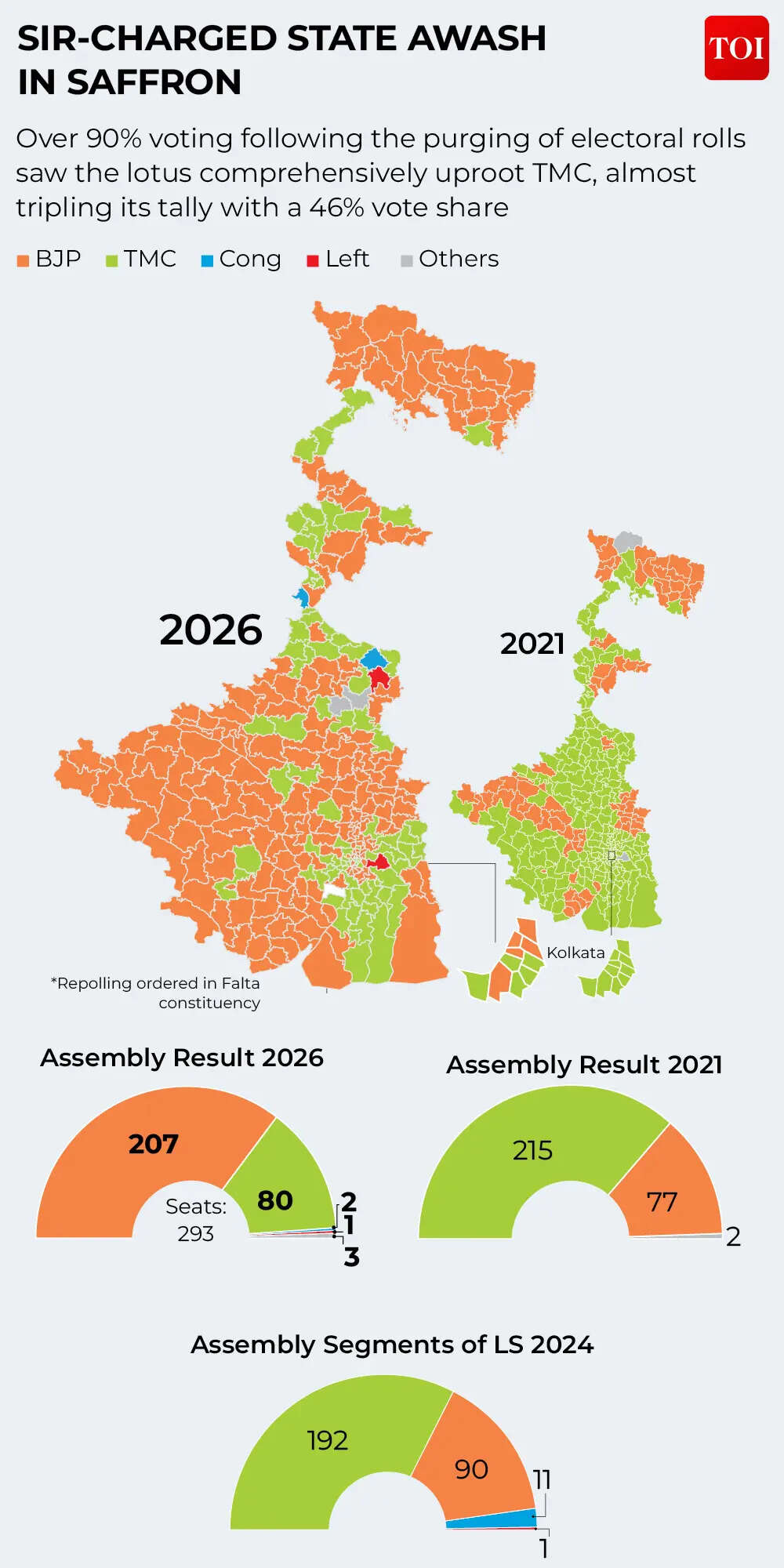
Saffron surge in West Bengal
A complete reset
This outcome felt inevitable for reasons that go well beneath the final numbers where lies layers of discontent, recalibration, and political strategy that unfolded over years.At the heart of the verdict was a powerful and deeply embedded anti incumbency sentiment. Fifteen years of TMC rule under Mamata Banerjee had created fatigue that cut across rural and urban Bengal. What began in 2011 as a movement against the Left Front’s stagnation had, by 2026, come full circle. Mamata Banerjee had once represented disruption and hope. Over time, her regime became associated with a different vocabulary. Words like “cut money”, “syndicate control”, and “tolabazi” became shorthand for everyday governance failures.
![Kolkata [West Bengal], May 04 (ANI)_ A stark atmosphere in and around West Benga....](https://static.toiimg.com/photo/msid-130824812/kolkata-west-bengal-may-04-ani-a-stark-atmosphere-in-and-around-west-benga.jpg "A stark atmosphere in and around West Bengal Chief Minister Mamata Banerjee's residence on the counting day of West Bengal Assembly elections, in Kolkata on Monday. (ANI)")
A stark atmosphere in and around West Bengal Chief Minister Mamata Banerjee’s residence on the counting day of West Bengal Assembly elections, in Kolkata on Monday. (ANI)
This was not merely opposition rhetoric, it was a lived experience. From construction projects to small household repairs, local syndicates were perceived to control economic activity. For many citizens, governance appeared outsourced to local intermediaries, considered the foot soldiers of the Trinamool, rather than directed by the state. The gap between Mamata’s image as a grassroots leader and the functioning of her party machinery widened steadily. That disconnect proved politically fatal.
Strong stains of corruption
Corruption scandals played a crucial role in hardening this sentiment as Bengal had already seen controversies before, from Saradha to Narada, but the teacher recruitment scam struck a different chord. The cancellation of over 25,000 teaching and non teaching appointments by the Supreme Court transformed corruption from an abstract charge into a personal crisis for thousands of families. In a state where government jobs carry immense social value, the scandal symbolised a breakdown of trust.
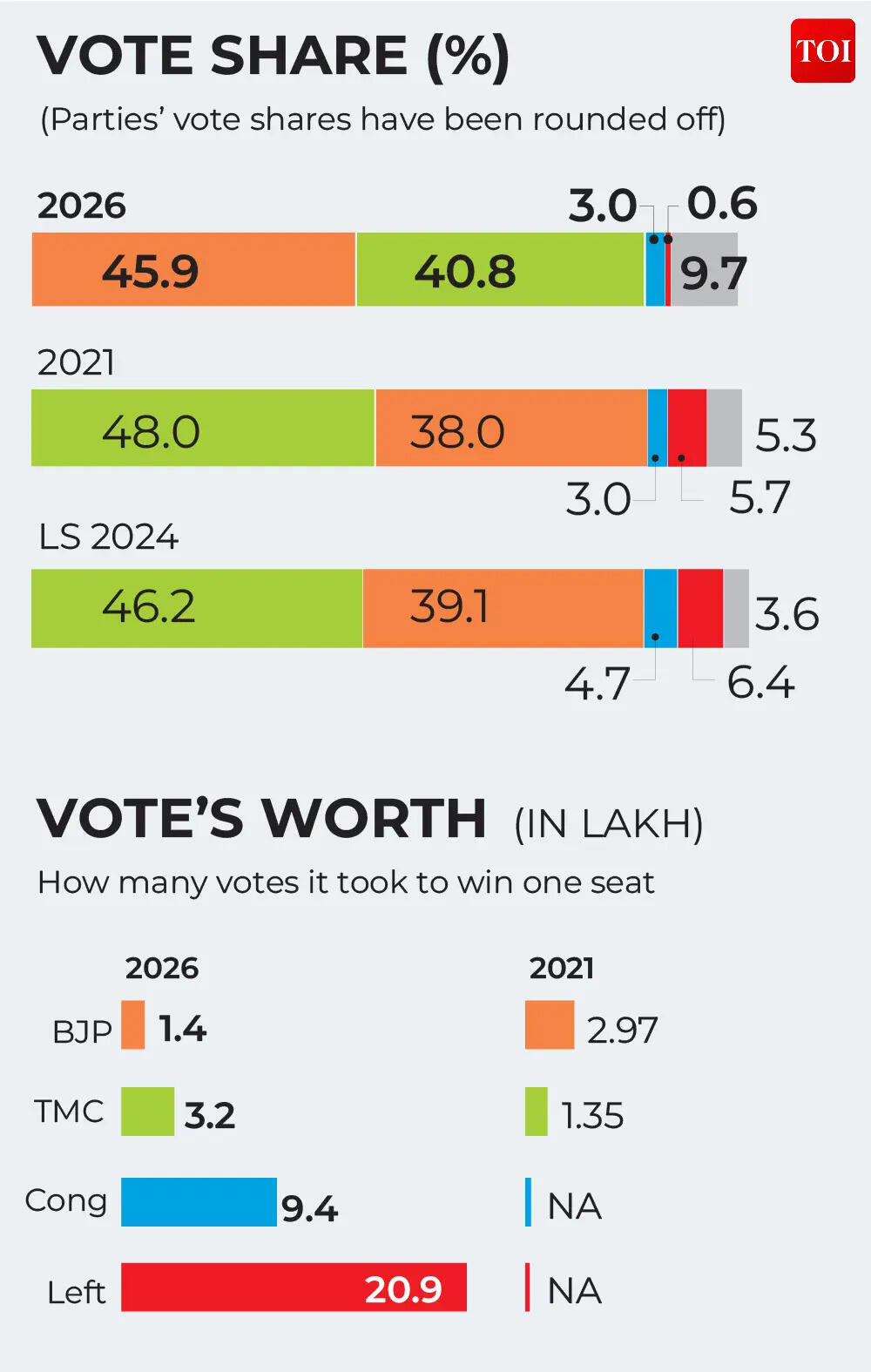
Vote Share in West Bengal elections
Alongside corruption came a pervasive concern about law and order. The rape and murder of a trainee doctor at RG Kar Medical College in 2024 became a turning point in the public psyche. The outrage that followed was not confined to Kolkata as it resonated to every Indian and made space for social media feeds, especially among women voters who had long been the backbone of Trinamool’s electoral strength. The perception that the government’s response lacked urgency or empathy deepened the damage. For a leadership that had built its legitimacy on emotional connection, this rupture was profound.
Women’s safety
Women voters did turn out in large numbers, even higher than men. However, the turnout did not translate into votes for TMC. Welfare schemes like Lakshmi Bhandar and Kanyashree had once secured unwavering support in favour of Mamata but by 2026, that backing had become conditional. Women voters began to weigh safety, employment, and long term prospects alongside financial assistance. The BJP recognised this shift early and responded with a calibrated strategy.
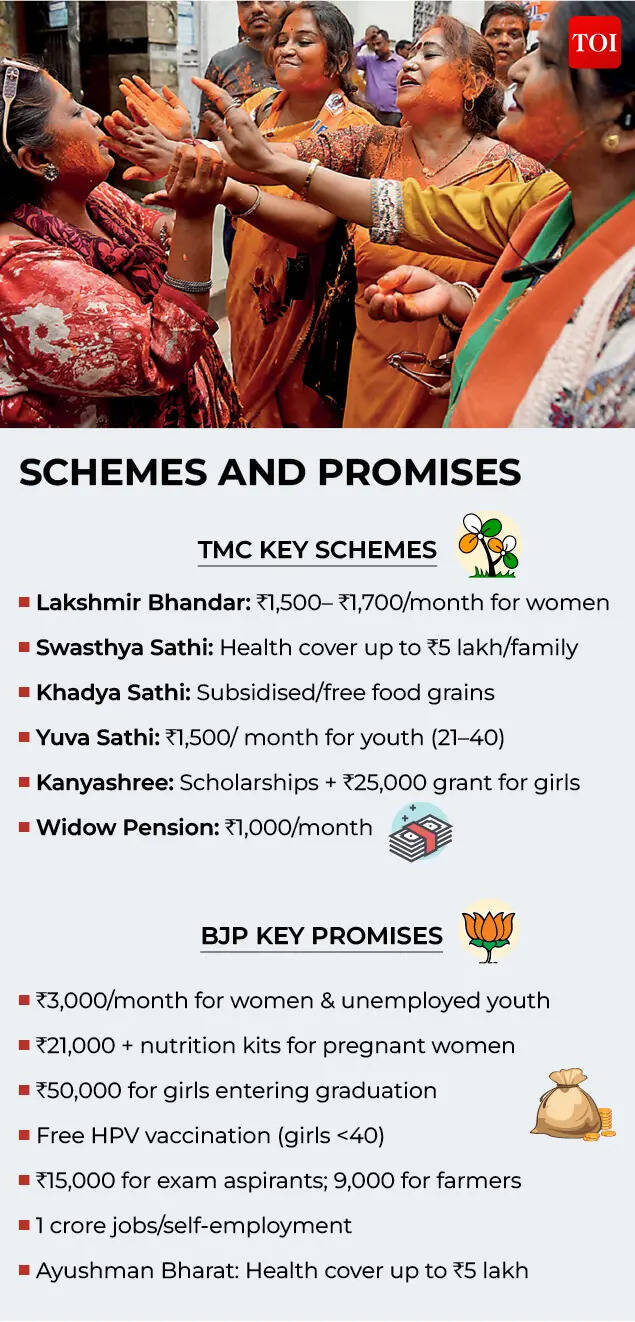
Schemes and promises
It promised higher cash transfers, effectively doubling existing benefits, while simultaneously foregrounding issues of safety and dignity. The result was not a complete realignment but a crucial erosion of Trinamool’s advantage.
Crisis of ‘chakri’
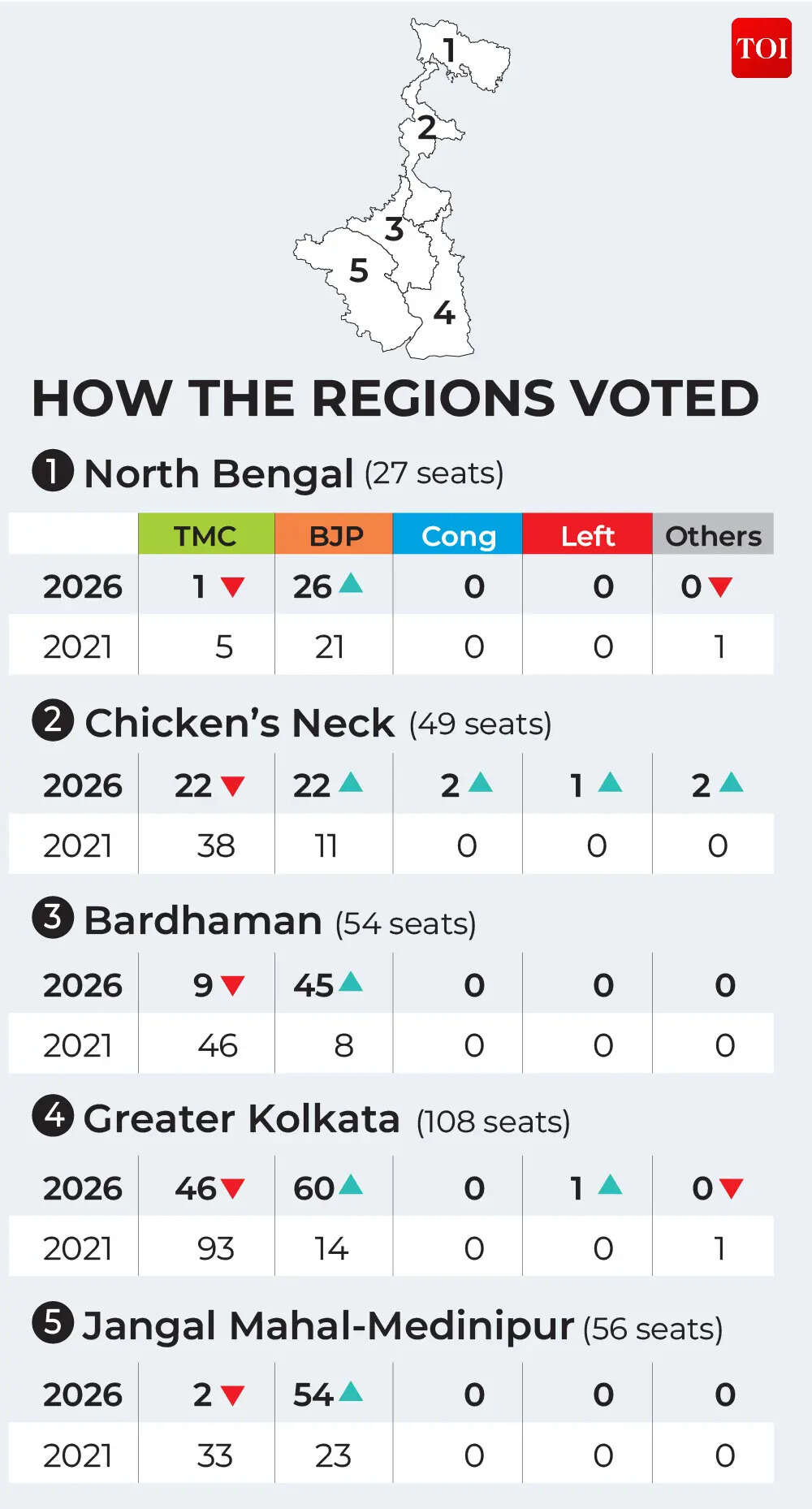
Economic anxiety formed another pillar of the BJP’s unprecedented performance in the non-Hindi speaking state. Bengal’s long narrative of de-industrialisation had reached a tipping point in the public imagination. Migration became a powerful symbol of failure. Families spoke openly about children leaving the state for work in other regions, including those governed by the BJP. This was not just about chakris (jobs). It was about dignity and aspiration. The promise of industrial revival and employment creation gave the BJP a credible economic plank, even if it remained aspirational.
How the regions voted
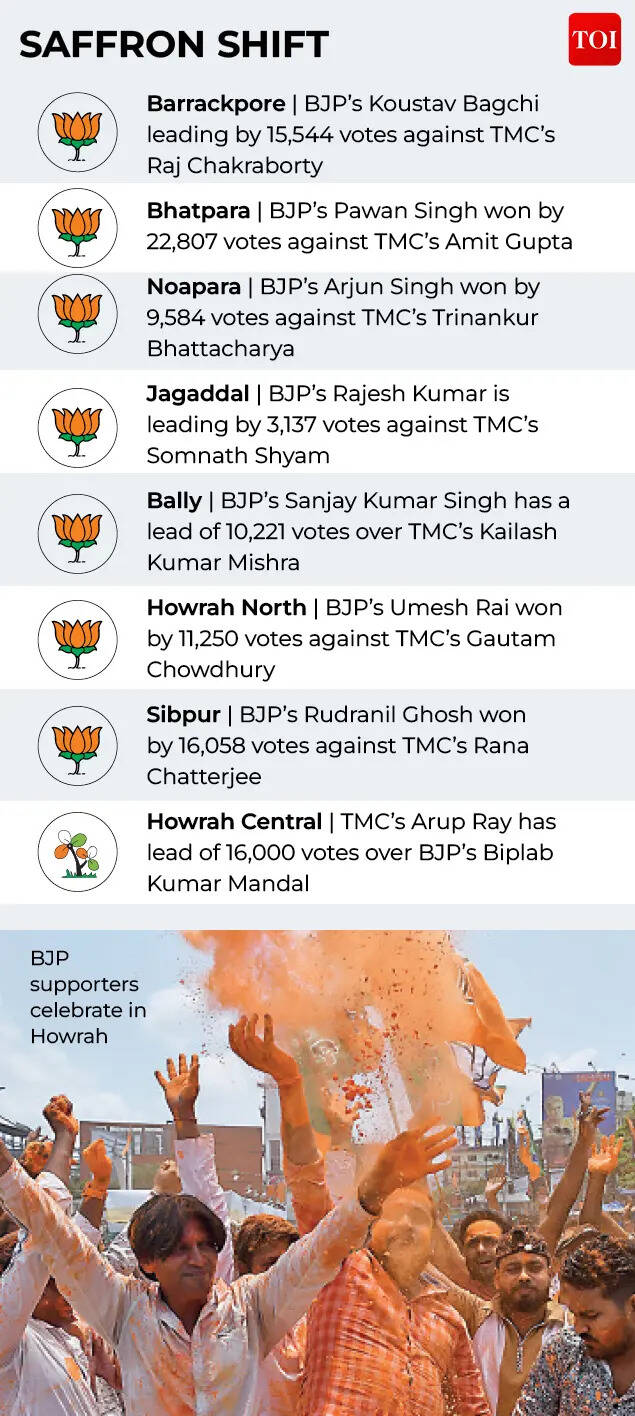
The impact of this narrative was particularly visible in industrial belts like Barrackpore and Howrah. These regions, once dominated by labour politics, had experienced decades of decline. Factories closed, jobs disappeared, and political networks shifted towards control of local economies rather than production. Voters in these areas responded to the BJP’s promise of disruption. The party’s success here was not just electoral. It was symbolic of a broader shift from nostalgia to impatience.
Counter consolidation of Hindus
Identity politics played a huge role in paving the way for Hindutva politics to make inroads in Bengal. The consolidation of Hindu votes, cutting across caste and linguistic lines, provided the BJP with a stable electoral base. Allegations of appeasement by the ruling party, whether fully grounded or politically amplified, created fertile ground for this consolidation. The BJP’s messaging was clear and consistent as it positioned itself as a party that would restore balance, enforce rule of law, and address concerns around illegal immigration and demographic change.
Saffron shift
However, the party did not rely solely on polarisation, but complemented this narrative with a conscious effort to localise its appeal. The outsider tag that had hurt it in 2021 was systematically dismantled with campaigns invoking Bengali culture, from references to Maa Kali to the use of local idioms and symbols. Leaders engaged with everyday cultural markers, whether through fish, jhalmuri or festivals, to signal familiarity rather than distance. This recalibration helped the BJP embed itself within Bengal’s socio-cultural landscape.
Relentless campaigns
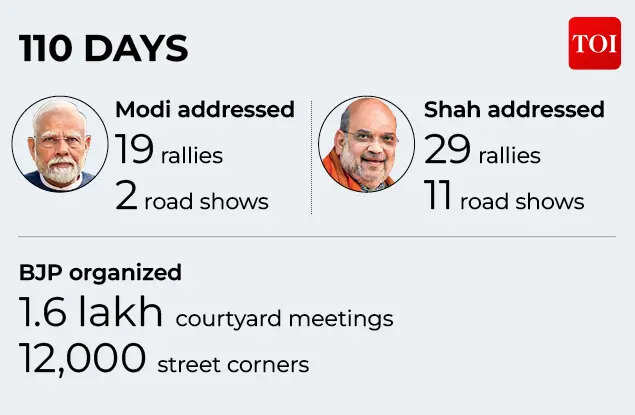
Prime Minister Narendra Modi and Union home minister Amit Shah, who stayed in the state for 15 days, maintained a constant presence on the ground, adding another layer to the relentless campaign by the local BJP cadre that was seemingly weak in substantial pockets of Bengal, especially rural Bengal.
110 days of campaigns
Their messaging evolved from broad ideological appeals to hyper local issues. The call for poriborton became both a slogan and a sentiment that resonated with voters already inclined towards change.
The Special Intensive Revision
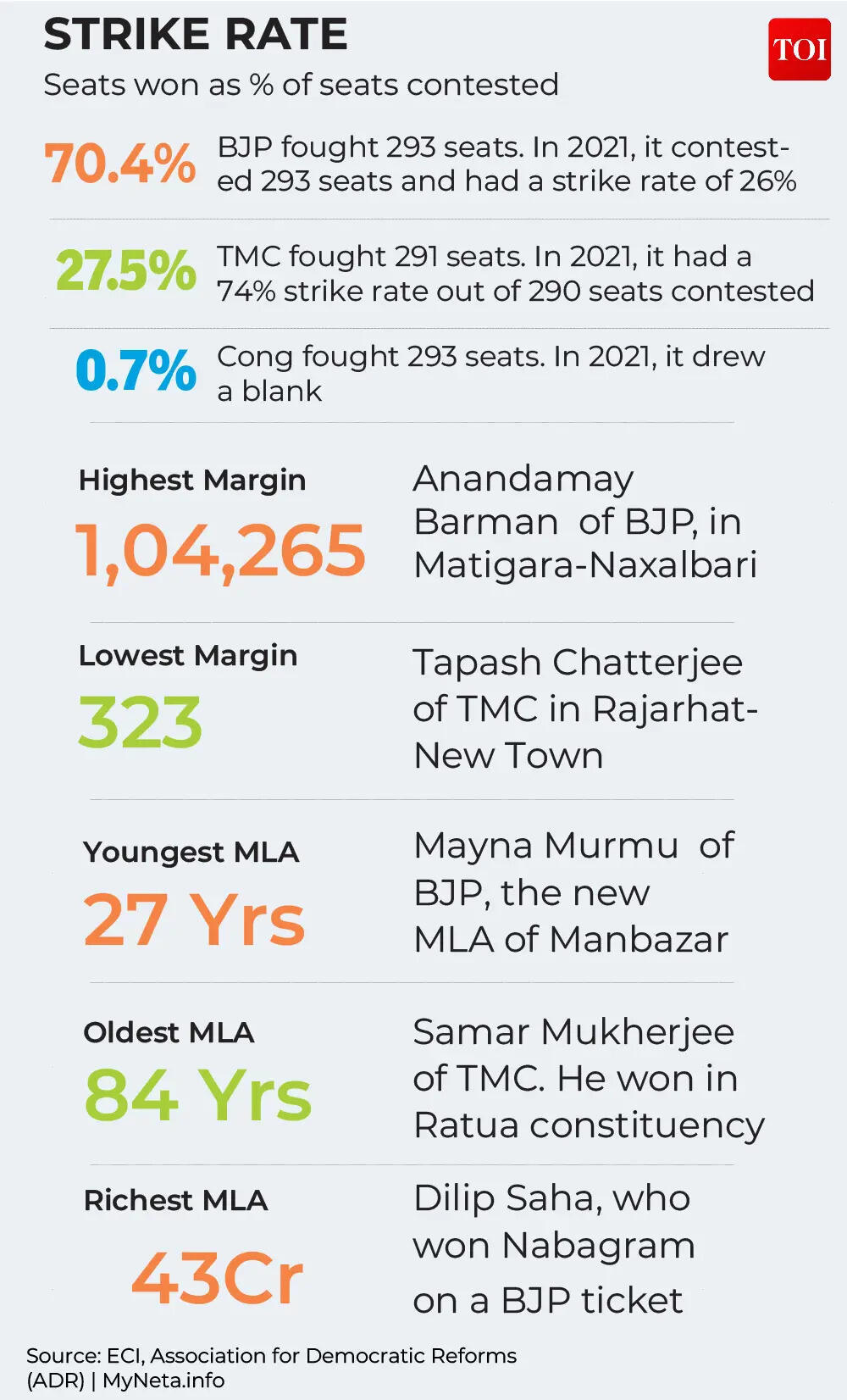
The role of institutional factors cannot be ignored as the revision of electoral rolls under the SIR process became a contentious issue. While the Trinamool framed it as a targeted exclusion of its voter base, the BJP argued it was a necessary correction of inflated lists. Regardless of where the truth lies, the outcome was clear. The issue did not translate into a political advantage for the ruling party. Instead, improved polling conditions and the presence of central forces appeared to embolden voters who might otherwise have hesitated.
Strike rate in 2026 Bengal polls
The BJP’s targeted reachout among its voter base further strengthened its position as Matua community, a significant electoral bloc, largely remained aligned with the party despite concerns over citizenship and voter list revisions. This continuity ensured that key constituencies in North 24 Parganas and Nadia stayed within the BJP’s fold.Urban and suburban voters too emerged as the decisive factor. The decimation of Trinamool’s dominance in the Kolkata belt and surrounding districts marked the tipping point. These areas had historically delivered the margins needed for victory. Their shift towards the BJP reflected a convergence of factors. Economic dissatisfaction, concerns over governance, and a desire for change combined to produce a decisive swing.
The perception war
What tilted this election decisively towards the BJP was Mamata Banerjee’s failure to set her own narrative. Instead, the chief minister played on her rival’s turf, reacting to their attacks. In the social media era, such a perceptual dent can prove irredeemable.The most striking aspect of the election was the BJP’s ability to craft a multi-layered narrative that addressed different constituencies simultaneously.
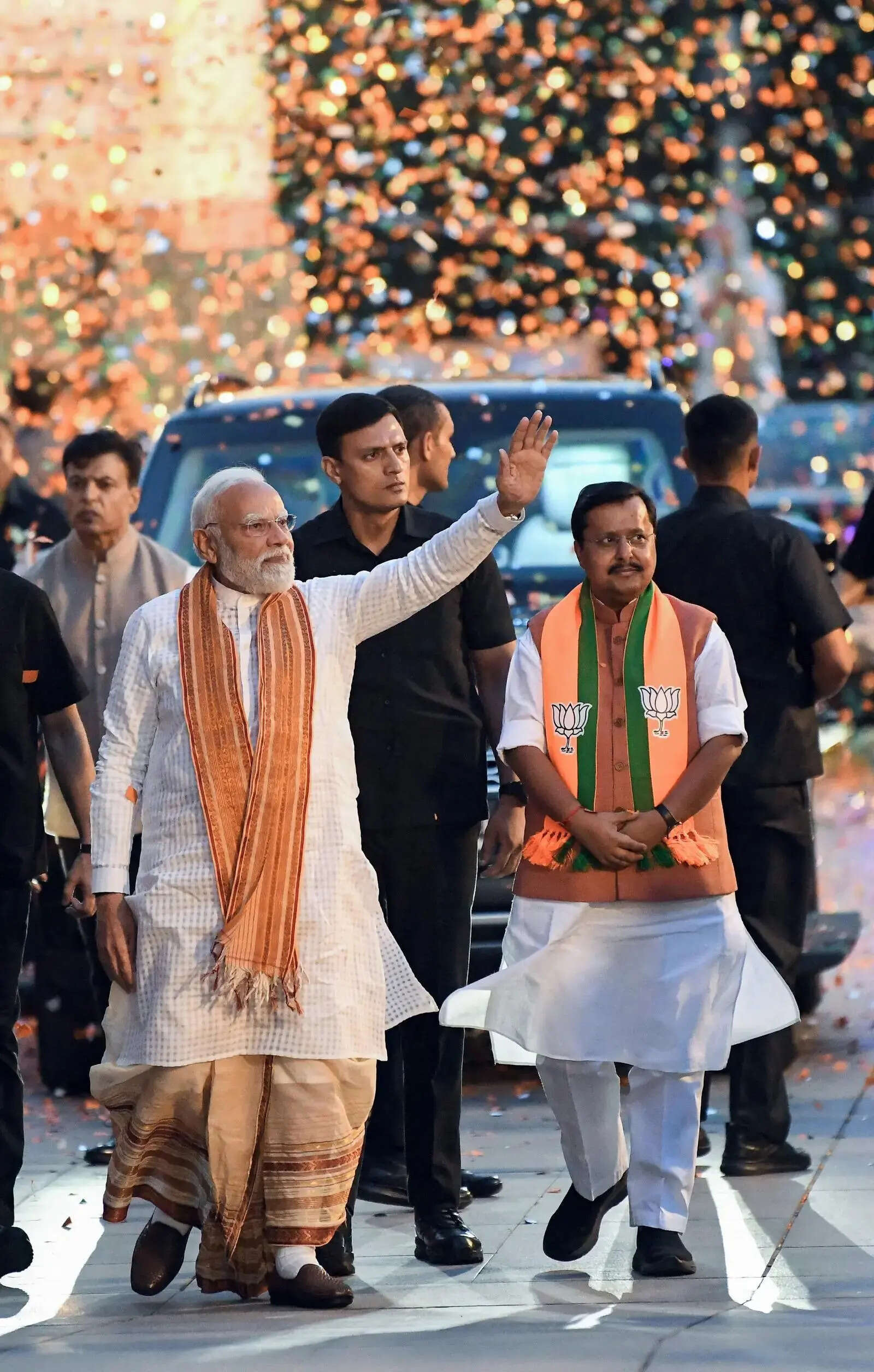
Prime Minister Narendra Modi arrives to celebrate victory with BJP supporters after the party’s massive win in the West Bengal, Assam and Puducherry Assembly election 2026 at BJP headquarters, in New Delhi on Monday. BJP National President Nitin Nabin also present.
For welfare beneficiaries, it offered higher financial support. For the unemployed, it promised jobs and industrial revival. For women, it highlighted safety and dignity. For Hindu voters, it emphasised identity and security. This broad based approach created a coalition that was difficult for the TMC to counter.In contrast, the ruling party struggled to adapt. Its welfare model, once innovative, had become predictable. Its narrative of Bengali identity, which had effectively countered the BJP in earlier elections, lost some of its resonance in the face of economic and governance concerns. Attempts at course correction, such as stipends for priests or increased support for cultural events, appeared reactive rather than strategic.Gratitude based politics gave way to transactional expectations as beneficiaries of welfare schemes began to see themselves as consumers of political offerings rather than loyal supporters and that shift made them more open to alternatives that promised better returns.Migration, industrial decline, corruption, safety concerns, and identity politics all converged to create a political environment in which change became not just desirable but inevitable. The BJP did not create these conditions. It recognised and capitalised on them more effectively than its opponent.Even incidents during the campaign hinted at the direction of the verdict. Localised confrontations, shifts in turnout patterns, and the changing tone of public discourse suggested that the ground was shifting. By the time votes were cast, the momentum had already moved decisively in one direction.The phrase “set in stone” may sound deterministic, but in the context of Bengal’s 2026 verdict, it captures a reality that unfolded over years. The BJP’s victory was not just the result of a successful campaign, but the product of accumulated grievances, politically prudent adaptation, and a changing consciousness among voters.By the time votes were cast, the outcome was no longer in doubt. As the results showed, the signs were visible in the anger, in the silence, and in the unprecedented turnout. Bengal did not wake up on counting day to choose change, it had made that choice long before. The result only confirmed what had already been “set in stone”, May the 4th be Poriborton!


