
Elderly Driving Healthcare Demand Spike NEW DELHI: The risk of being hospitalised in India doubles after the age of 45 and rises sharply among the elderly, signalling a shift in the country’s healthcare burden, according to the latest National Sample Survey Office (NSO) data.The survey shows that hospitalisation rates climb from 23 per 1,000 people in the 30-44 age group to 42 per 1,000 among those aged 45-59, and then nearly double again to 81 per 1,000 in those aged 60 and above. In comparison, only 15 per 1,000 people aged 15-29 required hospital care over the year. Hospitalisation among children aged 0-4 (34 per 1,000) is also higher than among adolescents and young adults, pointing to a dual burden at the two ends of the age spectrum.Election Results 2026Vijay’s TVK party emerges as formidable force in Tamil Nadu; all you need to know about its journeyWest Bengal election results: Mamata lags behind Suvendu Adhikari after 2nd round in BhabanipurTVK pushes DMK, AIADMK to margins; BJP may oust Mamata in Bengal, retain AssamThe data points to a clear transition, with healthcare demand increasingly driven by middle-aged and older populations. Experts say this reflects a rising burden of chronic diseases such as diabetes, heart conditions and respiratory illnesses, which become more common with age and often require hospital treatment.”The sharp rise in hospitalisation after 45 reflects a systemic gap in preventive healthcare. Lifestyle diseases like diabetes, hypertension, obesity, fatty liver and heart disease are accumulating earlier, but structured screening and risk modification are not keeping pace,” said Dr Rommel Tickoo, director, internal medicine, Max Hospital, Saket.”If India invests in early detection, routine metabolic screening, cardiovascular risk assessment, and primary care strengthening, we can significantly reduce avoidable hospital admissions in later decades,” he added.State-wise differences are stark. Kerala reports among the highest hospitalisation rates, with about 186 elderly persons per 1,000 admitted in a year-more than double the national average. Other regions such as Lakshadweep and Tripura also show elevated levels, while some northeastern states report lower rates. However, experts say that higher rates in states like Kerala may also reflect better access to healthcare and higher detection of illnesses.Among the elderly, hospitalisation rates are higher for men (93 per 1,000) than women (69 per 1,000), while differences are smaller or reversed in younger age groups.The trend highlights a growing pressure on hospitals as India’s population ages. With more people living longer and developing long-term conditions, demand for inpatient care is expected to rise in the coming years.The NSO data, based on hospitalisations over the past year (excluding childbirth), underline the need for stronger primary healthcare, early detection and better management of chronic diseases to reduce avoidable hospital admissions.The findings from the NSO suggest that India’s healthcare needs are shifting rapidly towards middle-aged and elderly populations.Follow the latest election results 2026, live updates, winner lists, constituency-wise results, party-wise trends and full coverage for Tamil Nadu election results, West Bengal election results, Kerala election results, Assam election results and Puducherry election results results on Times of India.About the AuthorAnuja JaiswalAnuja Jaiswal is a Senior Assistant Editor at The Times of India, with an impressive 18-year career in narrative journalism. She specializes in health and heritage reporting, expertly simplifying complex health information to make it engaging and understandable for readers. Her deep dives into heritage topics are well-researched, resulting in captivating narratives that resonate with her audience. Over the years, she has worked in Chandigarh, Chhattisgarh and West UP, gaining diverse on-ground experience that shapes her storytelling.Read MoreEnd of ArticleFollow Us On Social MediaVideosIndia Rejects Nepal’s Objection To Kailash Mansarovar Yatra Route Via Lipulekh PassNepal Objects To India-China Plan To Conduct Kailash Mansarovar Yatra Via LipulekhIndia-Linked LPG Tanker MT Sarv Shakti Heads To Visakhapatnam After Crossing HormuzPassenger Opens Emergency Exit Door On Air Arabia Flight While Taxiing At Chennai Airport, ArrestedAhead Of Counting, Gunmen Open Fire At BJP Leader’s House In Bengal’s Noapara‘I Am Also A Victim’: Vinesh Phogat Identifies As Complainant In Brij Bhushan Sexual Harassment CaseBJP MP Sandeep Pathak Claims ‘No Information’ On FIRs, Alleges Misuse Of State Machinery In PunjabIndian Startup Launches Mission Drishti, World’s First OptoSAR Satellite, Aboard SpaceX Falcon 9Diljit Dosanjh Confronts Khalistan Supporters at Calgary Concert, Explains KBC AppearanceDelhi Approves ₹48,000 Crore Metro Expansion Plan To Connect Outer Regions With City Core123PhotostoriesFrom Tomatoes to Beetroot: 7 red foods that protect our heart every dayKhatron Ke Khiladi 15 confirmed contestants list: Gaurav Khanna, Rubina Dilaik, Orry join Rohit Shetty showApple vs. Banana: Which has more nutrition and should be consumed daily and whySleeping late vs waking early: What your body prefers, the answer might surprise youKim Kardashian to Katy Perry: Worst Met Gala dresses ever that sparked major criticismWhy homemade khasta kachori becomes soft after a few hours: 4 halwai-approved smart tips to make them perfect at homeStruggling with a small home? These smart design tricks can make your 200 sq ft space feel twice as bigHissing to Rattling: 7 Sounds that snakes make and which one is the dangerousRihanna to Princess Diana: Best Met Gala looks of all timeNot your usual Kolkata trip: 5 rare and unconventional experiences every traveller should try123Hot PicksBarrackpore election resultTiruchirappalli election resultMettupalayam election resultsEttumanoor election resultPerambur election resultBagnan election resultKazhakkoottam election resultTop TrendingWest Bengal Assembly Election ResultsAssam Assembly Election ResultsTamil Nadu Assembly Election ResultsKerala Assembly Election ResultsPuducherry Assembly Election ResultsBhabanipur election results 2026Mamata BanerjeeNEET 2026: Exam-day guideHPBose 12th ResultTVK Chief Vijay

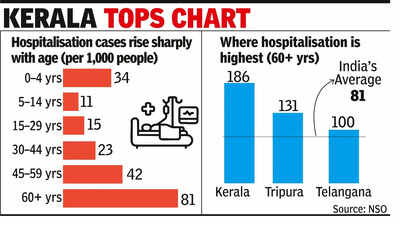
NEW DELHI: The risk of being hospitalised in India doubles after the age of 45 and rises sharply among the elderly, signalling a shift in the country’s healthcare burden, according to the latest National Sample Survey Office (NSO) data.The survey shows that hospitalisation rates climb from 23 per 1,000 people in the 30-44 age group to 42 per 1,000 among those aged 45-59, and then nearly double again to 81 per 1,000 in those aged 60 and above. In comparison, only 15 per 1,000 people aged 15-29 required hospital care over the year. Hospitalisation among children aged 0-4 (34 per 1,000) is also higher than among adolescents and young adults, pointing to a dual burden at the two ends of the age spectrum.The data points to a clear transition, with healthcare demand increasingly driven by middle-aged and older populations. Experts say this reflects a rising burden of chronic diseases such as diabetes, heart conditions and respiratory illnesses, which become more common with age and often require hospital treatment.
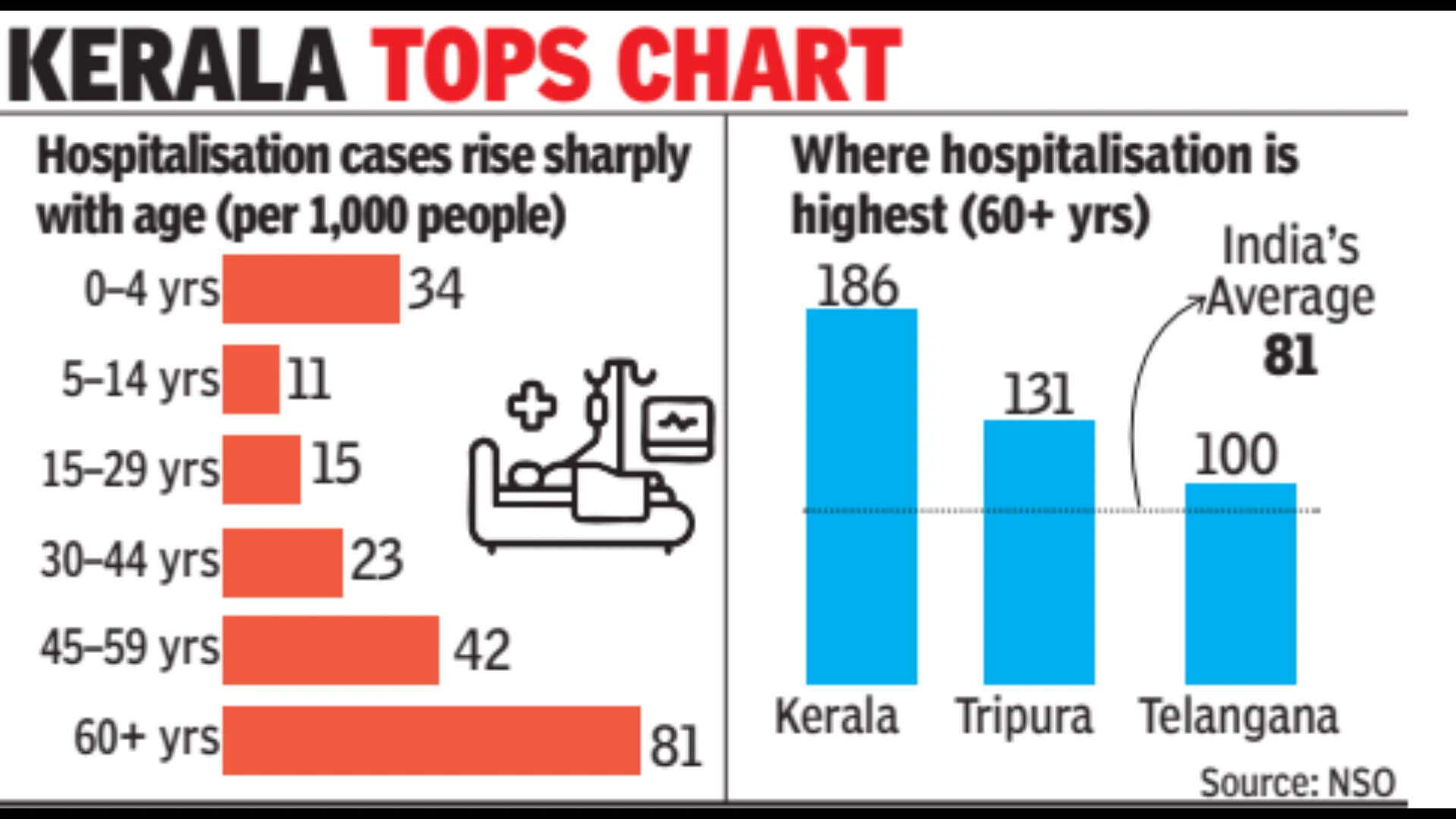
“The sharp rise in hospitalisation after 45 reflects a systemic gap in preventive healthcare. Lifestyle diseases like diabetes, hypertension, obesity, fatty liver and heart disease are accumulating earlier, but structured screening and risk modification are not keeping pace,” said Dr Rommel Tickoo, director, internal medicine, Max Hospital, Saket.“If India invests in early detection, routine metabolic screening, cardiovascular risk assessment, and primary care strengthening, we can significantly reduce avoidable hospital admissions in later decades,” he added.State-wise differences are stark. Kerala reports among the highest hospitalisation rates, with about 186 elderly persons per 1,000 admitted in a year-more than double the national average. Other regions such as Lakshadweep and Tripura also show elevated levels, while some northeastern states report lower rates. However, experts say that higher rates in states like Kerala may also reflect better access to healthcare and higher detection of illnesses.Among the elderly, hospitalisation rates are higher for men (93 per 1,000) than women (69 per 1,000), while differences are smaller or reversed in younger age groups.The trend highlights a growing pressure on hospitals as India’s population ages. With more people living longer and developing long-term conditions, demand for inpatient care is expected to rise in the coming years.The NSO data, based on hospitalisations over the past year (excluding childbirth), underline the need for stronger primary healthcare, early detection and better management of chronic diseases to reduce avoidable hospital admissions.The findings from the NSO suggest that India’s healthcare needs are shifting rapidly towards middle-aged and elderly populations.


