
There is something quietly radical about a book that begins not with a theory but with a classroom moment. A student raises his hand and tells a veteran corporate leader, with polite but unmistakable firmness, that everything he just said belongs to a different world. It is an uncomfortable opening. It is also the perfect one.You Inc. arrives at a moment when the old grammar of careers — loyalty rewarded, ladders climbed, institutions trusted — is visibly crumbling. Dr. Bhaskar Das, drawing on decades in Indian corporate life and academia, does not mourn this. He diagnoses it with the precision of someone who has watched the shift from the inside, and then does something more useful: he offers a framework for living within the disruption rather than waiting for it to pass.The world Das describes is one he calls NAVI — nonlinear, accelerated, volatile and interconnected. Industries no longer transform once a generation. They transform every few years, often at the hands of companies that did not exist when established players were drawing up their last strategic plans. For individuals navigating careers within this environment, the implications are profound. The assumptions that guided earlier generations — that loyalty would be rewarded, that expertise accumulated over decades would retain its value, that institutions would provide the stability that individuals could not generate themselves — no longer hold with any reliability.His answer to this is the central idea of the book, and it is deceptively simple. Everyone must begin to think of themselves as a corporation. Not a startup chasing disruption, not an entrepreneur burning bridges, but a self-directed enterprise with a product portfolio of capabilities, an ecosystem of relationships, a strategy for the long term, and the discipline to review and renew itself continuously. Das unpacks this through concepts that feel genuinely earned rather than borrowed: the shrinking half-life of skills, the danger of experience hardening into baggage, the importance of operating in what he calls a permanent beta state, always functional, never finished.What prevents the book from becoming a management manual dressed in philosophical clothing is its texture. Das populates the narrative with characters who carry the argument on their backs rather than simply illustrating it. Aarav, the Gen Z student who refuses to plan a life around one organisation. Vikram, the senior executive quietly wondering whether his best thinking now belongs to a different era. Meera, returning to the workforce after years away, discovering that the world did not wait. And several others experiencing different walks of life. Each of them is specific enough to feel real, and the book is considerably richer for their presence.Das writes with the cadence of someone who has spent years in front of rooms full of intelligent, sceptical people. The prose is conversational without being lightweight. The philosophy is substantive without becoming airless. And the recurring aphorisms he calls Bhaskarisms — compressed, memorable, occasionally surprising — land with the force of ideas that have been lived rather than merely thought. This is a book that speaks to professionals at every career stage, from those just finding their footing to those wondering what remains when the titles and designations finally fall away.Poignantly, Dr. Bhaskar Das passed away from cancer before he could see this book completed. It was posthumously written and curated by R. Sridhar, who has honoured both the rigour and the warmth of Das’s thinking with evident care and devotion. That the ideas feel so alive on the page, so present and unhurried, is in itself a tribute worth noting. You Inc. is not simply a book about navigating an uncertain world. It is evidence that certain minds, and certain ideas, outlast the circumstances that produced them.The book is priced at Rs 399 and is available on Amazon – You Inc.: View Yourself As A Corporation End of ArticleFollow Us On Social MediaVideosIndia Tests Disaster Information System, Citizens Get ‘Extremely Severe Alert’ On PhonesIndia May Rethink Conventional Missile Strategy As Global Conflicts Redefine Warfare: Defence SecyPune: 4-Year-Old Girl Allegedly Sexually Assaulted and Murdered by 65 Year-Old-Man in Bhor‘No Further Orders Necessary’: SC Bench Rejects TMC Plea On Counting StaffFormer Diplomats React To Bangladesh Summoning Indian Envoy Over Assam CM Himanta’s Remarks‘Stop Poking Nose In India’s Internal Affairs’: JKSA Slams Pakistan Over Jamia Protest RemarksDelhi, Dhaka Move To Resume Full-Scale Visa Services Amid Ties ResetFuel Prices May Go Up Soon As Oil Firms Face Losses Amid Global Crude SpikeNine Dead As Tourist Boat Capsizes In Jabalpur, Survivors Allege Major Safety LapsesJPMorgan Executive Sued Over Sexual Abuse, Coercion And Racial Harassment Allegations In New York123PhotostoriesMet Gala 2026: From Karan Johar’s debut to Deepika Padukone’s return – rumoured Indian celebs on the guest listDog breeds that have been a part of the British Royal FamilyArchana Puran Singh to buy a new bungalow worth approximately Rs 50 crore in Madh Island; says, ‘Not sure if we can afford it but…’Blake Lively and Justin Baldoni head to court: Here’s all we know about the case ahead of the trialRs 6,700 crore project: How ‘missing link’ will improve Mumbai–Pune connectivityWhy Bengaluru’s long-awaited double-decker flyover is a big win for commutersCheteshwar Pujara, aka “The Wall’s”, ₹4 crore Gujarat villa is rooted in family living, Test cricket legacy and quiet luxuryThe love between Krishna and Yashoda holds 5 lessons every mother should know8 black superfoods you should add to your diet todayDog breeds that can survive in Australian climate123Hot PicksAssam key constituenciesKerala key constituenciesPuducherry election resultsTamil Nadu constituenciesAjay Pal SharmaBengal Poll RecordHimanta Biswa SarmaTop TrendingUS Germany relationsBank Holiday MayVande Bharat expressLPG cylinder price hikeMumbai missing linkPetrol, Diesel, LPG priceCBSE Class 12th ResultNEET 2026: Exam-day guideBSE AP SSC Class 10th ResultIPL Orange Cap

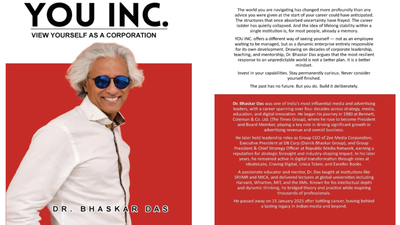
There is something quietly radical about a book that begins not with a theory but with a classroom moment. A student raises his hand and tells a veteran corporate leader, with polite but unmistakable firmness, that everything he just said belongs to a different world. It is an uncomfortable opening. It is also the perfect one.You Inc. arrives at a moment when the old grammar of careers — loyalty rewarded, ladders climbed, institutions trusted — is visibly crumbling. Dr. Bhaskar Das, drawing on decades in Indian corporate life and academia, does not mourn this. He diagnoses it with the precision of someone who has watched the shift from the inside, and then does something more useful: he offers a framework for living within the disruption rather than waiting for it to pass.The world Das describes is one he calls NAVI — nonlinear, accelerated, volatile and interconnected. Industries no longer transform once a generation. They transform every few years, often at the hands of companies that did not exist when established players were drawing up their last strategic plans. For individuals navigating careers within this environment, the implications are profound. The assumptions that guided earlier generations — that loyalty would be rewarded, that expertise accumulated over decades would retain its value, that institutions would provide the stability that individuals could not generate themselves — no longer hold with any reliability.His answer to this is the central idea of the book, and it is deceptively simple. Everyone must begin to think of themselves as a corporation. Not a startup chasing disruption, not an entrepreneur burning bridges, but a self-directed enterprise with a product portfolio of capabilities, an ecosystem of relationships, a strategy for the long term, and the discipline to review and renew itself continuously. Das unpacks this through concepts that feel genuinely earned rather than borrowed: the shrinking half-life of skills, the danger of experience hardening into baggage, the importance of operating in what he calls a permanent beta state, always functional, never finished.What prevents the book from becoming a management manual dressed in philosophical clothing is its texture. Das populates the narrative with characters who carry the argument on their backs rather than simply illustrating it. Aarav, the Gen Z student who refuses to plan a life around one organisation. Vikram, the senior executive quietly wondering whether his best thinking now belongs to a different era. Meera, returning to the workforce after years away, discovering that the world did not wait. And several others experiencing different walks of life. Each of them is specific enough to feel real, and the book is considerably richer for their presence.Das writes with the cadence of someone who has spent years in front of rooms full of intelligent, sceptical people. The prose is conversational without being lightweight. The philosophy is substantive without becoming airless. And the recurring aphorisms he calls Bhaskarisms — compressed, memorable, occasionally surprising — land with the force of ideas that have been lived rather than merely thought. This is a book that speaks to professionals at every career stage, from those just finding their footing to those wondering what remains when the titles and designations finally fall away.Poignantly, Dr. Bhaskar Das passed away from cancer before he could see this book completed. It was posthumously written and curated by R. Sridhar, who has honoured both the rigour and the warmth of Das’s thinking with evident care and devotion. That the ideas feel so alive on the page, so present and unhurried, is in itself a tribute worth noting. You Inc. is not simply a book about navigating an uncertain world. It is evidence that certain minds, and certain ideas, outlast the circumstances that produced them.The book is priced at Rs 399 and is available on Amazon – You Inc.: View Yourself As A Corporation


