
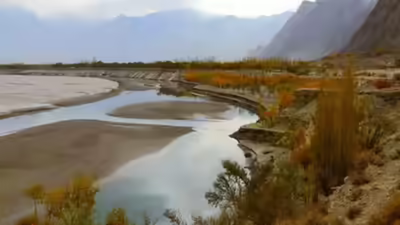
File photo The Indus River System comprises six major rivers, the Indus, Chenab, Jhelum, Ravi, Beas and Sutlej, flowing through the territories of both India and Pakistan. The system sustains drinking water, agriculture and electricity generation across the Indus Basin, supporting hundreds of millions of people on both sides of the border.When British India was partitioned in 1947, the Indus River System was also divided between the two successor states.The geographic reality was stark: India, as the upper riparian state, held the headwaters of most rivers, while Pakistan’s agricultural heartland, the heavily irrigated Punjab plains, depended critically on continued water flows from the east.India, for its part, required access to the system for its own development objectives in Punjab and Rajasthan, while seeking stability and normalised relations with its new western neighbour.Despite its own pressing domestic needs, India concluded this highly concessionary water-sharing pact with Pakistan on 19 September, 1960, an agreement facilitated by the World Bank.Negotiations India paid the price for rationalityPakistan’s strategy of delay and the 1954 World Bank proposal:The trajectory of the negotiations was shaped, from the outset, by the asymmetry between India’s reasonable and constructive approach and Pakistan’s maximalist, sometimes absurd, demands — an asymmetry that anchored outcomes far more favourably to Pakistan than equity would have warranted.The World Bank’s first substantive proposal of 5 February 1954 illustrates this plainly: even at this initial stage, it required significant one-sided concessions from India:All planned Indian developments along the upper reaches of both the Indus and Chenab were to be abandoned, with those benefits accruing to Pakistan instead.India was required to forgo diverting approximately 6 MAF from the Chenab River.No Chenab waters at Merala (now in Pakistan) would be available for Indian use.No water development would be permitted in Kutch from the river system.Despite these considerable impositions, India accepted the proposal in good faith almost immediately, signalling its genuine desire for a speedy resolution. Pakistan, by contrast, delayed its formal acceptance for nearly five years until 22 December 1958.As a result of this goodwill gesture of India, the restrictions were imposed on her while Pakistan continued developing new uses on the Western rivers without equivalent constraints.Pakistan absorbed the lesson that obstruction pays and cooperation costs, and has applied this lesson consistently ever since.What India lost: The scale of sacrificeThe water allocation:Under the Treaty’s allocation formula, India received exclusive rights to the three Eastern rivers — the Sutlej, Beas, and Ravi, while Pakistan received rights to the waters of the three Western river, the Indus, Chenab, and Jhelum.India was permitted certain limited, non-consumptive uses of the Western rivers within its own territory, primarily for run-of-river hydropower generation, subject to extensive design and operational restrictions.In volumetric terms, the Eastern rivers allocated to India carry approximately 33 million acre-feet (MAF) of annual flow, while the Western rivers allocated to Pakistan carry approximately 135 MAF, giving Pakistan roughly 80 per cent of the system’s water. India received 20 percent, in exchange for relinquishing all claim to the vastly larger Western system.The critical point is that India did not gain new water from the agreement. What India received was formal acknowledgment of flows it already accessed, in exchange for relinquishing all claim to the far larger Western system.India was permitted certain non-consumptive uses of the Western rivers within its territory, primarily run-of-river hydropower generation.The financial concession: Paying to give away waterPerhaps the most striking anomaly of the Treaty is the financial provision. India agreed to pay approximately £62 million (approximately $2.5 billion in present value) as compensation to Pakistan to build water resources infrastructure in Pakistan-occupied Kashmir.This payment represents a unique precedent in which the upstream country, which was already surrendering the majority of the system’s water, additionally paid the downstream country for the “privilege” of doing so.India essentially subsidised Pakistan’s acceptance of a deal that heavily favoured Pakistan on the fundamental question of water allocation.The treaty’s structural unfairnessUnilateral asymmetric restrictions on India: The Treaty imposes a series of specific design and operational restrictions on India’s use of the Western rivers that have no corresponding obligations on Pakistan’s side:India can develop only a limited Irrigated Cropped Area (ICA) in its territory.India faces strict limits on the volume of water that can be held in any storage facility on the Western rivers.India must comply with specific design criteria for any hydropower facilities on the Western rivers, including restrictions on pondage and storage capacity.These restrictions are one-directional: they constrain India’s lawful development of resources within its own territory while imposing no equivalent transparency or restriction requirements on Pakistan. The result is a treaty that treats the upstream state, India, as the party requiring oversight and restraint, while the downstream state benefits from guaranteed flows.End of ArticleFollow Us On Social MediaVideosIndia-Bangladesh Row: Dhaka Summons Indian Envoy Over Assam CM Himanta’s RemarksJabalpur Cruise Boat Capsize: 9 Dead as Rescue Operations Continue at Bargi Dam in Madhya PradeshChanakya Today Exit Poll: BJP Sweep In Bengal, DMK Ahead In TN, Assam Favours NDAUS Hands Back 657 Stolen Antiquities Worth $14 Million To India, Exposes Global Smuggling NetworksNaval Anti-ship Missile : Navy, Drdo Demonstrate Salvo Launch That Can Sink ShipsECI Introduces New QR Code Photo ID Rule To Prevent Unauthorised Entry At Counting CentresCCTV Shows Car Plunging Into Gorge In Una, Himachal | Tyre Burst Suspected, 2 KilledDelhi HC Freezes Sunjay Kapur Assets, Restrains Priya Kapur In High-Stakes Inheritance DisputeLet’s Not Choose For People: Supreme Court Pulls Up Centre Over Minor Rape Survivor’s Pregnancy Case’Sonia Gandhi Takes Decisions’: Congress President Kharge On Karnataka CM Change Buzz123PhotostoriesDeepika Padukone, Shah Rukh Khan, Priyanka Chopra, Alia Bhatt: Bollywood celebrities who’ve graced Met Gala over the years5 times Usha Vance taught us lessons in minimalistic chicMay 2026 theatrical and OTT releases: ‘Raja Shivaji’, ‘The Devil Wears Prada 2’ and moreWhat is the foamy layer on top of cooked dal? Tips to cook dal right for better digestionShubman Gill’s Chandigarh villa is a multi-crore home shaped by cricketing success and strong family rootsSluggish digestion? Harvard doc reveals a 10-minute fixFlower Moon 2026: Manifest your desires tonight based on your date of birth7 European fruits that can grow in the balcony during this seasonReliever vs controller: What people living with asthma often get wrongMaharashtra Day 2026: 11 Maharashtrian street foods every foodie should try123Hot PicksExit Poll Result 2026Bengal Election 2026Bengal ElectionPM ModiAjay Pal SharmaBengal Poll RecordHimanta Biswa SarmaTop TrendingStock Market Holiday TodayBank Holiday MayVande Bharat expressLPG cylinder price hikeMumbai missing linkPetrol, Diesel, LPG priceCBSE Class 12th ResultMumbai Police DeathBSE AP SSC Class 10th ResultIPL Orange Cap

The Indus River System comprises six major rivers, the Indus, Chenab, Jhelum, Ravi, Beas and Sutlej, flowing through the territories of both India and Pakistan. The system sustains drinking water, agriculture and electricity generation across the Indus Basin, supporting hundreds of millions of people on both sides of the border.When British India was partitioned in 1947, the Indus River System was also divided between the two successor states.The geographic reality was stark: India, as the upper riparian state, held the headwaters of most rivers, while Pakistan’s agricultural heartland, the heavily irrigated Punjab plains, depended critically on continued water flows from the east.India, for its part, required access to the system for its own development objectives in Punjab and Rajasthan, while seeking stability and normalised relations with its new western neighbour.Despite its own pressing domestic needs, India concluded this highly concessionary water-sharing pact with Pakistan on 19 September, 1960, an agreement facilitated by the World Bank.Negotiations India paid the price for rationalityPakistan’s strategy of delay and the 1954 World Bank proposal:The trajectory of the negotiations was shaped, from the outset, by the asymmetry between India’s reasonable and constructive approach and Pakistan’s maximalist, sometimes absurd, demands — an asymmetry that anchored outcomes far more favourably to Pakistan than equity would have warranted.The World Bank’s first substantive proposal of 5 February 1954 illustrates this plainly: even at this initial stage, it required significant one-sided concessions from India:All planned Indian developments along the upper reaches of both the Indus and Chenab were to be abandoned, with those benefits accruing to Pakistan instead.India was required to forgo diverting approximately 6 MAF from the Chenab River.No Chenab waters at Merala (now in Pakistan) would be available for Indian use.No water development would be permitted in Kutch from the river system.Despite these considerable impositions, India accepted the proposal in good faith almost immediately, signalling its genuine desire for a speedy resolution. Pakistan, by contrast, delayed its formal acceptance for nearly five years until 22 December 1958.As a result of this goodwill gesture of India, the restrictions were imposed on her while Pakistan continued developing new uses on the Western rivers without equivalent constraints.Pakistan absorbed the lesson that obstruction pays and cooperation costs, and has applied this lesson consistently ever since.What India lost: The scale of sacrificeThe water allocation:Under the Treaty’s allocation formula, India received exclusive rights to the three Eastern rivers — the Sutlej, Beas, and Ravi, while Pakistan received rights to the waters of the three Western river, the Indus, Chenab, and Jhelum.India was permitted certain limited, non-consumptive uses of the Western rivers within its own territory, primarily for run-of-river hydropower generation, subject to extensive design and operational restrictions.In volumetric terms, the Eastern rivers allocated to India carry approximately 33 million acre-feet (MAF) of annual flow, while the Western rivers allocated to Pakistan carry approximately 135 MAF, giving Pakistan roughly 80 per cent of the system’s water. India received 20 percent, in exchange for relinquishing all claim to the vastly larger Western system.The critical point is that India did not gain new water from the agreement. What India received was formal acknowledgment of flows it already accessed, in exchange for relinquishing all claim to the far larger Western system.India was permitted certain non-consumptive uses of the Western rivers within its territory, primarily run-of-river hydropower generation.The financial concession: Paying to give away waterPerhaps the most striking anomaly of the Treaty is the financial provision. India agreed to pay approximately £62 million (approximately $2.5 billion in present value) as compensation to Pakistan to build water resources infrastructure in Pakistan-occupied Kashmir.This payment represents a unique precedent in which the upstream country, which was already surrendering the majority of the system’s water, additionally paid the downstream country for the “privilege” of doing so.India essentially subsidised Pakistan’s acceptance of a deal that heavily favoured Pakistan on the fundamental question of water allocation.The treaty’s structural unfairnessUnilateral asymmetric restrictions on India: The Treaty imposes a series of specific design and operational restrictions on India’s use of the Western rivers that have no corresponding obligations on Pakistan’s side:India can develop only a limited Irrigated Cropped Area (ICA) in its territory.India faces strict limits on the volume of water that can be held in any storage facility on the Western rivers.India must comply with specific design criteria for any hydropower facilities on the Western rivers, including restrictions on pondage and storage capacity.These restrictions are one-directional: they constrain India’s lawful development of resources within its own territory while imposing no equivalent transparency or restriction requirements on Pakistan. The result is a treaty that treats the upstream state, India, as the party requiring oversight and restraint, while the downstream state benefits from guaranteed flows.


