
2,000-year-old Roman cup found in Spain may link directly to Hadrian’s Wall

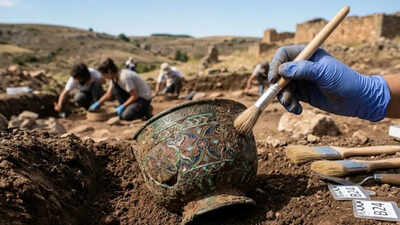
Archaeologists have identified a rare, 2,000-year-old Roman artefact known as the ‘Berlanga Cup,’ discovered in the soil of the La Cerrada de Arroyo site in Soria, Spain. This cup is made from bronze and is a very rare example of what are known as ‘Hadrian’s Wall Series’ vessels, and these normally come with decorative enamel work and inscriptions identifying Roman legions and the military fortifications built by those legions.Most of the known examples of ‘Hadrian’s Wall Series’ vessels are made in the area that contains the western portion of Hadrian’s Wall, while this example is noted as being the only example of a ‘Hadrian’s Wall Series’ boot that documents the eastern portion of Hadrian’s Wall, specifically the forts located in the western part, such as Benwell and Halton Chesters. Scholars are suggesting that this cup might possibly have been given as a personal gift to a soldier, and it may have been given to that soldier in memory of his service to the Cohors I Celtiberorum when he returned home to Roman Spain.
The Berlanga Cup: New evidence of Hadrian’s Wall found in Spain
The finding of the Berlanga Cup (now identified in the journal Britannia) has provided a unique opportunity to understand how military souvenirs were distributed throughout the Roman Empire. According to a journal published in Cambridge, the cup is the largest of the known Hadrian’s Wall pans, measuring approximately 114 millimetres in diameter and 81 millimetres in height. The outside of the cup contains elaborate decorative designs, including horizontal friezes with colored (i.e., red, green, turquoise, navy) enamel, and an inscription along the upper rim, which names four different forts located on the east side of Hadrian’s Wall: Cilurnum (Chesters), Onno (Halton Chesters), Vindobala (Rudchester), and Condercum (Benwell).
How the cup reached Spain
As noted in a journal published in Cambridge, the cup was found at the Roman site of ‘La Cerrada de Arroyo’ in Berlanga de Duero and is currently located in the Numantine Museum of Soria. Researchers have utilised ground-penetrating radar (GPR), along with detailed archaeological surveys of objects, to place the cup in context with its geographical location. The finding of the cup in Spain, which is an area far removed from the Roman frontier, supports the previously suggested hypothesis that these types of artefacts served as mementoes to Roman soldiers. Scholars have concluded that the cup was probably either made or purchased by a veteran who wanted to commemorate his military service while stationed in Britain prior to returning home to Roman Celtiberia.
Revealing the cup’s secrets through modern science
Beyond its historical narrative, the Berlanga Cup has undergone rigorous scientific investigation to confirm its authenticity and origin. Researchers utilised portable X-ray fluorescence (pXRF) spectrometry to perform an archaeometric characterisation of the metal alloy. The analysis revealed a composition of leaded gunmetal – a material common in second-century AD Roman metalwork – containing trace elements of silver and antimony that align with metal groups frequently found in Roman Britain. Furthermore, experts employed advanced 3D virtualisation techniques to create a ‘digital twin’ of the vessel. This reconstruction allowed scholars to virtually assemble the fractured pieces, facilitating precise measurements of its dimensions and a clear reading of the inscriptions that had been obscured by deformation.


