
Representational image New Delhi: An expert committee formed by Supreme Court has laid down minimum standards for intensive care units (ICUs), defining what hospitals must have to qualify as possessing an ICU – covering infrastructure, equipment and staffing. The framework mandates a dedicated ICU space with access to emergency services, operation theatres and laboratories, along with power backup, sanitation and proper layout. Bedside essentials include oxygen, suction and electrical points, along with equipment such as monitors, ventilators, defibrillators, crash carts, infusion and syringe pumps, glucometers and ECG machines.New rules at a glance Staffing is central to the norms. ICUs must be led by trained doctors and be manned round the clock, with higher nurse-to-patient ratios than in wards – ranging from 1:2 to 1:3 and up to 1:1 for critically ill or ventilated patients – supported by allied healthcare staff. The guidelines also emphasise continuous monitoring, life-support systems and strict infection control protocols as essential to ICU care. The norms are part of “Guidelines for the Organisation and Delivery of Intensive Care Services”, a report drafted by a three-member committee and vetted by medical experts, and endorsed by the court as “practical, implementable and necessary as a minimum standard for an ICU”. A bench of Justices Ahsanuddin Amanullah and R Mahadevan has asked states and Union territories to submit action plans identifying gaps and implementation strategies by May 18. The Supreme Court-appointed panel – comprising AIIMS doctor Nitish Naik, additional solicitor general Aishwarya Bhati and advocate Karan Bharioke – has said clinical judgment should guide decisions on the level of care required. Dr Harsh Mahajan, chairman of Mahajan Imaging Lab and one of the experts who vetted the guidelines, said it recognises gaps in rural and remote areas and suggests measures such as interim staffing norms and linking smaller ICUs with higher centres through e-ICU or tele-ICU support. Dr Saumitra Rawat of Sir Ganga Ram Hospital, part of group that vetted the guidelines, said, “The new guidelines classify ICUs into levels, making it mandatory for even entry-level units to meet defined norms,” he said.About the AuthorAnuja JaiswalAnuja Jaiswal is a Senior Assistant Editor at The Times of India, with an impressive 18-year career in narrative journalism. She specializes in health and heritage reporting, expertly simplifying complex health information to make it engaging and understandable for readers. Her deep dives into heritage topics are well-researched, resulting in captivating narratives that resonate with her audience. Over the years, she has worked in Chandigarh, Chhattisgarh and West UP, gaining diverse on-ground experience that shapes her storytelling.Read MoreEnd of ArticleFollow Us On Social MediaVideos“Fix Delhi And Pahalgam First” West Bengal CM Mamata Banerjee Launches Fierce Attack On BJP“TMC’s Time Is Over” Amit Shah Tears Into TMC Over Infiltrators During Bengal RallyPassport Row Escalates: Pawan Khera Approaches Supreme Court After Gauhati HC Rejects Bail PleaBJP MP Sudhanshu Trivedi Attacks TMC, Raises RG Kar Case And Law And Order ConcernsPM Narendra Modi To Inaugurate 594 Km Ganga Expressway In Uttar Pradesh On April 29“India Expands Global Trade Reach” Union Minister Piyush Goyal On NZ FTAMarathi Mandatory In Maharashtra From May 1 |CM Fadnavis Pushes Language Rule For Auto, Taxi Drivers“TMC Is Protecting Goons In Sandeshkhali” PM Modi’s Big Charge At RallyBJP Destroyed All Good Work” Kejriwal Says Schemes Will Be Scrapped In West BengalAAP Seeks Disqualification Of 7 Rajya Sabha MPs Who Joined BJP, Legal Battle On Anti-Defection Law123Photostories7 radiant baby girl names that symbolise sunshineFrom facing trolls over husband Shardul Bayas’ past divorces to choosing not to have kids, Nehha Pendse opens up about her career, marriage, and lifeRhea Chakraborty gets relief in Sushant Singh Rajput case: What court said on unfreezing bank accounts and what it meansEat smart for every organ: Foods that support your lungs, liver, gut, and eyes6 foods that spoil faster than most people realise in summerCan a low birth weight increase stroke risk even in healthy adults?Growing persimmon at home? These 5 tips make it surprisingly easy9 foods you should avoid grinding in a mixer grinder’Greenland 2: Migration’ OTT release: Gerard Butler to Morena Baccarin, know all about the cast and charactersUTI symptoms you shouldn’t ignore: How a simple infection can lead to kidney damage123Hot PicksTamil Nadu ElectionWest Bengal voter turnoutAssembly Election 2026Mamata BanerjeeTamil Nadu voter turnoutAmit ShahPM ModiTop TrendingRaghav Chadha Joins BJPTamil Nadu electionAP SSC Class 10 resultsRRB opens qualificationAIIMS B.Sc. coursesJac Class 12 ResultPatrick MahomesBengal PollsNirmala SitharamanIPL Orange Cap

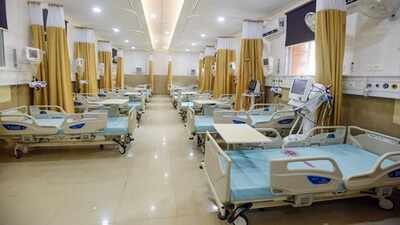
New Delhi: An expert committee formed by Supreme Court has laid down minimum standards for intensive care units (ICUs), defining what hospitals must have to qualify as possessing an ICU – covering infrastructure, equipment and staffing. The framework mandates a dedicated ICU space with access to emergency services, operation theatres and laboratories, along with power backup, sanitation and proper layout. Bedside essentials include oxygen, suction and electrical points, along with equipment such as monitors, ventilators, defibrillators, crash carts, infusion and syringe pumps, glucometers and ECG machines.
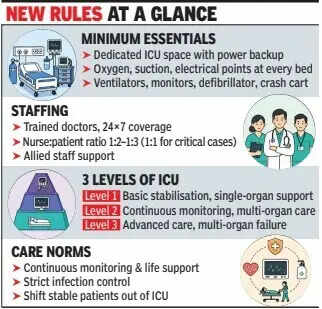
New rules at a glance
Staffing is central to the norms. ICUs must be led by trained doctors and be manned round the clock, with higher nurse-to-patient ratios than in wards – ranging from 1:2 to 1:3 and up to 1:1 for critically ill or ventilated patients – supported by allied healthcare staff. The guidelines also emphasise continuous monitoring, life-support systems and strict infection control protocols as essential to ICU care. The norms are part of “Guidelines for the Organisation and Delivery of Intensive Care Services”, a report drafted by a three-member committee and vetted by medical experts, and endorsed by the court as “practical, implementable and necessary as a minimum standard for an ICU”. A bench of Justices Ahsanuddin Amanullah and R Mahadevan has asked states and Union territories to submit action plans identifying gaps and implementation strategies by May 18. The Supreme Court-appointed panel – comprising AIIMS doctor Nitish Naik, additional solicitor general Aishwarya Bhati and advocate Karan Bharioke – has said clinical judgment should guide decisions on the level of care required. Dr Harsh Mahajan, chairman of Mahajan Imaging Lab and one of the experts who vetted the guidelines, said it recognises gaps in rural and remote areas and suggests measures such as interim staffing norms and linking smaller ICUs with higher centres through e-ICU or tele-ICU support. Dr Saumitra Rawat of Sir Ganga Ram Hospital, part of group that vetted the guidelines, said, “The new guidelines classify ICUs into levels, making it mandatory for even entry-level units to meet defined norms,” he said.


