
This AI-powered robot can tell which trees are thirsty and which aren’t

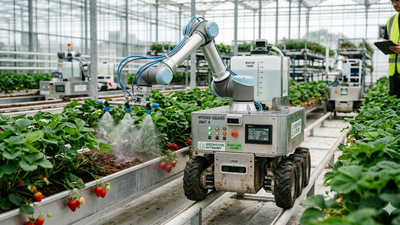
Water scarcity is emerging as a major threat in contemporary agriculture, necessitating the development of innovative means by which every drop of water should be put to use efficiently. Previously, irrigation was done through a universal method, in which all the trees were watered, thus causing inefficiency at times due to wastage. Luckily, an innovation in the use of robots in agriculture has completely changed this idea. Scientists have invented an intelligent robot, which is capable of telling whether specific trees need watering or not.
Precision irrigation technology : Ending guesswork
The core of this invention is a tiny robot that is built on the ground and capable of mapping the moisture of the soil with high accuracy. Scientists from the Pennsylvania State University have designed a method which includes sending robots into an orchard and measuring moisture for each tree individually rather than treating the whole area as a homogeneous piece of land.As per this report on Precision Irrigation Management his invention solves one of the major problems existing in agriculture, namely the diversity of soil properties. Sometimes even trees standing close to each other may receive significantly different amounts of water depending on their soil type and its ability to absorb water. As the researchers noted, irrigation has always been “a guessing game,” as watering each tree equally does not necessarily mean they will get enough water.
How the smart watering robot works
The machine employs sensors that can sense soil electrical conductance, which is an accurate measurement of moisture level. This measurement will be calibrated by taking into account direct soil measurements.During its testing phase, carried out from October 2024 to March 2025, the researchers reported excellent results. In particular, they succeeded in achieving a median error of only 0.039 m³/m³ when evaluating the soil. This was considered an “acceptable” level of error given the objective.Furthermore, the study also observed that the fewest number of calibration sites, only four or six per field, was enough to sustain good results. This eliminates costly structures in maintaining soil moisture measurement equipment.Soil moisture detection equipment, like many smart agriculture devices, uses automation to help in decision-making. As mentioned in a previous paper on automated irrigation, technologies such as sensors, robotics, and algorithms play significant roles.
Environmental impact and future of smart farming
The consequences of this technology do not end with convenience. Over-watering leads not only to wastage of water but also causes diseases among crops, makes soil deficient in nutrients, and causes damage to trees. Precision irrigation, on the other hand, allows trees to receive the required amount of water, which helps maximize crop yields.Today, water scarcity becomes more apparent with each passing day due to the increased drought conditions and global warming. The use of robots with such a system will make it possible to grow the same products with less water, something that was not even remotely conceivable before.In the future, it is quite probable that such a system could be merged with other technological innovations to create a self-sustained system for watering. Artificial intelligence and climate forecasts are technologies that could complement precision irrigation systems and make the farm self-sufficient by regulating its response to weather changes.What is perhaps the most valuable aspect of this technology, however, is that it demonstrates the possibility of perfection in agriculture. With the use of robotics and advanced technology, perfection and resource efficiency in farming are achievable.


