
Opposition: Parliament showdown over women’s quota, delimitation bills: Centre, opposition trade barbs — who said what | India News

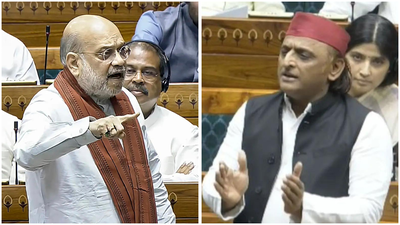
Parliament showdown over women’s quota, delimitation bills: Centre, oppn trade barbs — who said what
NEW DELHI: A sharp showdown erupted between the Centre and the Opposition in the Lok Sabha on Thursday, with both sides trading charges over the proposed women’s reservation and delimitation bills, setting the tone for a heated special session of Parliament.Union ministers Arjun Ram Meghwal and Amit Shah moved to introduce three bills in the Lok Sabha amid strong protests from Opposition members, who termed the proposals “anti-constitutional”.The Lok Sabha voted on the introduction of the Constitution (One Hundred and Thirty-First Amendment) Bill, 2026, with 207 MPs supporting it and 126 voting against, after Opposition members pressed for a division.The session, scheduled from April 16 to 18, is expected to focus on operationalising women’s reservation in legislatures ahead of the 2029 Lok Sabha elections, while also undertaking a wider restructuring of parliamentary constituencies.
What the three bills propose
- The Constitution (One Hundred and Thirty-First Amendment) Bill, 2026 seeks to implement 33% reservation for women in the Lok Sabha and state assemblies from the 2029 elections, based on the 2011 Census. It also proposes increasing Lok Sabha strength from 543 to a maximum of 850 seats to accommodate the quota.
- The Delimitation Bill, 2026 provides for redrawing parliamentary and assembly constituencies based on population data, effectively reshaping political representation across states. This provision has triggered strong Opposition resistance due to concerns over its impact on federal balance.
- The Union Territories Laws (Amendment) Bill, 2026, introduced by home minister Amit Shah, aims to align electoral and administrative provisions in Union Territories with the proposed reservation and delimitation framework.
Who said what:
Kiren Rijiju (BJP)
Union minister Kiren Rijiju outlined the timeline for the debate, indicating that the discussion would be extensive and could be extended if required.“The discussion will be held for 12 hours. The speaker should have the authority to extend the time for discussion. The voting on the bills will be done tomorrow.”
Om Birla (Lok Sabha speaker)
Lok Sabha speaker Om Birla provided further clarity on the schedule, stating that the debate could run longer than initially planned and confirming the timing for voting.“Discussion on these three bills will be held for 15-18 hours. Voting on these bills will be done at 4 pm tomorrow.”
K C Venugopal (Congress)
Congress leader K C Venugopal strongly opposed the introduction of the bills, arguing that the changes undermine the federal structure and questioning why such provisions were not included earlier when the women’s quota law was passed. He termed the move unconstitutional and raised concerns over its intent.“I object to the bill introduced by Union Ministers Arjun Ram Meghwal and Amit Shah. This bill is a fundamental attack on the Indian federal structure. What exactly is the intention of this bill?”
Akhilesh Yadav (Samajwadi Party)
Samajwadi Party chief Akhilesh Yadav backed women’s reservation in principle but questioned the urgency behind the bills. He argued that the government should first conduct a Census before proceeding with delimitation-linked reforms, highlighting concerns over outdated population data.“Why is the government in a hurry? We are in favour of Women’s Reservation Bill. They don’t want the census because then we will demand caste reservation, you want to mislead.”
Dharmendra Yadav (Samajwadi Party)
Samajwadi Party MP Dharmendra Yadav opposed all three bills, reiterating support for women’s reservation but objecting to its linkage with delimitation. He stressed that his party remains committed to reservation while questioning the legislative approach adopted by the government, reported ANI.“We oppose the Constitution (One Hundred and Thirty-First Amendment) Bill, 2026, Union Territories Laws (Amendment) Bill, 2026 and Delimitation Bill, 2026… There is no other party which is a bigger supporter of women’s reservation.”
Amit Shah (BJP)
Home minister Amit Shah hit back at the Opposition, stating that the Census process is already underway and will include caste enumeration. He also rejected demands for religion-based reservation, calling it unconstitutional.“I want to inform the entire country that the census process has already begun. The government has taken a decision to conduct a caste census.”“Our Constitution doesn’t allow reservation on the basis of religion… any reservation to Muslims on the basis of religion is unconstitutional.”“To take the Women’s Reservation Bill to a logical end, these two laws are necessary, that is why these two laws have been brought together. The opposition is opposing the bills because they had decided to oppose everything in their meeting.”
Asaduddin Owaisi (AIMIM)
AIMIM chief Asaduddin Owaisi strongly opposed the Constitutional Amendment Bill, alleging that it violates federalism and the basic structure of the Constitution. He argued that the proposed delimitation exercise would disproportionately favour states with larger populations while reducing the representation of southern states and OBC communities.Owaisi also questioned the legislative process, raising objections over procedural lapses in introducing the bill and warning that the move could distort India’s parliamentary democracy.“I oppose this introduction of this Constitutional Amendment Bill because it violates the Parliamentary form of democracy and federalism, which are both part of the basic structure of the constitution. This is not about women’s reservation. The main goal is to rule South and to completely erase the representation of OBCs from the legislature.”“Federalism is the basic structure of the Constitution. Removing the delimitation freeze, it gives more seats and power to the larger population while denying a fair voice to the smaller population.”
Arjun Ram Meghwal (BJP)
Union law minister Arjun Ram Meghwal defended the bills, stating that the proposed amendments are aimed at implementing women’s reservation in a structured manner through delimitation, without reducing representation for any state. He emphasised that the expansion of Lok Sabha seats would ensure adequate space for the quota while maintaining balance across regions.“The women’s reservation bill was passed in 2023, providing for implementing its provisions based on census after 2026 and delimitation. There will be an equal, 50 per cent increase in the strength of Lok Sabha members, and this will translate to 815 seats, of which 272 will be reserved for women, which comes to one-third of the strength of the House. There will be no loss to anyone (states), and they will retain their strength.”
Gaurav Gogoi (Congress)
Congress MP Gaurav Gogoi criticised the government, alleging that it was creating obstacles to delay the implementation of women’s reservation by linking it to delimitation. He argued that the quota could be implemented immediately based on the current Lok Sabha strength and accused the Centre of using the bill as a backdoor route for delimitation.“You are again and again creating hurdles for women’s reservation. If you had listened to us in 2023, women’s reservation would have been implemented in 2024.”“Women’s reservation should be implemented on current strength of Lok Sabha — 543; it must not be linked to delimitation.”“This bill is not for women’s reservation, but it is for delimitation through the back door.”


