
Humans return to the Moon’s doorstep: Just hours to go for Artemis II launch

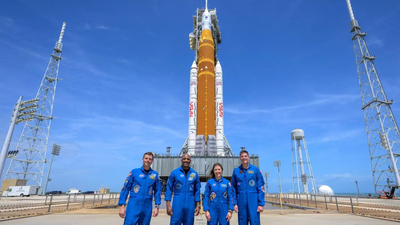
BENGALURU: In the early hours of Wednesday, while most of India sleeps, four astronauts will ride a column of fire into a chapter of history that has been waiting 53 years to be written. At 3.54am IST on April 2, Nasa’s Artemis II is scheduled to lift off from Kennedy Space Center in Florida — and if it does, humanity will have its first travellers to the Moon’s vicinity since Apollo 17 in December 1972.With countdown officially underway, engineers are powering up flight hardware, checking communication links and preparing the rocket’s cryogenic systems for the precise fuelling sequence required to load hundreds of thousands of gallons of super-cooled liquid hydrogen and liquid oxygen, Nasa said. Nasa launch director Charlie Blackwell-Thompson told reporters the run-up to the countdown start has gone extremely smooth, with only a few minor ground equipment issues to deal with.Before the rocket can light up the Florida sky, several critical steps remain. In the early morning hours of launch day, teams will activate the ground launch sequencer — an automated system that will orchestrate thousands of commands in the final minutes before liftoff, managing valve movements, system transitions, and timing cues. Engineers will also initiate an air-to-gaseous nitrogen changeover inside the rocket’s cavities, an important safety step that replaces atmospheric air with inert nitrogen gas to create a stable, non-reactive environment ahead of fuelling. The four astronauts, currently in quarantine at Kennedy Space Center, will suit up and board Orion in the hours before the launch window opens.Artemis II is Nasa’s first mission with crew aboard the SLS (Space Launch System) rocket and Orion spacecraft. It is also, by any reckoning, the most consequential crewed launch since the Space Shuttle era. Not because the crew will land on the Moon, but because they will prove that human beings can get there and back alive in a ship built for the 21st century.Commander Reid Wiseman, Pilot Victor Glover, and Mission Specialist Christina Koch from Nasa, and Mission Specialist Jeremy Hansen from the Canadian Space Agency, will fly around the Moon and back to Earth on a ten-day mission.The road to the pad has been far from smooth. A March 2026 launch window was scrubbed after engineers found a problem with helium flow to the rocket’s upper stage. An earlier Feb 8 date had also been cancelled after issues arose during the first wet dress rehearsal. The mission profile is deceptively simple in outline. After launch, the crew will travel on a free-return trajectory around the Moon and back to Earth, a path that uses the Moon’s gravity to slingshot the spacecraft home without a dedicated engine burn, a safety margin borrowed from the Apollo playbook. The farthest point will take the crew approximately 4,700 miles beyond the Moon, the deepest any human being has ventured into space since Gene Cernan left the lunar surface 53 years ago.Reentry will be the most technically demanding phase. Orion will hit the atmosphere at approximately 25,000 miles per hour — the fastest crewed reentry ever attempted.Engineers had originally planned a “skip reentry”, briefly bouncing off the upper atmosphere to bleed off speed. That was abandoned after heat shield “spalling” was observed during the uncrewed Artemis I flight in 2022, in favour of a steeper entry profile. Nasa reviewed the heat shield question extensively before clearing the mission. Its analyses concluded that the underlying structure of the Orion capsule would remain intact and capable of protecting the crew under conditions exceeding those expected during reentry.The mission carries a weight of symbolism Nasa has not shied away from. Victor Glover will become the first person of colour to leave low Earth orbit; Christina Koch the first woman; Reid Wiseman the oldest person to do so; and Jeremy Hansen the first non-American citizen to travel to the Moon’s vicinity. Four firsts in a single ten-day flight.Nasa describes the mission as testing the systems that will return astronauts to the Moon for an enduring presence, and paving the way to human exploration of Mars. The agency adds that SLS is the only rocket that can send Orion, astronauts, and cargo directly to the Moon in a single launch. Artemis III, the planned lunar landing, follows directly from whatever Artemis II proves — or flags — about deep-space human endurance and spacecraft systems. The Moon has been waiting for half a century. India’s Wednesday dawn may just be the morning it all begins again.


