
April’s full moon, known as “Pink Moon”, peaks on April 1: Why it won’t actually turn pink and the science behind it

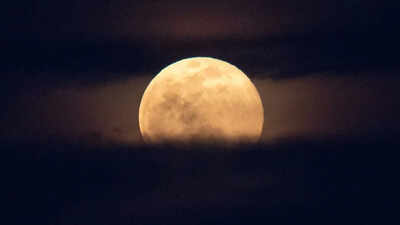
The ‘Pink Moon’ will occur in the night sky on April 1, 2026 – the culmination of a combination of lunar orbital mechanics and historical cultural significance. While the name indicates a radical colour change, it really reflects the rules of physics between our planet, the moon and the sun, along with plant cycles in the Northern Hemisphere. For scientists, this full moon will be a wonderful opportunity to measure the difference between observing objects at opposition and measuring the nuance of lunar perigee.
Why April’s full Moon may look unusually bright this year
When the Moon reaches its full phase, it is located 180 degrees from the Sun in this same alignment (syzygy). The Moon is also located at its furthest orbital point from the Sun during this phase, as the Earth is situated directly between the Sun and Moon, allowing the Sun’s light to completely illuminate the area of the Moon facing Earth. NASA’s Jet Propulsion Laboratory has noted that there will be a lot of significance surrounding this event in 2026, because it is near the vernal (spring) equinox, and this will have an impact on the Moon’s tilt, and therefore the quality of the way sunlight reflects off the Moon’s surface (the regolith). Because of these circumstances, there will also be an occurrence of an ‘opposition surge’, which means that the Moon appears to be much more luminous than at other times due to the absence of shadows created by craters because of our angle to the Moon when viewed from Earth.
Will the Moon actually look pink?
The Moon will not actually turn pink; however, the name was first used by the Algonquin Indians and later documented in the Old Farmer’s Almanack to refer to Phlox subulata (also known as moss pink), one of the earliest spring herbage to bloom. As noted in the NOAA article, there is a scientific phenomenon that can cause the Moon to appear pink when you look at it near the edge of the horizon. At that time, the light of the Moon travels through a thicker portion of the atmosphere than the direct vertical path above us, in turn causing the shorter wavelengths (blues) to be scattered by the atmosphere, leaving longer wavelengths (red and pink) to penetrate through to the surface of the Moon.
Are ‘King Tides’ dangerous during this period?
The 2026 Pink Moon occurs relatively close to perigee (i.e. the point on the moon’s elliptical orbit when the moon is at its closest distance to the Earth). According to the National Ocean Service, there will be a ‘perigean full moon’ which will create a greater gravitational effect on Earth’s oceans and contribute to increased tidal ranges this week, though the most significant ‘King Tides’ of the month are predicted for the New Moon window starting April 17-21. The reason for the formation of king tides in 2026 will be due to the alignment of both the moon’s and the sun’s gravitational forces toward Earth’s oceans, thereby increasing the amount of tidal force exerted on Earth’s oceans.At 02:12 UTC on April 2 (10:12 PM ET tonight, April 1), the northern hemisphere will see the moon reach maximum illumination. The Danjon scale (which measures the moon’s brightness and clarity) is often used for studying lunar features during a lunar eclipse but is not commonly used for measuring lunar characteristics such as the brightness and clarity of the lunar disk for the 2026 event since atmospheric stability (seeing) will be the predominant means of determining the clarity of features on the moon, including features such as the Tycho crater and the maria (lava flows).
Lunar libration : Seeing beyond the fixed disk
When looking at the Moon with the unaided eye, it appears to be a fixed disk in the sky. There is a special opportunity to observe lunar libration during the full pink moon (April 2026). Because the Moon has a slightly elliptical and tilted orbit related to Earth, it has a constant ‘nodding’ and ‘swaying’ motion throughout the month. According to the US Naval Observatory, astronomers will be able to see 59 per cent of the lunar surface throughout the night in the first week of April by way of libration, therefore seeing features on the far eastern limb of the Moon that would otherwise be obscured.
Topographic flattening at zero phase
When discussing the flat appearance of the full moon versus the crescent moon, a question can commonly be asked about the Opposition Effect (Seeliger Effect). The full Pink Moon occurs when the Sun is positioned directly behind the Earth, with regard to the moon, hitting the lunar surface at a phase angle of zero degrees. Research published in the Journal of Geophysical Research: Planets explains that the alignment of the Earth and Moon in relation to the Sun removes any visible shadows on the Moon because of the craters; therefore, it provides an increase in brightness but at the same time eliminates any perception of topography due to the absence of shadows, causing the lunar highlands to appear very bright and somewhat uniform.
Pink Moon 2026 : When is the best time to see
The US Naval Observatory states that the Moon will achieve 100 per cent illumination (known as the astronomic Full Moon) at exactly 02:12 UTC on the 2nd of April 2026. However, for viewers watching from the United States, this full phase will take place on Wednesday evening, April 1, at 10:12 PM Eastern time. Even though this is the only true point, the moon is actually full, it will still be perceived to be full before and after this period of time for approximately 1 full day from the moment of maximum brightness.


